Hire S.H.A.R.P.E.R. People – Part 7

R = References 

Get references and contact them!  One of the biggest mistakes made by small and medium-sized businesses is the failure to check on references (or even get them in the first place!)  So this newsletter is going to help you understand which references are the best and how to interview those references for the right information.

Do you REALLY KNOW who this candidate is????

We’re going to assume that you are smart enough to do the following:

  1. Have a criminal background check done by a professional.
  2. Contact the Department of Motor Vehicles (if they are going to be driving a company vehicle).
  3. Run a credit check (especially if they are going to be handling company funds or having access to company bank accounts).  KEEP IN MIND… If you turn down an applicant because of a bad credit report you must inform them of this fact.
  4. Troll the social media sites for any of their public postings.  And…
  5. Conduct this whole process legally (which usually means having their written permission for certain of these actions).

Beyond these, look for (or maybe even ASK FOR) these types of references:

  1. Bosses
  2. Peers, colleagues, or co-workers
  3. Subordinates, or people the applicant has mentored
  4. Vendors or customers
Make sure you talk to the right people!

Seek feedback on a variety of work assignments, projects, and roles.  You want to gain examples of the many different facets of the applicant’s work experiences, skills, and talents.

If the applicant is doing what they should be doing in the job-seeking process, they will provide you with contact information for each reference (including the best time to call) as well as some background information; the nature of their professional relationship with the applicant; and what type of information they can be expected to give about the applicant.

Don’t stop there. 

Work your own network to find other sources of information about the applicant.  If you know someone who works at an organization where the applicant worked, call them and find out who you can talk to there that knew or worked with the applicant – someone who can give you helpful feedback.  If you don’t know someone at the organization, use your LinkedIn contacts to find someone, or… talk to colleagues at your own company to see if THEY know someone there.

One of the challenges is to do this carefully and discreetly, especially if the applicant is conducting a confidential job search.  Another challenge is to find a person who will be open and honest with you! 

One Final Tip

Pay very close attention to what is NOT being said!

When you have those conversations with references, pay close attention to what is NOT being said.  If references are giving you generic information or simply not being forthcoming, that may be telling you something even more important about the applicant!

If you want more help in managing and supervising your team, call us!  We have helped leaders in thousands of organizations—equipping them with practical tools to lead and manage their people more effectively.  And stay tuned to this blog for more great ideas and tips!

Until next time… Yours for better leaders and better organizations,

Dr. Jim Dyke – “The Boss Doctor” ™ helping you to BE a better boss and to HAVE a better boss!

Posted in Decision-making, Hiring, Interviewing, Leadership, Management, Recruiting, Success, Supervision, Team Leadership, Teams, Uncategorized | Tagged , , , , , , , | Leave a comment

Hire S.H.A.R.P.E.R. People – Part 6

E = Enthusiastic

A recent article on a website for hiring managers posed the question: 

If you have to choose, do you hire for experience or attitude? 

Their answer was clear—HIRE FOR ATTITUDE!

This kid is GOING SOMEWHERE!!

The reason is simple—you can train skills but it’s almost impossible to train someone to have a positive attitude… they either have it or they don’t!  Attitude is a product of one’s mindset.  And mindsets run deep in an individual’s personal and emotional life.  Every experienced manager knows this is true, because almost every manager I know has that one person on their team who exhibits a firmly-entrenched NEGATIVE attitude.

Maybe you have THIS GUY on YOUR team??!!!

Motivational author and speaker Jim Rohn agreed with the concept of hiring for attitude or mindset.  One of our subscribers (Joan Augsburger) sent us an on-target article from his archives where he quotes a service-based company that embraces this principle.  In their advertising, they say,

We don’t teach our people to be nice… we hire nice people! 

Attitude matters because it has a direct impact on performance.  Many studies in the workplace have shown that an enthusiastic and optimistic frame of mind has a measurable positive impact on a worker’s productivity and resulting profitability!

Why is that?

Enthusiasm and optimism are self-fulfilling mindsets—a person with a “can do” attitude usually accomplishes what they set out to do, whether it is solving a difficult problem; devising a creative alternative; learning a new skill; achieving a certain result; or overcoming a challenging obstacle.

This is who you want talking to YOUR customers!!!

Up Close and Personal

I’ve told stories about David Payne before—how he took over managing a failing factory in his company and turned it into one of the organization’s highest profit centers.  In his factory-wide meetings, he told his beleaguered employees, “You are our company’s SECRET WEAPON.  You are so good at your jobs, that our competition is SCARED TO DEATH OF YOU!  They are deathly afraid that you will put them out of business with the incredible work you do!”

The same employees who were failing under incompetent management, were able to THRIVE and SUCCEED under David’s positive, enthusiastic, and optimistic leadership!  Yes, David was also extremely COMPETENT as a leader!  But his positive attitude infused everything he said and did in his leadership role.  AND IT AFFECTED THE ATTITUDE OF HIS EMPLOYEES, who ended up producing measurable and profitable outcomes as a result!

IT CAN HAPPEN WITH YOUR LEADERSHIP AS WELL!

How do you determine if a particular candidate has a positive attitude?

Ask the candidate questions like these:

  • Why should we hire you?
  • What sets you apart from the run-of-the-mill employee?
  • Why do you think you are particularly well-equipped to solve the problems you will encounter in this position?
  • What makes you think you will be able to learn and grow into the challenges of this job?

Ask them to give examples from their work history that illustrate their positive mindset:

  • Tell us about a problem you faced in the past and how you went about addressing it.
  • How did your positive spirit help you deal with a difficult challenge at work?
  • Have you ever faced a disappointing or discouraging barrier at work?  Tell us about it.

Be prepared to ask follow-up questions, to explore their answer in greater detail.  And look for clues in their answers that point to a positive, enthusiastic, and optimistic mindset.

If you want more great tips on hiring, don’t miss the last post in this series!  And give us a call if you need help—we’re leadership experts who believe that you will achieve extraordinary results when you unlock the leadership potential in everyone in your organization!

Until next time… Yours for better leaders and better organizations,

Dr. Jim Dyke – “The Boss Doctor” ™ helping you to BE a better boss and to HAVE a better boss!

Posted in Character, Collaboration, Customer Service, Emotional Intelligence, Hiring, Influence, Interviewing, Leadership, Management, Productivity, Team Culture, Team Dynamics, Team Leadership, Teams, Uncategorized, Values, Work | Tagged , , , , , , , , , | Leave a comment

Hire S.H.A.R.P.E.R. People – Part 5

P = Producer

Ken Blanchard maintains there are only two choices when you are hiring:

1.  A producer – someone who can do the job without needing a lot of help or supervision.

2.  A potential producer – someone who will eventually be able to do the job without needing a lot of help or supervision, but you will need to invest some time initially to train them.

This is all about what I call the “REAL” job description. 

In my training seminars I help leaders understand the difference between the FORMAL job description and the REAL job description.

The FORMAL job description is the job description on file in the HR office.  The FORMAL job description usually defines 2 things:

  • Responsibilities
  • Qualifications

The REAL job description is about one thing: PERFORMANCE

The essence of the REAL job description consists of the 2 or 3 things this person needs to accomplish within the first 6 to 12 months after their hiring—key performance objectives that must be met in order for their hiring to be considered a SUCCESS.  It defines the tangible results the new hire needs to achieve for you and your team!

Sure, he’s SMART… but CAN HE DO THE JOB?????

Up Close and Personal

During one of my training seminars, I presented the concept of the REAL job description to a room full of middle- and upper- level managers.  One of the students confessed her confusion about the concept.  I asked her, “When you hire a new person for your team, what important benchmarks do you need them to hit fairly soon after their on-boarding?”  She told me, “That’s simple!  Within the first couple of months, I need them to…

  • Learn the ropes of our company—who’s who; what’s what; and how to get their work done…
  • Gel with the rest of the team…
  • Master the software we use to do our work…
  • And get their productivity up to the same level as the rest of the team… 

“Because after two months I DON’T HAVE TIME TO MESS WITH THEM!”

I had to laugh at the ENERGY in her voice—her own answer was a perfect illustration of my point!  “That’s the REAL JOB DESCRIPTION you are hiring for!” I told her.  She understood!

If PERFORMANCE is your primary concern, then during the interview, the key question you need to answer—for yourself—is simple:

Do I think this person can perform at the level at which I need them to perform?

HIRE THIS GUY!!! He will give you REAL RESULTS!!!

Certainly, they must be qualified in terms of training, education, and certification.  But ultimately they must have the ability to apply these to produce effective job performanceThis is where their job history becomes vital.  In the interview process, make sure you get plenty of information about their previous work, and what kind of results they were able to achieve!

Ask your candidate to share stories or examples of…

  • When they performed above and beyond the expectations of the job…
  • When they achieved exceptional results…
  • When they demonstrated the ability to perform at the level of the position they are interviewing for NOW…

This is also where the hiring manager must have clarity about any so-called secondary skills that are required for successful performance in the position. 

Primary skills are usually technical in nature—nursing, accounting, computer programming, engineering… to name a few.  Secondary skills are often described as “soft” skills, but they can be just as important to the new hire’s success in their particular position—verbal or written communication, interpersonal dynamics, conflict resolution, creativity, and the like. 

Up Close and Personal

During one of my management training seminars, I had a student who gave the whole class a wonderful example of the importance of secondary skills.  She told me that she always had a tough time finding just the right person for her team of forensic accountants.  I commented (before really understanding), “Oh…are forensic accountants difficult to find!”  She laughed, “No, skilled forensic accountants are plentiful!  But I need more than just good accounting skills!” 

She explained, “My team is sent into organizations that are experiencing fiscal stress or financial failure of some kind.  Our assignment is to do a deep dive into their records to discover where the problems are.  To do that, we have to be able to work very closely and collaboratively with the people on the inside of the organization.  So… I need forensic accountants who have good people skills, who can collaborate and communicate effectively with other people.  I have found it difficult to find individuals who excel in both areas—accounting AND interpersonal strengths.”

Your team may be like hers!  You may need team members who have strengths in areas beyond the technical skills needed for the work they do.  If so, you must design interview questions that help you discern those skills in your candidates.  For example…

If you need people who can handle conflict and friction in the workplace…ask questions like these:

  • Can you tell us about a time when you had to address misunderstandings by other departments about the work you were doing?
  • Can you give us an example of a situation where you had to resolve a difficult conflict with another worker or another team?  What did you do?  What did you say? What happened as a result?
  • If you worked for us, and you discovered that an employee on another team was not performing adequately—and that was creating problems for you—how would you resolve that?  How would you handle that?
Can they play nice with the other kids on the playground???

Sometimes, you may need to find people who have a certain natural strength or talent, not a specific skill or technical expertise! 

Here’s an example:

If you are hiring manufacturing or production line workers, you may also have a keen interest in finding people who are comfortable working at a fast pace.  Here’s a tip:  Talk to your front line supervisors.  Find one who has good instincts for “reading” effective workers… someone who can read the body language of candidates and spot the clues of a fast-paced production worker.  Include that supervisor in the interview process.  It’s worth a try!

One more thing: 

Don’t make the mistake of thinking that your small organization can afford low-producing workers.  Here is the truth: THE SMALLER YOUR ORGANIZATION, THE MORE CRITICAL IT IS TO HIRE HIGH-PERFORMING WORKERS.

If you or your organization needs help equipping your leaders with hiring skills, CALL US—we can help!  We can also help you craft an effective orientation strategy for new hires that will bring them on board quickly and effectively.

For more great hiring tips you can use to find and hire the right people, stay tuned to this blog.  And PLEASE feel free to leave a comment!  I’d love to hear from you, and be able to respond to any questions, needs, or suggestions!

Until next time… Yours for better leaders and better organizations,

Dr. Jim Dyke – “The Boss Doctor” ™ helping you to BE a better boss and to HAVE a better boss!

Posted in Competence, Hiring, Interviewing, Leadership, Management, Performance Management, Potential, Productivity, Supervision, Team Dynamics, Team Leadership, Teams, Uncategorized, Work | Tagged , , , , , , , , | Leave a comment

Hire S.H.A.R.P.E.R. People – Part 4

R = Relational

A recent survey of thousands of hiring managers (conducted by a national professional staffing organization) revealed the number one quality that hiring managers are looking for in a potential employee:

The ability to work well with others!

Can your new hire work well with others???
Image by © Royalty-Free/Corbis

More and more organizations today are relying on employees and work groups to function collaboratively rather than competitively.  And… as organizations grow… there is an increasing demand for cooperation and collaboration BETWEEN teams across departmental lines.  This calls for mature attitudes, a willingness to accept responsibility, the need to keep egos out of the process, and the ability to set aside personal agendas for the purpose of serving the customer.  It also requires effective “people skills.”

How do you determine if a candidate has the ability to connect and interact with others effectively…especially with the ones you have already hired—YOUR CURRENT TEAM!?

Take a candidate to lunch.

One expert recommends that hiring managers bring final candidates into informal settings where they can get a read on the potential employee’s social skills.  One CEO I know always takes executive candidates to lunch.  Her primary purpose is to see how they interact with the wait staff.  The reason?  As the leader of her company, she consistently sends the message to employees that every person in the organization is important to the success of the company.  So she wants to know that her executive team places the same value on every employee, no matter how “humble” their role! 

Another value of an informal setting like lunch—it gives you a chance to see how the candidate behaves when the pressure is off, especially in an unstructured setting where there is no formal agenda.  The idea here is to see what the candidate is REALLY like, when they’re no longer “on stage.”  It’s also an opportunity to assess their basic social and conversational skills.

Up Close and Personal

The local branch of a large commercial real estate property management firm needed to add a new property manager to their team.  The company’s local VP and the current Branch Manager fell in love immediately with a well-prepared candidate who wowed them in the interview.  After the meeting, the potential employee was hanging out at the front desk, and the receptionist got a VERY DIFFERENT view of the employee’s behavior and personality.  The receptionist shared her observations with the bosses—and her concerns about the candidate.  The VP and BM dismissed the feedback and made the hire anyway.  SIX MONTHS LATER, THEY TERMINATED THE NEW EMPLOYEE!

Do NOT hire this guy!!!!!

Let them meet your team!

I know a highly successful manager who has a unique way of assessing a potential employee’s collaborative “fit” with his team and his organization.  He always gives his final candidate an opportunity to interact privately with his current team members.  (When I say privately, I mean he stays out of the room for this meeting!)  This gives the candidate an opportunity to ask candid questions of the team—and vice-versa.  This also allows the manager to get a sense of how well the candidate fits with the team’s chemistry… by talking with his team afterwards and getting their feedback.

Will they work well with you AND YOUR TEAM???

Of course, we are all aware that some people are more naturally “sociable” than others.  But even a quiet, introverted person needs to have the ability to interact positively with other people.

Listen to your “gut.”

Author and consultant Brian Tracy recommends an instinctive “gut check” with potential hires.  He urges hiring managers to ask themselves questions like these: 

  • Would I feel comfortable having this person over to dinner in my home, interacting with my family? 
  • Would I feel comfortable having my children work WITH or FOR this person? 
  • Would I feel comfortable working with this person for another 20 years?

The point of these questions is to trigger instinctive, gut feelings about hiring the candidate.  And the key is to always follow your instincts in this regard:

If your gut tells you “don’t hire this person,” then don’t hire them, even if they are qualified!

Will this guarantee a perfect hire every time?  No.  But it may give you just the edge you need to hire the right person at a time when you can’t afford NOT to.

If you or your leaders need help with their hiring skills, let us know—we can help!  We can provide lively, interactive training seminars that will equip your people with what they need to recruit and hire the RIGHT PEOPLE for their teams!

And for more great hiring tips—stay tuned to this blog—I’ve got plenty more good stuff to share with you!

Until next time… Yours for better leaders and better organizations,

Dr. Jim Dyke – “The Boss Doctor” ™ helping you to BE a better boss and to HAVE a better boss!

Posted in Character, Collaboration, Hiring, Interviewing, Leadership, Management, Morale, Success, Supervision, Team Culture, Team Dynamics, Team Leadership, Teams, Uncategorized, Work | Tagged , , , , , , , , , | Leave a comment

Hire S.H.A.R.P.E.R. People – Part 3

A = Ambitious

Hire THIS GUY!!!

Managers and supervisors are looking for team members who have the energy and commitment to make progress in their jobs and in their careers.  How do you know if you have a candidate who has the ambition to take responsibility for their professional development? 

You can start with questions about their learning—how they have done it in the past and how they plan on continuing it in the future.  (I covered that in my last post!)  Then you can explore how they have demonstrated positive ambition with some additional carefully-worded questions.

Ask questions like these in the interview…

  • Where and how do you want to grow and develop in your work and your career? 
  • What do you want to be doing in 1 year; 2 years; 5 years?

(One of the better answers to that last question is “I want YOUR job!”)  And don’t be afraid to ask them to give examples of their history of learning, professional development, and advancement in their jobs or career.  Find out how they have exercised ambition in the past—taking on greater responsibilities in a current job; going for promotions; getting certifications; attending training sessions; taking courses in school; recruiting a mentor or sponsor; taking advantage of organizational programs.

Ask direct questions that explore these examples of ambition!

HERE’S THE TRUTH:  Every team benefits from members who want to get better and get ahead!

Make sure your next hire is a WINNER!!!
— Image by © Royalty-Free/Corbis

In an earlier post I told you about Tony Knight’s creative approach to encourage and support the ambitions of his team members.  You can access it here: Great Advice from Top CEO’s – #22 | The Boss Doctor  

Tony understood how ambition fuels greater ownership of a job; higher productivity; and increased morale at work.  You can use his ideas to do the same with YOUR team!

And while we’re on the subject, what about YOU????  What is YOUR plan for your own professional development and career advancement?  Your team will benefit from having a leader who will be a positive role model for learning, growth, and advancement!

Are you a good model of ambition for your team???
— Image by © Royalty-Free/Corbis

If you; your organization; or your leaders need help developing effective hiring skills, CALL US!  We can help!  We can provide high-energy training that will equip your managers and supervisors with the skills they need to find the right people for their teams.

In the meantime, stay tuned to this blog for more techniques that you can use to find and hire the right people! 

And follow this blog for your OWN professional development and career advancement!  This blog is one of my favorite media for sharing my many years of experience, training THOUSANDS of leaders just like YOU—equipping them for greater effectiveness in their leadership, management, and executive roles.  AND YOU CAN ACCESS IT FOR FREE, WITH NO STRINGS ATTACHED.

Lucky you!

Until next time… Yours for better leaders and better organizations,

Dr. Jim Dyke – “The Boss Doctor” ™ helping you to BE a better boss and to HAVE a better boss!

Posted in Ambition, Career, Character, Competence, Employee Development, Employee Motivation, Hiring, Interviewing, Leadership, Learning, Management, Morale, Personal Growth, Personal Success, Potential, Professional Development, Promotion, Success, Supervision, Team Leadership, Teams, Uncategorized, Work | Tagged , , , , , , , , , , , | Leave a comment

Hire S.H.A.R.P.E.R. People – Part 2

H = Hardworking

In this post, we’re going to explore one of the most important qualities of a good hire: the motivation and intention to work with diligence.  The last thing leaders want on their teams is an acceptance of low performance as the norm, or an attitude of “how little can I do to avoid getting fired?”  Leaders want and NEED hard-working team members who are willing to roll up their sleeves and “Get’r Done!”

Hard workers fuel your organization’s bottom-line!

Up Close and Personal

At one time during my career, I spent a lot of time working with college students and young adults.  As part of their mentoring, I often shared my formula for vocational success:

If you are willing to…

  1. Be RELIABLE – and show up ON TIME when you are scheduled to show up
  2. Be HONEST – and not steal from your employer
  3. Be HARDWORKING – and give an honest day’s labor for an honest day’s work
  4. Be TEACHABLE – and be willing and able to LEARN…

…You will always have opportunities to work!!!

Organizations need hard-working employees because markets today are so competitive!  High productivity is essential in order for businesses to survive.  In some industries, it’s even more demanding! For example, in my role as a consultant, I have worked with many organizations that experience a dynamic (and often dramatic) ebb and flow of work; business; orders; demand.  Most of these organizations can’t staff for dynamic changes in workload—they need employees who are willing to work harder when the circumstances demand it, in exchange for less stress and pressure when the situation allows.

Ask this question during the interview

How do you know if the candidate sitting in front of you is a hard worker?  One expert suggests you ask your potential hire,

What do you think about the possibility of occasional requirements to work late or work on a weekend in order to meet a deadline? 

If they hesitate (even the least bit) you may want to reconsider hiring them.  If they aren’t willing to work hard occasionally, they probably won’t be working hard in a normal workday!  Be sure to also ask anyone who knows them or has worked with them in the past.  (I’ll share more ideas about references in a future post.  DON’T MISS IT!)  Another clue will be how much they apply themselves in the exercises I recommended in my last post.

Ask this question

Did you ever accept a tough, dirty, challenging assignment that no one else wanted?  Tell us about that experience—what you did; what you accomplished; and what you learned from it.

Learning is a part of hard work

Managers and supervisors are also looking for team members who have the energy and commitment to learn and grow and get better at their jobs.  In today’s fast-moving tech-based workplace, employees are forced to continually learn how to function with ever-changing hardware, software, processes, procedures, and regulations.

In a May, 2021 Harvard Business Review article on-line, consultant Marc Zao-Sanders summarized the current situation for organizations world-wide:

In January 2020 — before Covid had even become a pandemic — the World Economic Forum called for a global reskilling revolution, and firms now require different skills of their workforces, including resilience, adaptability, digital, design, and interpersonal skills.

This guy is working HARDER, but is he working SMARTER????

How do you know if you have a candidate who has the motivation to take responsibility for their learning and growth? 

Ask this question during the interview

How do you learn?

Zao-Sanders explains the reason for this question, and what employers need to hear in the answer:

This is not about simplistic learning preferences (such as schedules and modalities) or broadly discredited learning styles (such as being a visual or aural learner). This is about an individual’s personal system for updating, improving, and sharing … [their] knowledge and skills. Does the job candidate you’re considering have such a system?

The hiring manager should look for any of a variety of useful sources for learning and growth that the candidate may employ.  In his article Zao-Sanders mentions things like formal training courses, books, people, poems, performance support tools, songs, films, conversations, observations, reflections, memories. 

Press the candidate for more details about their learning.  Use questions like these:

  • How do you go about choosing sources for your learning?
  • How do you decide what is most relevant?
  • How do you handle information overload?

Then ask them THIS question

Tell me about something you have recently learned—how you applied it in your work; and how you might apply it in the role you are applying for today.

What does this have to do with “hardworking???”

The motivation to commit oneself to diligent work also encompasses a commitment to building skill in the work one does!  The two go hand-in-hand.  For example, leaders who manage production work are always looking for employees who combine effectiveness with efficiency.  These are workers who produce high-quality results in a timely manner.  That kind of work shows a commitment to eliminating time-wasting and productivity-killing bad habits and poor use of time.

If you; your organization; or your leaders need help developing effective hiring skills, CALL US!  We can help!  We can provide high-energy training that will equip your managers and supervisors with the skills they need to find the right people for their teams.

In the meantime, stay tuned to this blog for more techniques that you can use to find and hire great employees for your organization. 

Until next time… Yours for better leaders and better organizations,

Dr. Jim Dyke – “The Boss Doctor” ™ helping you to BE a better boss and to HAVE a better boss!

Posted in Agility, Character, Customer Service, Deadlines, Hiring, Honesty, Integrity, Interviewing, Leadership, Learning, Management, Productivity, Promotion, Success, Supervision, Uncategorized, Values, Work | Tagged , , , , , , | Leave a comment

Hire S.H.A.R.P.E.R. People – Part 1

S = Strategic

I’ve decided to follow-up my series on DELEGATION with one on HIRING.  My reasoning is pretty straightforward here:  There’s an obvious—and logical—connection between these two essential executive functions:

Before you can assign work to a person, you have to HAVE a person to assign work TO!

Here’s another way of thinking about the connection between these two functions:

DELEGATION is a whole lot easier (and more successful) if you HIRE the right person in the first place!

Can I get an AMEN from all you hard-working managers out there???!!

Everybody wants to hire THIS guy!

In the organizations I serve, conversations about staffing usually come down to this: 

How do I find and hire “sharper” people? 

In this series of blogposts, I’m going to describe the qualities that define a “sharper” person and help you learn how to detect those qualities in the hiring process.  So… stay tuned, and don’t miss a post!

To begin with, SHARPER is an acronym for seven qualities of a great hire.  In this post, I’m going to focus on the “S” which stands for “strategic.”  A person who is strategic is smart enough and motivated enough to think and act beyond the next task or assignment.  They don’t just focus on activities; they think about the big picture of results—and how to achieve those results EASIER, BETTER, FASTER, CHEAPER, SMARTER, or SAFER. 

We’re not talking about the “minimal mindset” here—represented by the employee whose only concern is to exert the minimum effort required to qualify for their next paycheck (and maybe keep the boss of their back!).  We’re talking about the “maximum mindset”—exemplified by the team member who is always trying to figure out how to get the most done and achieve the greatest impact in the best way possible.

You want to find people who can THINK, and WORK SMARTER!!!!

These THINKING people are results-driven, and bring real, measurable, bottom-line value to any organization, team, or boss.

How do you know if your candidate is strategic???

If you are hiring for a front-line position…

Make the following request during the interview: “Tell me about a time you figured out how to streamline a certain job or function and make it easier or faster to accomplish.”  Their answer will tell you right away if they work and think strategically.

If you are hiring for a supervisory or managerial position…

Use this additional request: “If you were hired for this position, tell me what 2 or 3 things you would focus on accomplishing in the first 6 to 12 months.”  Better yet, put them in a room with paper and pen and ask them to write down their plan and be prepared in three hours to present their plan orally to you and your interview team.  You will be able to make a fairly good assessment of four key leadership skills:

  • Their ability to think strategically;
  • Their ability to communicate in writing;
  • Their ability to communicate verbally; and
  • Their ability to present before a group—to organize and deliver their ideas in a clear and compelling way.

If you are hiring at an executive level

You might consider this additional overnight assignment:  Ask them to write out a description of what a typical week at work would look like for them in six months after their hire.  You can study their description and determine if they are likely to move the job and its activities in the direction you feel is necessary.  For example, if you feel the position requires time in the field and they describe spending most of their time in their office, they may not be a good match for the job.

Are you looking for more good ideas?  Stay tuned for upcoming posts!  I’m going to share EVEN MORE valuable insights and useful tools culled from years of experience and wisdom!  And if you need help developing your hiring skills (or developing your employee’s hiring skills)—CALL US!  We can train your people how to find and hire team members who will move your organization forward!

And in-between posts, take a few moments and give us some feedback—we would love to hear from you!

Until next time… Yours for better leaders and better organizations,

Dr. Jim Dyke – “The Boss Doctor” ™ helping you to BE a better boss and to HAVE a better boss!

Posted in Competence, Creativity, Delegation, Failure, Hiring, Innovation, Interviewing, Leadership, Management, Performance Management, Supervision, Uncategorized, Work | Tagged , , , , , , | Leave a comment

The High Jump Principle

I am continuing my posts on the topic of DELEGATION with this foundational principle.  I owe my good friend and colleague, Keith Drury, for this concept that he shared with me years ago.  It is as important today as it was when he shared it back then, so I am passing it on to YOU.

Here is the principle:

If you want to win the High Jump event, you need ONE PERSON who can jump 7 feet, not 7 PEOPLE who can each jump ONE foot.

The APPLICATION is clear for you as a manager:  When you need a successful outcome for a given assignment, you need to give it to a person who has the skills and ability to complete the task effectively.  It won’t do to give it to a “committee” of employees who lack the skills.  You need THE PERSON who can do THE JOB.

You need THIS guy—He can do the job!
Image by © Royalty-Free/Corbis

This is one of the reasons why CEO salaries are so high in the current marketplace!

Detractors are quick to criticize governing boards for offering CEO candidates “excessive” salaries that appear obscenely higher than the rest of the staff member’s or frontline employees.  To some critics, it looks unfair on the face of it.  We often hear complaints that “The CEO’s salary is A THOUSAND TIMES the salary of the common employee!”  As if that is its own justification for its argument.

The plain truth is that CEO’s are neither more greedy or less greedy than the rest of us. 

CEO salaries, like everything else in the marketplace, are a product of supply and demand.  CEO’s get high salaries because they are OFFERED high salaries by their respective governing boards, who understand the High Jump principle—that they need that ONE LEADER who has the skill and ability to lead the ENTIRE ORGANIZATION successfully.  Board members understand that this is a job that cannot be accomplished by a COMMITTEE of underskilled members, however sincere their desire to succeed!

Effective hiring is governed by the same principle!

When you hire, you are employing the same concept.  You are looking for that ONE PERSON who can accomplish what the job demands. 

Do you have an effective team backing you up?

Up Close and Personal

During a session with one of my coaching clients, I presented the important topic of leadership succession.  I asked her, “Do you have anyone on your team who, you believe, has the potential to succeed at your level?”

WHY IS THAT IMPORTANT?  There are two main reasons why this is important:

1.  If you want any kind of flexibility in your role and your schedule, you need to have someone on your team—possibly MORE than just ONE person—who can handle some of your responsibilities when you are not available (for whatever reason).  If you want to be able to take a stress-free vacation; attend a professional conference; or pursue continuing education opportunities of some kind; you need to have team members who can handle important aspects of your work when you are not there! 

2.  If you want to be promoted, it will make it easier for YOUR Boss if you help YOUR Boss solve the obvious problem your promotion will create—the problem of REPLACING YOU.  If you have groomed one of your team members to step into your role when you leave, you have taken the first step on YOUR journey to the next level!

Who are you grooming to be as effective as YOU?

Of course, there are OTHER REASONS why this is a good idea:

3.  HIGHER-UPS are always looking for promotable leaders within their organization!  Consequently, they value managers who are good at developing people and helping the organization succeed as a result.

4.  REALLY GOOD EMPLOYEES are eager to work for a manager who is good at developing their people and helping them get promotions!

Back to the story…

Sadly, my client could not identify anyone on her team with this potential!  This, of course, was one of the reasons why her job was so stressful—she felt it impossible to be out of the office for more than a day at a time.  The pressure to be at work and handle EVERYTHING was becoming unbearable. 

Don’t let this happen to YOU.
Image by © Royalty-Free/Corbis

I told her, “Now that you have permission to add a person to your team, your Number One priority in this search is to find someone who you believe has the potential to (with your help) step into at least SOME of your shoes!”

GET MORE DELEGATION IDEAS WITH THESE FREE RESOURCES!

If you would like more tips and tools for effective delegation, download the following FREE resources that will help you…

  • Make clearer assignments
  • Eliminate confusion and miscommunication
  • Match assignments to employee motivations
  • Manage deadlines effectively
  • Engage team members more effectively
  • Create better outcomes

This information is not high-flying theory.  It’s down-and-dirty practical tools and techniques—easy to understand and easy to apply.  This is exactly what I have taught to thousands of managers and aspiring leaders in seminars, workshops, consults, and coaching sessions all across the country and internationally.  It’s yours for FREE! 

Here are the resources:

Issue #9 of The LeadershipTracks Newsletter outlines the 6 Levels of Delegating Authority.  You can access it here

The companion edition of The Personal Trainer shows you exactly how to delegate effectively, using a logical, well-organized approach.  You can access it here.

If you are looking for ways to become a better manager and team leader, we can help!  We have experience working with teams and team leaders, helping them to work together more effectively.  And we can help you and your team do the same.  Give us a call, and start your journey of leadership growth today!

Until next time… Yours for better leaders and better organizations,

Dr. Jim Dyke – “The Boss Doctor” ™ helping you to BE a better boss and to HAVE a better boss!

Posted in Career, Coaching, Competence, Delegation, Hiring, Leadership, Management, Organizations, Personal Success, Potential, Promotion, Success, Supervision, Team Leadership, Teams, Uncategorized | Tagged , , , , , , , | Leave a comment

Can They? Will They?

The Two Essential Questions of Effective Delegation

I posted last time about the issue of DELEGATION.  Since there are so many important and interconnected elements to effective delegation, I decided to continue this topic with added insights and additional tips.

This blogpost introduces the two-pronged question that every manager must address when delegating or giving a work assignment to a team member:

Can They?  Will They?

IS THIS GUY READY TO TAKE ON AN ASSIGNMENT????

Can They? Is the question of COMPETENCECan they do the job?  Can they fulfill the assignment?  Do they have sufficient skill, training, resource, authority?

Will They? Is the question of MOTIVATION—Are they willing to do the job?  Are they engaged enough to take on the assignment with sufficient energy and determination?

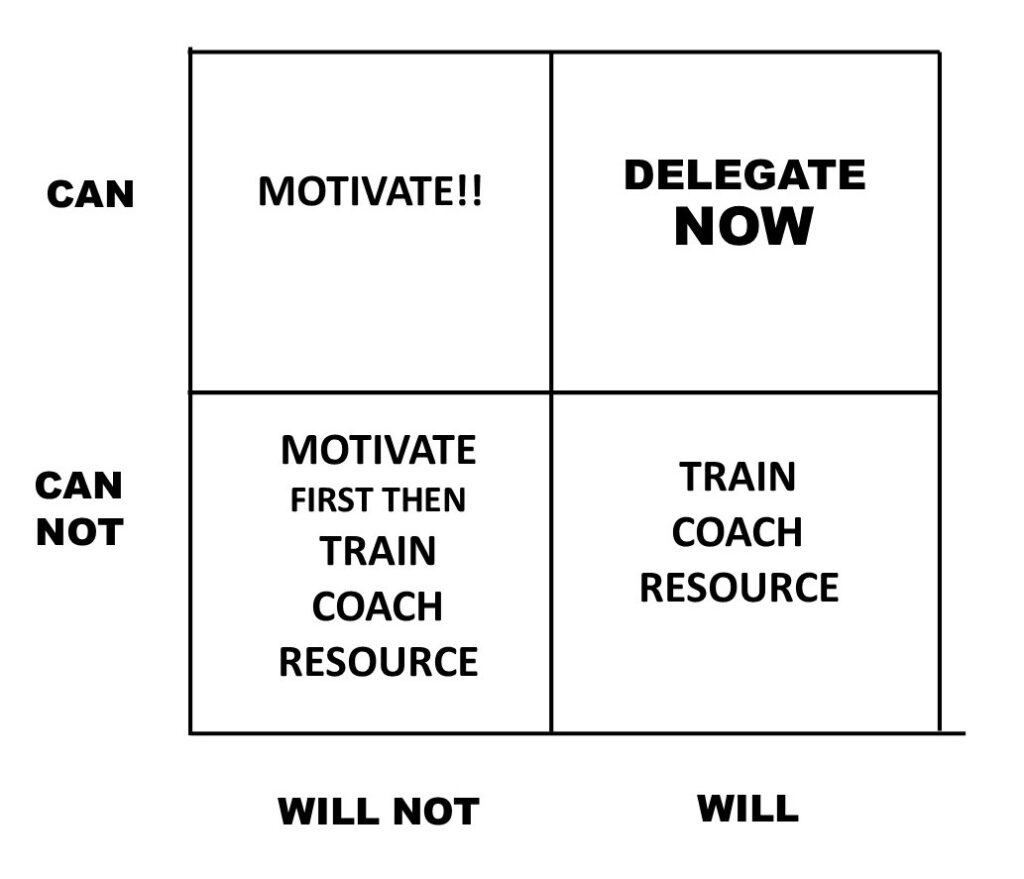
The answers to these questions determine what the boss needs to do, to effectively manage the performance of a subordinate.  The graphic below summarizes a manager’s appropriate response, in each case:

CAN / WILL is the ideal combination of answers to these questions. 

This guy is ready to go–GIVE HIM THE GO-AHEAD!!!!

The manager is ready to give this subordinate an assignment because the worker CAN do the job (they have the skills and resources necessary) and the employee is WILLING to do the job (they are motivated to take on the assignment and see it through successfully).  In this case, the manager can go ahead and apply basic management oversight to ensure a clear assignment and an successful outcome.

CAN NOT / WILL is less than ideal, but offers the assigning manager a clear path forward. 

She’s EAGER…but is she READY????

In this case, a willing employee needs training or coaching or resourcing of some kind in order to take on the assignment successfully.  The boss must determine exactly what prevents the employee from performing and address each need specifically and practically.  That might include things like:

  • Permission to act (official authorization of some kind)
  • Authority to act
  • Training
  • Coaching
  • Equipment of some kind
  • Budget
  • Additional personnel
  • Cooperation from another team or department
  • Possibly the ability to put other assignments on hold in order to take on the new assignment

The advantage of CAN NOT / WILL is that the toughest part of delegation is already a given—employee motivation.

CAN / WILL NOT is a bit of a challenge. 

The subordinate has the skills and resources to succeed.  But the delegating manager must find a way to connect with the employee’s personal and internal incentives, to ensure they have the will and determination to take on the assignment and complete it successfully. 

She may be READY…but is she EAGER????

Here’s the challenge:  Internal incentives are highly individualized and vary from person-to-person.  So the boss has to know each subordinate well enough to have identified their particular internal motivational “buttons.” 

Internal incentives come in all shapes and sizes.

  • Personal financial goals
  • Professional development goals
  • Personal growth goals
  • Challenging work
  • Key roles and responsibilities
  • Recognition of various kinds
  • Interpersonal interaction at work
  • The ability to work independently or remotely
  • The ability to work cooperatively or collaboratively
  • Meaningful assignments
  • Visibility with higher-ups

Managers who want engaged team members must take the time to identify each subordinate’s unique internal motivators.  That information equips managers to make assignments that tap into each person’s natural incentives and provide engaging work for every team member.

CAN NOT / WILL NOT is the most challenging combination. 

This is the employee who lacks skill and is unmotivated to work!  (Some parents out there might be thinking, “That sounds like my teenage kid!”).  The manager’s proper response begins with the correct answer to the question:

Which comes first—COMPETENCE or MOTIVATION??

DOES THIS GUY LOOK READY TO TRAIN????

Does it make sense to try and train an unmotivated person?  The answer is obvious: FIRST you must motivate the worker; THEN you can more easily provide the necessary training and resourcing! 

CAN THEY? WILL THEY? Is also an essential step in managing performance problems!

When an employee is not performing well, it is the manager’s responsibility to take initiative and address the problem directly.  It is vital that the manager establish the true cause of the problem!  One of the most common mistakes made by inexperienced supervisors is to assume that an employee’s performance problem stems from their unwillingness to do the job. 

Experienced managers know that there are many “CAN NOT” reasons for a lack of effective performance (as shown above).  It is vital for the manager to do a thorough examination of the situation; ask the right questions; LISTEN TO THE EMPLOYEE; determine the real cause of the problem; and address the issue effectively.

GET MORE DELEGATION IDEAS WITH THESE FREE RESOURCES!

If you would like more tips and tools for effective delegation, download the following FREE resources that will help you…

  • Make clearer assignments
  • Eliminate confusion and miscommunication
  • Match assignments to employee motivations
  • Manage deadlines effectively
  • Engage team members more effectively
  • Create better outcomes

This information is not high-flying theory.  It’s down-and-dirty practical tools and techniques—easy to understand and easy to apply.  This is exactly what I have taught to thousands of managers and aspiring leaders in seminars and workshops all across the country and internationally.  It’s yours for FREE! 

Here are the resources:

Issue #9 of The LeadershipTracks Newsletter outlines the 6 Levels of Delegating Authority.  You can access it here

The companion edition of The Personal Trainer shows you exactly how to delegate effectively, using a logical, well-organized approach.  You can access it here.

If you are looking for ways to become a better manager and team leader, we can help!  We have experience working with teams and team leaders, helping them to work together more effectively.  And we can help you and your team do the same.  Give us a call, and start your journey of leadership growth today!

Until next time… Yours for better leaders and better organizations,

Dr. Jim Dyke – “The Boss Doctor” ™ helping you to BE a better boss and to HAVE a better boss!

Posted in Authority, Coaching, Communication, Control, Deadlines, Delegation, Employee Engagement, Employee Motivation, Leadership, Management, Performance Management, Productivity, Supervision, Team Dynamics, Team Leadership, Teams, Uncategorized, Work | Tagged , , , , , , , , , | 1 Comment

Great Advice from Top CEO’s – #24

You will never be an effective leader until you can be comfortable being responsible for what other people do.

This issue’s great advice comes from one of my favorite CEO’s – Rick Frost of LP (Louisiana-Pacific Corporation).  I heard Rick address a group of his mid- and upper-level managers and executives on the topic of delegation, and this is what he told them:

“You will never be an effective leader until you can be comfortable being responsible for what other people do.”

He told this audience of leaders, “As CEO, I am ultimately responsible for everything that is done in this company by its employees.” It was a stark reminder of the tremendous responsibility of leadership!

This is one of the main reasons why delegation is a challenge – no matter who you assign the work, ultimately YOU are still responsible for the outcome!  It’s why many managers become MICRO managers when they delegate – they “over-supervise” because they fear their team member will not produce an acceptable outcome.

There are a couple of things you can do to dial down your anxiety when you delegate.

First, be sure your team member understands CLEARLY what outcome you want. 

Does this guy look like he understands????

Two of the most common things that derail successful delegation are CONFUSION and MISUNDERSTANDING.  Confusion is caused by managers who don’t give clear instructions.  Misunderstanding is caused when the person receiving the assignment misinterprets the instructions.  

It’s the manager’s responsibility to ensure clear understanding when giving assignments.

How do you do that???? 

Many managers ask the following clarification question when they finish giving instructions to a subordinate:  “Do you understand?”  Here’s the irony:  Most experienced managers know that a “yes” answer does not guarantee clear understanding!  Here’s a better approach:  When you have finished giving your instructions, tell your subordinate

“Now tell me what you’re going to do.” 

Author Ferdinand Fournies calls this “mind reading.”  It’s a sure-fire way to find out if your team member is clear on their marching orders.  When they feed back your instructions in their own words, you will be able to spot any confusion or misunderstanding immediately.

The second thing you can do to get better results when you delegate is to build “check-in” times into your assignment

Get agreement on clear, specific check-in times!

Check-ins are clear, specific, agreed-upon times when you are going to inspect the progress of the assignment with your subordinate.

Clear, specific—“I will be checking in with you on Tuesday morning and Wednesday morning.”

NOT vague, general—“I will be checking in with you from time-to-time.”

And this is the important part:  get clear agreement on those check-in times.  When you build these moments into the assignment at the outset, it feels less like micromanagement to your subordinate when you show up at the agreed-upon time to discuss their progress. 

You can also use this technique when you are working with a colleague on an agreed-upon deadline!

Are you SURE this guy is going to deliver on his promised deadline????

If you are having to collaborate with a colleague who has trouble fulfilling their promise or delivering on their agreed-upon deadlines, you can use this same technique to help you gain more dependable performance from them!

Just remember this:

Check-ins are an OPTIONAL tool for managing assignments—only use check-ins if you need them.

If you are giving an assignment to a subordinate or colleague who has demonstrated consistent reliability, you don’t need to use check-ins!  That would be insulting, demeaning, and demotivating to a hard-working, reliable employee!

There are many more things we can help you with when it comes to delegation… How to: 

  • fit the assignment to the right person
  • gain greater buy-in and worker engagement
  • get super-high productivity
  • manage risk more effectively
  • delegate authority with clarity and effectiveness.  

So…stay tuned to this blog and get the tools and techniques you need to excel at delegating and assigning work!

Until next time… Yours for better leaders and better organizations,

Dr. Jim Dyke – “The Boss Doctor” ™ helping you to BE a better boss and to HAVE a better boss!

Posted in Authority, Collaboration, Communication, Consistency, Control, Deadlines, Delegation, Leadership, Management, Performance Management, Risk, Supervision, Team Leadership, Teams, Uncategorized, Work | Tagged , , , , , , , , , , , , | Leave a comment