5 Questions Every Boss Needs Answered by Their Subordinates – #2

If you want to be an effective leader, you must be able to get clear answers to five essential questions—from EACH OF YOUR TEAM MEMBERS.

Are you talking to your people…and really LISTENING?

The first question is the most fundamental:

WHAT DO YOU NEED FROM ME IN ORDER FOR YOU TO DO YOUR BEST WORK?

The second question is built on the first: Do you have the opportunity every day to do what you do best?

As I mentioned in my last post, this series was inspired by a recent Harvard Business Review article by Susan Peppercorn, where she points out the importance of dialogue between workers and leaders (and the lack of those important interactions that exist in many organizations!).  She writes:

…these conversations may be too little too late. In a recent Gallup study, more than half of employees surveyed said that no one — including their manager — had talked to them about how they were feeling in their role in their last three months before they quit.  And 52% of exiting employees stressed that their manager or organization could have done something to prevent them from leaving their job.

NOTE: If you’re interested in the study, you can access it here:  Gallup study

She adds…

…it’s critical to know what motivates employees to stay with an organization and why. Gallup research shows 12 needs managers can meet to improve employee engagement, including:

Prioritizing employee development

Facilitating a sense of purpose

Caring about employees

Considering employee opinions

Focusing on employee strengths

NOTE: If you’re interested in this research, you can access it here:  12 needs

This series focuses on the 5 key questions that are most likely to illuminate the most important needs that employees have in their workplace roles—and how leaders can respond, with relevance and positivity.  The end result, of course, is more satisfied workers with higher productivity, and stronger loyaltywith less likelihood of leaving their positions.

The second question builds on the research that Gallup has done in the area of workplace talents or strengths.  Marcus Buckingham is well known for his thinking and writing on this topic.  His book, Now Discover Your Strengths, is a best-selling resource for anyone who is interested in exploring this area.  Other authors, like Mihaly Csikszentmihalyi, have built on this information with additional research and application.

Buckingham offers important insights about workplace talents:

  • Everybody has at least one, and most people have more than one.
  • When people are doing tasks that utilize a workplace talent, they are much more efficient and productive.
  • When people are doing tasks that utilize a workplace talent, they also produce better results. 
  • When people are doing tasks that utilize a workplace talent, they also experience greater mental focus, engagement, and enjoyment.

Doing what you’re good at is more productive…and FUN!!!

So Buckingham applies this insight to workers and leaders.  For workers, his advice for long-term success in a career is…

  1. Focus your time and effort—as much as possible—on doing work that utilizes your workplace talent.
  2. Spend as little time and effort as possible doing work that does NOT utilize your workplace talent.
  3. When it comes to learning and training—focus on developing and growing in your workplace talents.
  4. Avoid trying to be effective at everything.

His advice for leaders echoes the same insight…

As much as possible, assign people work that utilizes their workplace talents.

Of course, this is the point of the second question: Do you have the opportunity every day to do what you do best?

Up Close and Personal

I have written before about one of my management heroes, David Payne.  At one point, he was a divisional sales head for a heavy equipment manufacturer here in the U.S.  He and his team became increasingly frustrated with the failure of the company factory in their division.  The factory was so poorly managed that it was over a YEAR behind in deliveries.  It was so bad that David and his team began sending their orders to company factories outside their area and paying for the added delivery fees out of their sales commissions.  David finally got fed up enough to call HIS boss to complain.  He told his boss, “Even I could do a better job of managing that factory than the current guy in charge!” 

So higher-ups took him up on his challenge, and offered him the job!!

The rest is history—under his leadership, the factory became the #1 profit center for the ENTIRE company!  The whole story of what he did and how he did it is STUFFED with great management and leadership lessons—I have written about some of them in previous posts. 

But here’s an example of ONE THING he did that illustrates the principle of strength-based assignments and roles:

When he took over the management of the factory, he interviewed EVERY EMPLOYEE.  Part of his intention was to make sure that everyone had the “right” job—the job that really “fit” their strengths / talents / gifts.  He discovered that one of his factory employees was what David called, “one of the most talented and gifted draftsman in our whole company NATION-WIDE.”  But David’s predecessor had assigned him to the role of Quality Assurance.  The employee HATED doing that job!  So David IMMEDIATELY reassigned him to his real passion and strength—drafting the blueprints for the custom made equipment they were designing and manufacturing for their clients.

I asked David, “Who did you get to replace him in Quality Assurance?”

David laughed.  He said, “You mean, who did I hire, to be the last pair of eyes to inspect one of our completed vehicles and make sure it is perfect before we ship it to the client who ordered it???  I hired a retired Marine Corp officer!”   I laughed, too!  I thought to myself, “Yeah…that’s what I call a perfect fit!” 

What about YOU????

Your team is counting on YOU to deploy them effectively!

If you’re in a leadership role and you want to utilize the powerful advantage of work/talent connection, you must:

  1. Discover which talents each of your direct reports possess.
  2. Determine which work assignments best “fit” each person’s strengths.
  3. Make assignments accordingly, as much as possible. 
  4. AND STOP TRYING TO MAKE EVERY PERSON GOOD AT EVERYTHING.

Now… does that mean you ignore weaknesses—either yours or your team members’?

NOT NECESSARILY!  But that’s a topic for another blogpost! If you’re interested, you can read about it HERE.

If you want to do a better job of leveraging your strengths and the strengths of your people, give us a call—we have the experience and resources to equip you and your team for greater engagement, stronger morale, better collaboration, and higher productivity!

Until next time… Yours for better leaders and better organizations,

Dr. Jim Dyke – “The Boss Doctor” ™ helping you to BE a better boss and to HAVE a better boss!

Posted in Career, Collaboration, Communication, Competence, Delegation, Employee Engagement, Employee Motivation, Feedback, Hiring, Interviewing, Leadership, Management, Morale, Performance Management, Personal Success, Productivity, Professional Development, Self-Awareness, Staffing, Supervision, Team Culture, Team Dynamics, Team Leadership, Teams, Uncategorized, Work | Tagged , , , , , , , , , , , , | Leave a comment

5 Questions Every Boss Needs Answered by Their Subordinates – #1

If you want to be an effective leader, you must be able to get clear answers to five essential questions—from EACH OF YOUR TEAM MEMBERS.

Your people have important questions to answer!

This series is an expansion of the principle I shared in my last post:

If you listen to your people, they will hand you leadership success on a silver platter.

My advice to leaders in the workplace has always been this:  Take the initiative in this process—by asking important questions and listening carefully to your employees’ answers.

This special series of posts was inspired by a recent web article by Susan Peppercorn published on January 21st by Harvard Business Review.  I’ve taken the premise of the article and added additional details to give managers and supervisors clear direction to guide them in the process.  I’ve also included some practical tools to help them interact productively with their direct reports. 

The first question is the most important and fundamental:  What do you need from me in order for you to do your best work?

Let me set the stage for this series and this post with an anecdote from my looooong history as a leader and as a management consultant…

Up Close and Personal

When I decided to start my own management consulting practice, my wife and I moved back to our hometown of San Diego to establish the “home base” for the business.  Before we bought a house, we rented a place in La Jolla, just outside the “Golden Triangle.”  I loved the neighborhood.  It was quiet—away from the noise and bustle surrounding the high-rise condos and apartments in the Triangle.  And it was just blocks away from dual shopping centers that were loaded with shopping conveniences—restaurants, movie theaters, grocery stores, drug stores, and both Starbucks AND Peet’s! 

We did a lot of grocery shopping at the Ralph’s that was there.  Inside the store was a Postal Annex franchise that was manned by a young woman in her twenties.  It was where I often mailed out books and packages.  During a friendly conversation, I divulged my vocation as a management consultant and she shared that she was not just the manager of the franchise—she was the owner!  That’s when she challenged me with the following question:

What’s the ONE THING I have to get right, in order to be an effective manager?

It reminded me of the movie, City Slickers, when the wise old cowboy, Curly, has a heart-to-heart conversation with Mitch Robbins (the character played by Billy Crystal):

  • Curly: Do you know what the secret of life is? [points index finger skyward] This.
  • Mitch: Your finger?
  • Curly: One thing. Just one thing. You stick to that and the rest don’t mean sh*t.
  • Mitch: But, what is the “one thing?”
  • Curly: [smiles and points his finger at Mitch] That’s what you have to find out.
Get this ONE THING right as a manager and you will succeed!

I confess, this question about “What’s the ONE THING for me as a manager?” was one of the toughest I’ve ever been asked!  I could think of a DOZEN things that managers need to get right.  I could boil it down to FIVE… or maybe just THREE.  But condensing it to ONE really baked my noodle!  It took a loooooong time of reflection and soul-searching before I was able to give her this answer:

Clarity!

Clarity about what????  Clarity about EVERYTHING!!!

  • Clear VISION and VALUES
  • Clear PURPOSE
  • Clear GOALS
  • Clear PRIORITIES
  • Clear ROLES and RESPONSIBILITIES
  • Clear ASSIGNMENTS
  • Clear EXPECTATIONS
  • Clear MEASUREMENTS for SUCCESS

Of course, clarity requires communication—LOTS OF IT—especially two-way communication!  This is one of the most important elements of my management training content: Telling managers to take the initiative in establishing open, honest, direct, and forth-coming communication with their teams. What does that mean? It means this:

  • OPEN = we can talk about anything—there’s no such thing as an “elephant in the room”
  • HONEST = we will never be punished for speaking the truth
  • DIRECT = if we have an issue with another person, we talk to them directly about it
  • FORTH-COMING = we don’t need to drag information out of one another—it’s freely volunteered
People need to feel comfortable talking with their boss!

This is about establishing what social scientists call, a “warm communication climate.”  It means making sure that you and your team members are able to share information freely, without any emotional, social, or political barriers.  I introduced this concept in an earlier blog.  You can access it HERE.

The blogpost also made two helpful tools available for readers who were looking for practical help in understanding how to go about creating a warm communication climate.  The first resource—LeadershipTracks Newsletter – Issue #10—describes a communication climate using six distinctive qualities—defined in contrasting opposites.  You can access it HERE.

For more practical help, you can dive into the applications supplied in the matching issue of The Personal Trainer.  It includes specific examples of what each quality looks like (and sounds like!) in typical workplace conversations.  (It also includes an entire section showing you how to communicate more effectively with your boss—even if that person presents a bit of a challenge in doing so!)  You can access it HERE.

I realize that this is a MAJOR INTRODUCTION to the whole five-part series.  But I wanted to emphasize how important it is for managers to establish healthy, effective communication with their team members.  Everything you need to discover through your team’s answers to these 5 questions depends on your ability to communicate well with them.

With that in mind, allow me to revisit the first question:

#1:  What do you need from me in order for you to do your best work?

The answer to this #1 question is designed to help you accomplish your #1 job as a boss…

Your #1 job is to help your people succeed.

I wrote about this in a blogpost last fall.  It’s packed with useful information and well worth reviewing.  You can access it HERE.

Asking your subordinates this straightforward question enables you to be CLEAR about what your team members need from you, in order to do their jobs well. 

I know how easy it is for leaders to assume that their people have what they need.  Bosses get busy with their own work; demands; priorities; schedules.  It’s easy for them to neglect the important conversations with subordinates that take longer than a quick greeting in the hallway. 

But it is vital that employees get the support they need from their boss.  Like what??? 

Like THIS:

  • Resources—budget / equipment / personnel
  • Information—goals / plans / priorities / direction / feedback / coaching / “intel”
  • Authority—to act / to decide / to represent the boss or the team / to be trusted
  • Problem-Solving—running “interference” / dealing with higher-ups and other team leaders
  • Decision-Making—especially for issues requiring higher authority

You may be at a point where you assume “no news is good news” and your people have what they need because nobody is saying anything.

You may be assuming too much!  And that would be a gigantic mistake on your part!

I often tell managers:

If you want to have a true “open door policy” then YOU must take the initiative—get up from your desk; walk through your own open office door; and get out there where your people are!  Meet them where THEY are and talk to them where THEY are!

If you need help engaging your people in honest, open, direct conversations about their work and their needs…give us a call – we can help!  We can give you the tools and the skills you need to build a productive communication climate with your team.  And stay in touch with this blog—we’ve got more great ideas and tips in store for you!

Until next time… Yours for better leaders and better organizations,

Dr. Jim Dyke – “The Boss Doctor” ™ helping you to BE a better boss and to HAVE a better boss!

Posted in Coaching, Collaboration, Communication, Competence, Employee Engagement, Employee Motivation, Feedback, Honesty, Leadership, Management, Morale, Performance Management, Productivity, Supervision, Team Culture, Team Dynamics, Team Leadership, Teams, Uncategorized, Work | Tagged , , , , , , , , , , , , | 1 Comment

5 Questions Everyone in the Workplace Wants Answered – #5

If you want to be an effective leader, you must be able to answer these questions for EACH OF YOUR TEAM MEMBERS.

  • The first question is the most important and fundamental:  WHAT’S MY JOB?
  • The second question follows the first: HOW WELL AM I DOING IT?
  • The third question is more profound: WHAT AM I PART OF?
  • The fourth question is about vision: WHERE ARE WE GOING?

The fifth question is about pure self-interest: How will I benefit when we succeed?

This is what we call the WII-FM — an acronym for the phrase, What’s In It For ME???

Employees want to know how they are going to benefit!

Before you get all pious or high-minded about why people SHOULD do their jobs (e.g. “Because they’re getting paid to…”), keep in mind that everyone on the planet is pretty much driven by self-interest.  Here’s the important thing to remember: each person’s motivation is unique to THEM!  So if you are going to be a motivating leader, you must know each of your team members well enough to understand their individual motivations…and then do the things that push each of their motivational “buttons.”

If you want some help understanding what motivates people, then GET MY BOOK!  I devote three separate chapters of Leading Teams to different dimensions of personal motivation, including EMOTIONAL TRIGGERS and VALUES AND INTERESTS.  Here’s a link to Amazon for the book, if you’re interested: 

Leading Teams: How to Inspire, Motivate, Lead, and Succeed!: James Dyke: 9781934589007: Amazon.com: Books

Personal motivation is a complex issue, but it really all boils down to the question, WHY SHOULD ANYONE FOLLOW YOU???  And, once again, the answer to that question is different for each person on your team. 

So…What’s a leader to do? 

  1. Know your people!
  2. Make sure you push EACH PERSON’S unique motivational “buttons”
  3. Start with the SINGLE MOST COMMON motivator in the workplace.

Yes — recent research has now identified the TOP MOTIVATOR in the workplace, and surprisingly, it is NOT recognition!  In an issue of Harvard Business Review, Theresa Amabile and Steven Kramer reveal the results of a multi-year study of motivation in the workplace.  Their information is a true revelation, and offers clear marching orders for every manager and supervisor.  The research findings run counter to the assumptions of managers and leaders everywhere.  The study shows that the top motivator of performance for employees is… Support for making progress in their work.

Managers need to be willing to help and support their people.

Here’s the blogpost I wrote about this article and its practical application in the workplace.  It’s CRAMMED with great ideas:

Great Advice from Top CEO’s – #13 | The Boss Doctor

But when it comes to WII-FM, this is really only a basic start.  To make a truly deep and strong connection with an individual team member’s WII-FM, you must know them well enough to know what they consider a benefit worth earning—worth applying their hard work and effective performance to obtain.

How do you find that out???

Here’s a thought—JUST ASK THEM!!!!

Up Close and Personal

I have personally trained thousands of supervisors and managers over the years.  That has given me an enormous opportunity to network and accumulate strategies, tactics, and practical tools from leaders serving in an extraordinary diversity of organizations—every conceivable industry, shape, and size—for profit; not-for-profit; public sector; private sector; Fortune 500; FORTUNE 100!!; every level of government (municipal; county; state; federal) and organizations under the Department of Defense (including every branch of the military).

So… I went to my network to get some help with this managerial task.  I collected ideas from hundreds of my management students—ideas designed to help leaders get to know their direct reports better and gain a clearer understanding of their employees’ motivations and drives.  I compiled those ideas into a simple, but effective tool.  It’s an easy, straightforward way for leaders to get to know the WII-FM of each of their team members.  And you can download it here FOR FREE:

The Employee Information Survey

Once you know the motivational “buttons” for each employee, it’s up to you to figure out ways that you can “scratch” those “itches.”  So…if an employee is energized by challenging work, you’ve got to identify challenging assignments you can give them.  Etc. etc.  This is a down-to-earth practical application of a seminal principle for successful leadership that I have always taught managers in my seminars:

If you listen to your people, they will hand you leadership success on a silver platter.

Are you REALLY LISTENING to your people???

So…LISTEN TO YOUR PEOPLE.  Take the initiative to talk to them—ask them the right questions and listen carefully to their answers.  What questions should you ask them????  That’s the focus for the next series in this blog.  DON’T MISS IT:

5 Questions Every Boss Needs Answered by Their Subordinates

And if you need help engaging your people and raising their performance…give us a call – we can help!  We can show you how to turn your people into motivated, engaged, high-productive members of cohesive and productive teams!

Until next time… Yours for better leaders and better organizations,

Dr. Jim Dyke – “The Boss Doctor” ™ helping you to BE a better boss and to HAVE a better boss!

Posted in Caring, Collaboration, Communication, Competence, Delegation, Employee Engagement, Employee Motivation, Leadership, Management, Morale, Performance Management, Productivity, Supervision, Team Dynamics, Team Leadership, Teams, Uncategorized, Work | Tagged , , , , , , , , , , | Leave a comment

5 Questions Everyone in the Workplace Wants Answered – #4

  • The first question is the most important and fundamental:  WHAT’S MY JOB?
  • The second question follows the first: HOW WELL AM I DOING IT?
  • The third question is more profound: WHAT AM I PART OF?

The fourth question is about VISION: Where are we going?

People want to know where they are going!!!

Allow me to build a context here…

In recent years, researchers in the human resource industry have been focusing their attention on what they are calling “employee engagement” and its vital role in determining worker productivity and longevity in a job.

The Gallup organization, in particular, has devoted a great deal of time and resource in studying employee engagement.  They have come to the conclusion that it is strongly connected to something all workers desire: a meaningful purpose to their work.

Here’s what the Gallup organization has learned about the connection between employee engagement and clear purpose:

“One of the most common mistakes companies make is to approach engagement as a sporadic exercise in making their employees feel happy… But it’s not that simple.  People want purpose and meaning from their work. They want to be known for what they’re good at.  …

“Employees need more than a fleeting warm-fuzzy feeling and a good paycheck… to invest in their work and achieve more for your company.  People want purpose and meaning from their work. They want to be known for what makes them unique. This is what drives employee engagement.”

People want to feel good about the work they do!!

An employee’s sense of meaningful purpose is ultimately dependent on the organization’s purpose.  In effect, is the purpose of the organization something that the employee considers meaningful??? 

Here’s the reality:  The individual employee really doesn’t have any influence in determining organizational purpose—that’s in the hands of the executives and the governing board.

The only choice the employee has is whether they are willing to embrace it as a requirement for meaningful employment!  If not, then they shouldn’t take the job in the first place.

Up Close and Personal

I have had the privilege of working with a number of offices and employees in the Social Security Administration.  One of the things that has impressed me is the overwhelming majority of employees who joined the administration because they felt the work they did there was of particular value and meaning in addressing the needs of their fellow Americans—through substantive, material assistance. They chose to work there because they felt they could make a meaningful difference in people’s lives because of the mission and pursuits of the organization.

Here’s the point:  To attract and engage employees via a sense of meaningful purpose, the organization, itself, must have a clear purpose that employees consider meaningful.

But that’s not enough!  That purpose must be translated into a clear direction at the team and employee level.

The Importance of a Clear Team Vision Statement

A ground-breaking study of successful and unsuccessful teams that was conducted by Harvard University found that a CLEAR TEAM VISION STATEMENT is a watershed-predictor of team success: have one, and your team will succeed; lack one, and your team will fail.

Employees need to know where their TEAM is going!!

Here are the basics you need to know in order to craft an effective team vision statement:

  1. It needs to support the vision of the organization.
  2. It must be crafted by you and your team working together.
  3. It should include the following information:
    • What we do as a team…
    • Who we do it for…
    • How well we intend to do it…
    • The measurable results we will achieve…

Grab a copy of my book for lots of examples of team vision statements (some of which you may even be able to use with very little editing!)  You can find it on Amazon here: Leading Teams: How to Inspire, Motivate, Lead, and Succeed!: James Dyke: 9781934589007: Amazon.com: Books

CLEAR VISION is what you need in order to head in the right direction as a team!

The important thing to remember about your vision statement is that you must make it central to everything you do as a team and a team leader.  That means you must talk about it; refer to it; and use it as a touchstone whenever you tackle the important work of a team:

When you are PLANNING, you ask the question: What are the things we need to accomplish together that will get us closer to achieving our vision? 

When you are EVALUATING the work you have done as a team or as team members, you ask the question: What could we have done differently to achieve our vision easier /better /faster /cheaper /safer? 

When you are solving a PROBLEM, you ask the question: What solution will get us closer to achieving our vision? 

When you are crafting an important DECISION, you ask the question: What decision will best support the achievement of our vision?

I also encourage team leaders to put their Team Vision in the center of one-on-one conversations they have with team members who are not performing well.  That sends the strong message that the team’s focus on effective performance is not a matter of “pleasing the boss,” but of “achieving our vision…our meaningful purpose.”

Up Close and Personal

In one of my training seminars I met a supervisor who understood the power of clear vision.  He worked for a large health services organization and was put in charge of their transportation team.  They were responsible for transporting patients, medicines, and medical supplies within the multi-location organization.  And they had a terrible record of turnover, absenteeism, tardiness, and complaints from patients and medical staff!  Under the leadership of this gifted supervisor, they ultimately became the top-rated team in the organization, in all categories of performance and customer service! 

I asked him how he did it.  His answer was simple.  He told me, “I kept emphasizing our team purpose and vision…over and over and over.  I kept telling my team members, “It’s all about the patients; it’s all about the patients; it’s all about the patients.”

He also constantly personalized the team vision whenever he challenged poor performance.  When one of his team members was a half hour late returning from his lunch break, he chided him with the follow admonition:

“Victor, if your grandmother needed to get to her doctor’s appointment, would you tell her, “Sorry grandma, you’re just going to have to wait…I’m not done with my lunch yet.”??  Then he told his team member, “Well, that patient who needed to get to her appointment was somebody’s grandma!!!  So… are we going to let that kind of thing happen to somebody’s grandma????” 

The team responded to his inspirational leadership by embracing the meaningfulness of the work they did.  As a result, they gradually developed a greater sense of pride and accountability for their assignments and their performance.  Under his leadership, they ultimately became the top-performing team company-wide, with the highest ratings in performance, attendance, and customer service.

If you need help molding your people into cohesive, collaborative teams… give us a call – we can help!  We offer helpful resources, training, and coaching that can get a drifting or conflicting team back on track—working and performing together.

And be sure to stay tuned for the next post, to learn the all-important fifth question!

Until next time… Yours for better leaders and better organizations,

Dr. Jim Dyke – “The Boss Doctor” ™ helping you to BE a better boss and to HAVE a better boss!

Posted in Agility, Collaboration, Communication, Competence, Creativity, Customer Service, Decision Making, Decision-making, Employee Engagement, Employee Motivation, Leadership, Management, Morale, Organizations, Performance Management, Planning, Problem-Solving, Productivity, Success, Supervision, Team Culture, Team Dynamics, Team Leadership, Teams, Uncategorized, Values, Vision, Work | Tagged , , , , , , , , , , , , , | Leave a comment

5 Questions Everyone in the Workplace Wants Answered – #3

This advice is adapted from Jerry R. Wilson’s book, 151 Quick Ideas to Inspire Your Staff.  If you want to be an effective leader, you must be able to answer these questions for EACH OF YOUR TEAM MEMBERS.

The first question is the most important and fundamental:  WHAT’S MY JOB?

The second question follows the first: HOW WELL AM I DOING IT?

The third question is more profound: What am I part of?

Your job as a team leader is to help your team members to:

  • Understand the “big picture” of the organization (how it measures success); and…
  • Understand clearly how their team contributes to that success.
Who exactly am I working for and with???

Up Close and Personal

In my management training seminars, there is ALWAYS the demand from students that I  “understand why our organization is different.”  I hear statements like:

  • We’re a government agency, not a business.
  • This is a business—we have to make a profit.
  • We’re a non-profit, not a business!
  • This is the military—we’re not like other organizations.

Of course, there is some truth to these statements.  What they often overlook is how much ALL ORGANIZATONS have IN COMMON.  And THIS is one of the most important and most fundamental:

All organizations require dough to operate.

EVERY ORGANIZATION has to keep an eye on their budget!

EVERY ORGANIZATION has a bottom-line!  Crucial to any organization’s success is how it acquires and uses money!  

  • For businesses it has to do with generating profit. 
  • For non-profits, it’s all about gaining donations. 
  • For public sector organizations it has to do with tax revenues, bond issues, legislation, and municipal, state, or federal budgets. 

Your organization AND YOUR TEAM must function within the restrictions of acquired operating funds.  The more your team members understand this all-important reality, the more effectively they can APPLY this knowledge at the next level: their role in helping the organization succeed.

Every team member must have a clear understanding of how their work affects the success of the team and its contribution to the overall success of the organization. 

And every team can measure their contribution in actual dollar amounts by determining how they can help increase revenue, savings, or productivity.  Because—in the words of my GenX daughter— “It’s all about the dough, Pops!” 

Yes indeed, it’s all about the dough:

  • How to MAKE IT… how to INCREASE REVENUE
  • How to SAVE IT… how to INCREASE SAVINGS
  • How to STRETCH IT…  how to INCREASE PRODUCTIVITY

So… how is your team making it, saving it, or stretching it? 

  • How are your team members playing their part in the success of the organization? 
  • How are you justifying TO YOUR BOSS the value that you are bringing to the organization? 
  • How is your team supporting more sales or donations?
  • How are they saving the organization money?
  • How are they increasing their productivity?  AND MOST IMPORTANT…How are you measuring the value they add—in dollar amounts? 

When your team members understand their connection to the success of the organization, they are also better able to understand how their mistakes, failures, poor quality work, and low productivity COST the organization!

Finally, you need to keep your team informed about the big picture of the organization – how it is performing, competing, growing, and developing.  The more information you share with them, the easier it is for them to feel part of the organization; to have a sense of ownership and stewardship; to develop loyalty and support; and to become a true stakeholder in the organization’s success.

Up Close and Personal

I often cite the example of David Payne, a good friend and client.  He took charge of a failing factory in his company and applied his brand of positive, effective leadership to completely turn it around and make it the highest-earning profit center in his organization, nation-wide!

One of the things he did to energize his employees, was to conduct regular, information-packed factory-wide meetings.  The factory would shut down for the last two hours of the shift; chairs would be set up on the main floor of the factory; and David would lead the meeting with every employee in attendance.  (David also PAID the employees for a full day of work—they were able to attend the meetings on the company’s dollar!)

He would use the time to share important information with his factory workers:

  • The latest production numbers
  • Safety issues and statistics
  • The on-time delivery totals
  • The amount of money generated by the factory deliverables
  • How their numbers compared with other factories in the company
  • How the company was performing in their industry and succeeding in key markets
  • How the company was growing through acquisition and expansion

Finally, he used the meetings to praise and affirm the great work of his employees.  In an earlier post, I shared a sample of his positive and powerful message.  He once told his people:

“You are the secret of our company’s success!  Our competitors are afraid of you!  They fear your skill, your hard work, and your commitment.  They fear you because you have the ability to put them out of business, AND THEY KNOW IT!”

An effective team develops GENUINE PRIDE in their work!

I guarantee that every one of David’s employees understood the importance of their job, and why it was imperative to do their job with excellence, and with timeliness!

If you want some ideas about how you can help your team members make a personal connection with your organization and with one another, give us a call – we can help!  Our consulting and training resources can help you and your team experience a higher level of morale, better teamwork, and greater productivity!

And if you want to know the rest of the 5 questions, stay tuned to this blogpost series!

Until next time… Yours for better leaders and better organizations,

Dr. Jim Dyke – “The Boss Doctor” ™ helping you to BE a better boss and to HAVE a better boss!

Posted in Collaboration, Communication, Leadership, Management, Morale, Organizations, Performance Management, Productivity, Success, Supervision, Team Culture, Team Dynamics, Team Leadership, Teams, Uncategorized, Work | Tagged , , , , , , , , , , | Leave a comment

5 Questions Everyone in the Workplace Wants Answered – #2

Question #2: How well am I doing it [my job]?

If you want to be an effective leader, you must be able to answer these questions for EACH OF YOUR TEAM MEMBERS.

The first question is the most important and fundamental:  WHAT’S MY JOB?

The second question follows the first: HOW WELL AM I DOING IT?

Your people want to know the answer to this all-important question!!

Your job as a leader is to answer the second question with FEEDBACK – accurate and straightforward – it’s essential for every one of your team members!  Management guru Ken Blanchard supports this idea enthusiastically.  He calls feedback, The Breakfast of Champions.

Most organizations recognize the value of feedback and incorporate it into their management practices in the form of the requisite annual performance review.  That’s a good thing, right??

Well…

What’s wrong with annual Performance Reviews???

Most employees view their annual performance review as a BIG HEADACHE

FIRST OF ALL… Sadly, for many employees… The annual performance review is the ONLY time they receive any feedback on their performance!

That is WAY too infrequent, especially if an employee is not performing at an acceptable level.  Think about it!  If one of your team members needs help in order to succeed in their work, the commonsense response for you as their leader is to give them the help they need AS SOON AS YOU DETECT A PROBLEM! 

Allowing a team member to continue to fail over time only worsens the problem!

  • It’s frustrating and demotivating for THEM…
  • It’s frustrating and demotivating for their fellow TEAM-MEMBERS, who are counting on them to pull their weight on the team and contribute to team success…
  • It’s frustrating and demotivating for colleagues on OTHER TEAMS in the organization who are counting on YOUR team to do their work effectively…
  • It’s frustrating and demotivating for YOU to have to find ways to work around their failure…
  • It’s frustrating and demotivating for YOUR BOSS, who is expecting you to FIX THE PROBLEM!!

By the way… If you DON’T do something to address the problem of a failing employee, eventually your boss will conclude that YOU are the problem; that YOU are the one who is failing in their job!

I do not recommend that you allow that to happen!

SECOND… Sadly, many performance reviews result in subjective ratings… determined by the boss! 

In other words, it’s up to the manager or supervisor to determine what “number” to give the employee.  Further, numbered ratings are often given vague definitions with no real objective means of measurement.  So…the employee and the manager are required to “guess” what it means to give an employee a rating of “satisfactory” in a given category when it is defined as “fulfills the minimum requirement.” 

Are you GUESSING about performance ratings???
THAT’S NOT GOOD!

So… if an employee comes to work EVERY DAY on time, which is the minimum requirement for attendance (isn’t that what it means to have a job—to show up on time?) does that mean they get a rating of “satisfactory?”  If so, how does an employee get a rating of “excellent” in the area of attendance???  Must they show up early every day??  Do employment laws (or union contracts) allow for that requirement???

That often creates friction between employees with different bosses, when those bosses apply different subjective ratings for the same level of performance.  So…one team is happy with a rating of “excellent” for showing up to work on time every day, but another team is frustrated with a rating of “satisfactory” for having the same pattern of on-time attendance.

That’s why a vague system of performance standards often produces disgruntled employees.

THIRD… Sadly, many companies arbitrarily set evaluation limits, often with unspoken policies that everyone understands and accepts as part of the corporate culture.

Maybe YOU have worked for such an organization, where everyone understands the policy “we don’t give fives” at this place.  That kind of policy—unwritten or not—also discourages employees! 

Imagine if you wanted to get into a really good college, but were required to go to a high school with the policy “we don’t give A’s at this school.”  Would you be motivated to do your best work at that school?  I’m guessing you would rather attend a high school without that arbitrary “ceiling.”

When employees face ARBITRARY STANDARDS…
They get a bit DISGRUNTLED!

Sometimes, that policy is supported by the idea that a “5” is for “perfect” performance, and that would mean “no more room for improvement.”  And since there is ALWAYS room for improvement, it wouldn’t make sense to give people a “5” rating.  Right??

Once again, this kind of thinking stems from a lack of OBJECTIVE standards.  Thus, nobody knows what actual performance justifies a level “5” rating.  It’s up to the boss to determine their own standards and ratings.

What do I recommend instead????

Instead of performance feedback that is:

  • Infrequent
  • Subjective
  • arbitrary

I recommend performance feedback that is:

  • Continual
  • Objective
  • Based on clear and measurable standards

Continual feedback takes place continually throughout the year, especially after every assignment—sometimes even during an assignment!  It means addressing any employee problems or failures when they are happening.  This is the only way you can help a failing worker correct performance, attendance or behavior problems and get back on course to succeed. 

Up Close and Personal

In my management seminars, I teach leaders to follow up EVERY completed assignment with this 3-fold strategy:

  • Review – take a look at the outcome and do a thorough evaluation.
  • Respond – give your team member feedback – both affirming AND correcting (if required).
  • Reward – find a way to give a successful team member tangible affirmation, even if it’s just a smile and a verbal “attaboy.”

This requires a private, one-on-one, face-to-face conversation with your team member.  If you are uncomfortable, unsure, or untrained to do this with confidence, download my LeadershipTracks Newsletter #6 by simply clicking on the title.   For expanded detail, download the companion issue of The Personal Trainer. Use the formula AND the forms I provide to guide you in this all-important management responsibility. 

Meet privately with your team member and give them clear feedback.

Now… here’s the real key to your success as a leader: don’t neglect to give your team members POSITIVE, AFFIRMING feedback when appropriate!  They need to hear from you when they are hitting the mark.  They need you to affirm and recognize their good work.  You must say something. The only way they will know for certain that they are succeeding in their work is if you TELL them – directly, openly, and clearly.  If you need help to do this part of your work with confidence and skill, check out the LeadershipTracks Newsletter #5 and its companion issue of The Personal Trainer. I provide an easy formula (and form) to guide you in this equally important process.

Don’t forget to affirm the good work that your people are doing!
Image by © Royalty-Free/Corbis

I know… some of you may be thinking: WHY SHOULD I PRAISE MY PEOPLE FOR DOING WHAT THEY’RE GETTING PAID TO DO?  I hear this question constantly from overworked managers and supervisors.  Here’s what I tell them: You need to say something, because you need to send the strong message to your people, “I notice, and I care.”  If you don’t care enough to at least say something, they won’t care either.  It’s that simple.

Objective feedback is based on measurable behavior and outcomes.  It starts with an assignment.  When you give a team member a task to do, make sure you describe what a successful outcome should look like!  When employees have a tangible, measurable standard for successful performance, they have the ability to manage their own performance without your constant oversight. 

What might that look like?

  • Load eight trucks per shift
  • Fix the air conditioning by the end of the workday
  • Process fifty applications per week
  • Raise one million dollars in donations this quarter
  • Increase sales by 20% this year
  • Don’t be late to work more than three times each month
  • Earn four additional educational units this year

Clear and measurable standards are like the ones I just showed you—they’re based on objective metrics. 

FOR EXAMPLE… How do you achieve or justify a level “5” performance rating???

  • Load eight trucks per shift
  • Fix the air conditioning by the end of the workday
  • Process fifty applications per week
  • Raise one million dollars in donations this quarter
  • Increase sales by 20% this year
  • Don’t be late to work more than three times each month
  • Earn four additional educational units this year

You get the picture. 

If you need some help re-energizing low-productive teams and equipping struggling leaders, we can help!  We can bring our expertise into your organization and help your whole management team.  Contact us and we will show you lots of affordable ways we can help your leaders get better.  And if you want to know the rest of the 5 questions, stay tuned – I’ll tell you about them in the next posts.

Until next time… Yours for better leaders and better organizations,

Dr. Jim Dyke – “The Boss Doctor” ™ helping you to BE a better boss and to HAVE a better boss!

Posted in Authority, Coaching, Communication, Consistency, Control, Delegation, Employee Development, Employee Engagement, Employee Motivation, Failure, Feedback, Honesty, Integrity, Leadership, Management, Morale, Performance Management, Recognition, Supervision, Team Culture, Team Dynamics, Team Leadership, Teams, Uncategorized, Work | Tagged , , , , , , , , , , , , , , , | Leave a comment

5 Questions Everyone in the Workplace Wants Answered – #1

Question #1: What’s my Job???

It’s the beginning of a brand new year, and I’m back in the saddle to bring you more practical, down-to-earth insights, tips, tools, and techniques to help you become a better leader—wherever you serve!

This post begins a new series –

5 QUESTIONS EVERYONE IN THE WORKPLACE WANTS ANSWERED

This great insight is adapted from Jerry R. Wilson’s book, 151 Quick Ideas to Inspire Your Staff.  These five key questions define and shape every employee’s work EVERY DAY.  If you want to be an effective leader, you must be able to provide clear, straightforward answers to each of these questions, for each of your team members. 

The first question is the most important and fundamental:  WHAT’S MY JOB? 

Don’t overlook this question or assume your people know the complete answer.  Here’s what the Blanchard Companies said about this in an issue of their web-based periodical, Ignite: 

“When employees do not receive the direction and support they need to accomplish their key tasks successfully, the result is wasted time, substandard results, and costly rework.  One big culprit?  Unclear direction and lack of follow-up.”

That’s right, UNCLEAR DIRECTION.  Whenever you assign a job, task, process, or goal, you must always start with a clear description of the successful outcome you desire (including deadline, timetable, and any other essential requirements). 

Employees need CLEAR DIRECTION!

If you’re concerned about the worker’s ability to succeed, then build into the assignment a few strategic “checkpoints” – moments in time when you will check in with your team member and evaluate their progress.  Make sure you gain clarity and agreement about these checkpoints, so it doesn’t feel like you are micro-managing. 

Here’s the idea: a job description isn’t really complete without clear direction! 

This especially applies to the “big picture” of an employee’s position.  I’m referring now to the major reason for their hire in the first place, what I call “the REAL job description.”   When I use that phrase, I’m not referring to the qualifications for their hire or what their job responsibilities will be if they ARE hired.  I’m talking about the RESULTS that will define successful PERFORMANCE in their role if they are hired and ultimately prove adequate for their new job.  I’ve described this in more detail in a previous post and you can access it here: 

Hire S.H.A.R.P.E.R. People – Part 5 | The Boss Doctor

For an employee to understand what their REAL JOB is, they need a clear answer to this question:

What are the most important things I need to accomplish in the next 6 to 12 months in order to demand and justify a raise in my salary? 

Since most of MY jobs in organizational life were “turnarounds,” I usually knew the answer to that question after even the briefest interview.  It usually sounded something like this: “Get in there and clear out the dead wood; turn things around; and get some decent numbers by the end of the year!”

The REAL JOB is to HIT THE TARGET!

Can you really summarize a job that succinctly? 

In an issue of Fast Company magazine, Linda Tischler tells the story of David Butler’s promotion to become the Vice President of global design for Coca Cola: 

“Butler’s marching orders when he arrived…were simple.  So simple, in fact, they fit on a Post-it Note.  On his first day of work, his then boss—chief creative officer Esther Lee—handed him a yellow sticky.  It said three things:  1) Meet a lot of new people and get to know the business.  2) Work on Coke.  3) Tell me when you need help.”

Up Close and Personal

I once took a position with a one-sentence assignment:  “Reverse a 9-year trend of decline.”  Of course, there was a lot more detail to the formal job description, including plenty of bullet points regarding responsibilities and management of staff.  But the CEO was clear about the “do-or-die” measure of success or failure in the job.

Here’s the point:  Sticky note or not, every person on your team needs a clear description of your expectations for their work, with a focus on the RESULTS you want.  Make sure they get it!

If you need some help giving or gaining clarity in your work, we can help!  We can help you become a better leader OR follower, with top-notch training and executive coaching.  Our fees are reasonable and our clients achieve real results, in promotions and new leadership opportunities.  And if you want to know the rest of the 5 questions, stay tuned – we’ll tell you about them in upcoming posts!

Until next time… Yours for better leaders and better organizations,

Dr. Jim Dyke – “The Boss Doctor” ™ helping you to BE a better boss and to HAVE a better boss!

Posted in Communication, Feedback, Leadership, Management, Performance Management, Supervision, Team Leadership, Teams, Uncategorized, Work | Tagged , , , , , , , , | Leave a comment

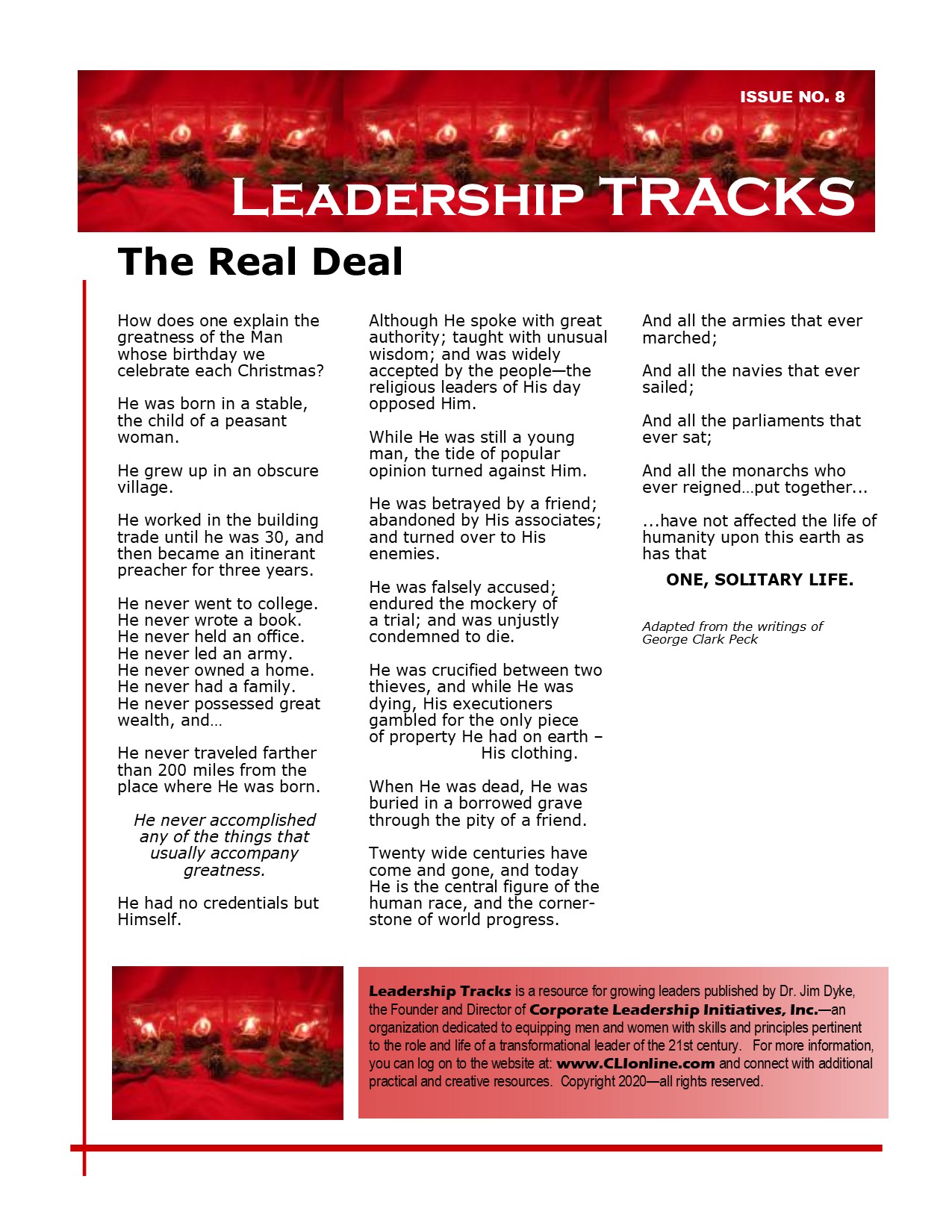
History’s Greatest Leader

I have purposefully been taking a “holiday break” from posting–to step back; take my foot of the accelerator; and spend some “down” time relaxing and re-charging from all the CoVid non-sense. However…in view of the Christmas season, I’m coming out of hiding to post this past newsletter–to give all my readers and leaders some food for thought with regard to leadership in general, and their own leadership in particular.

BTW…I’m certain that the great Ken Blanchard will agree with this post! He calls this leader, “simply the greatest leadership role model of all time” –someone who, Blanchard says, did leadership “to perfection.” You can access the book Blanchard wrote about this leader with this link: Lead Like Jesus (kenblanchardbooks.com)

Here’s the newsletter I published about this leader…

Here’s wishing you all a Merry Christmas, and a Happy New Year!

See you again in 2022!

Yours, for better leaders…and better organizations!

The Boss DoctorTM

Posted in Authority, Caring, Character, Competence, Consistency, Influence, Integrity, Leadership, Morale, Success, Teams, Trust, Values, Vision | Tagged , , , , , , | 1 Comment

If not YOU…WHO???

The Imperative of Leadership Succession

What is the difference between MANAGEMENT and LEADERSHIP?  That’s a question that often emerges in my training seminars.  One way I help students think about this is by describing management as focusing on the status quo—making sure that the CURRENT situation (which includes people, processes, functions, results) is working well.  Leadership, in contrast, concerns itself with the FUTURE—not so much predicting it, but rather creating it—and in great measure, doing so by innovating and improving in the present. 

One way that leaders create the future, is by anticipating the need for leaders in the future…and taking measures to prepare for that future by taking steps in the present.  By the way, strategic planning occurs in the same arena of reality.  Management guru Peter Drucker talked about it in the same way.  He is famous for saying, “Strategic planning does not deal with future decisions, it deals with the futurity of present decisions.”

To summarize:  Leaders make decisions in the present that have consequences for the future, and they take appropriate action to make it so. 

Leaders are always looking for new leaders

The need for leaders in the future can take on many different forms:

  • A new CEO to lead the organization
  • New executives and managers for added business enterprises
  • Additional roles for departments that are expanding to meet demand
  • Replacing leaders lost for various reasons—reassignment, retirement, relocation, resignation, termination, health-related (and other personal issues!)

Leadership succession at the top of organizations is a particular challenge—one which, sadly, the majority of organizations do not do well!  The statistics are rather dismal—only 54% of public companies are actively developing CEO successors. 

Up Close and Personal

One of my clients was a privately-owned company here in the U.S., founded by a creative entrepreneur who grew the organization to the point where he sold it to a French global enterprise.  He and his board worked collaboratively with the new ownership, and smartly recommended the COO to step into the CEO position vacated by the founder.

The COO was remarkably prepared for his new role:

  • He was particularly savvy when it came to the business of the company
  • He was familiar with the founding “culture” of the company and…
  • …The changes in culture that globalism would require, for future success
  • He also knew the leadership team well, and understood their strengths
  • Finally, he was particularly well-liked, and (more important) deeply-respected by staff

It turned out to be a very successful transition for the new company!

Leadership succession happens at every level

HERE’S THE TRUTH:  Leaders at every level need to anticipate the need for leadership succession and prepare!  They can be faced with the same situations mentioned above, including their desire to promote their people, and help them grow and develop as leaders—and eventually move into higher positions.

Their own survival can depend on it!

Do YOU have good people backing you up???

Up Close and Personal

One of my executive coaching clients was struggling with the demands of her position.  She was reluctant to take badly-needed vacation or even attend off-site meetings and conferences required by her role.  She complained, “I have to stay in constant touch with my team whenever I’m not there, just to make sure everything is okay.”  It was an irksome pressure she was struggling to address.  And it was also a staffing problem she needed to address.  Her team members simply lacked the level of skill needed to cover key areas in her absence.

I asked her a straightforward question designed to raise the relevant issue and help her address the challenge, “Do you have anyone on your team who you think has the potential to step into your position, if given the appropriate preparation or support?” 

Her answer was telling: “Not really!” 

I advised her, “Then that needs to be at the top of your list for your next hire.  You need to be looking for someone to add to your team who has that potential.”

It makes life a lot easier for YOU

It’s an obvious plus to have someone on your team who can cover key bases when you’re not there.  But it also puts you in a good light with higher-ups when you are seen as the kind of boss who is willing to invest in the development of your people and help them grow into increasing levels of leadership skill and management responsibility.  That makes you more valuable to the organization!  So…grooming one of your team members for advancement or promotion is good for your professional reputation.

Higher-ups LOVE people-developers!

It makes you more attractive as a boss. 

Word will travel fast in your organization that you help your people advance!  You will have some of the best people knocking on your door, wanting to join your team and work with you!  That makes it easier for you to recruit strong performers—they know that working for you will help them move forward in their career.

It makes you more promotable to higher-ups

If YOU want to be promoted, you can grease those wheels by developing your successor!  Think about this from your boss’s perspective.  If your boss promotes YOU, it automatically creates a problem for your boss—namely, who will replace YOU???  If you take the time to invest in one of your team members—to help them develop the ability to step into your shoes—you will make it a LOT easier for your boss to promote YOU.

Leadership succession in an entire organization is a whole other, much bigger challenge!   And according to research, there isn’t a lot of success out there with regard to this important issue.  (One survey found that five out of six HR managers are dissatisfied with the results of their leadership development programs!)  That will have to be a topic for another post.

Are YOU growing the next crop of leaders?

So…let’s get back to the issue on a personal level…

What are YOU doing, to prepare for leadership succession challenges on YOUR team?

  • Talking with team members about their career goals…
  • Pointing them in the direction of appropriate sources for growth and development…
  • Supporting their reading, research, course attendance, degree programs…
  • Giving them assignments to stretch them in the right direction for growth and development…
  • Investing your time and attention to guide, advise, instruct, and develop their potential…
  • Helping them advance and promote, even if it means losing them to your team…
  • Working with HR to identify candidates for your team who demonstrate leadership potential…
  • Taking team members with you when YOU advance!

It’s always in your best interest to be a leader who develops the next generation of leaders.  It’s also in the best interest of your organization to support that process and encourage managers and executives who have a knack for building leaders.  If you want some help to figure out how to do that well, call us!  We have experience working with leaders from an incredible diversity of organizations.  We can give you the ideas and the resources you need to become a “leadership engine.”

Until next time… Yours for better leaders and better organizations,

Dr. Jim Dyke – “The Boss Doctor” ™ helping you to BE a better boss and to HAVE a better boss!

Posted in Career, Coaching, Employee Development, Leadership, Management, Planning, Promotion, Recruiting, Staffing, Team Culture, Team Dynamics, Team Leadership, Teams, Uncategorized, Vision | Tagged , | Leave a comment

Don’t MICRO-MANAGE; Don’t OVER-MANAGE; Just MANAGE!

I was reading a recent web article by an executive who was extolling the virtues of what he called “micromanagement.” (??!!)  As I read further, I realized he was (in my opinion) misusing the term.  And I think his thoughts exemplify the widespread confusion over the concept of management—especially in the area of PERFORMANCE management.

I have often shared in person (in my training seminars and coaching sessions) and in print (in my training manuals and blogposts) this simple definition of what it means to supervise and manage people:

Your #1 Job as a Boss is to Help Your People Succeed

The #1 Thing is to keep the #1 Thing the #1 Thing!!

This simple principle encompasses the entire universe of responsibilities incumbent on a manager—including the most important responsibility to monitor the performance of subordinates—to determine if an individual employee is failing, and requires the boss to intervene and address the need!

Here’s the challenge for managers and supervisors:

  • Too little intervention can lead to continued failure. 
  • Too much can lead to the loss of employee engagement and motivation.

The Bane of Competent Employees

People HATE to be over-managed!!!

Here’s the simple truth: Employees hate to be over-managed.  According to a 2014 Accountemps survey, a majority of workers polled said they have firsthand experience with an overbearing boss. Fifty-nine percent of employees interviewed reported working for a micromanager at some point in their careers. The survey also found the constant scrutiny has a negative impact on most workers.  Of those who felt they’d been micromanaged, 68 percent said it decreased their morale and 55 percent said it hurt their productivity.

How does a manager strike the right balance???

It helps to understand the difference between OVER-managing and MICRO-managing.  Over the years, I have made a distinction between these.  In this post, I identified three reasons why leaders manage their people too closely and intrusively: 8 Management Archetypes – The Implementer and The Micro-Manager | The Boss Doctor

OVER-managing occurs when a manager has one of two problems:

  • They don’t trust their employees to do a good job
  • They have perfectionistic tendencies and have difficulty accepting outcomes different than what they, themselves would produce
Over-managing your people is crushing their motivation!

The over-managing boss ends up intruding in the work of the employee unnecessarily—over-ruling the worker’s decisions; second-guessing their opinions; and overturning the activities, decisions, and efforts of a subordinate ESPECIALLY without any accompanying coaching, training, or advising to help the worker improve.

MICRO-managing occurs when a worker steps into a leadership role and faces the challenge of embracing management functions and letting go of the type of tasks they performed as a “contributor.”  This phenomenon was described in the book, Leadership Pipeline (by Ram Charan and others).  The authors saw micromanagement happening when newly-promoted managers simply could not let go of the work they performed before promotion – work that their teams were tasked to perform.  The new managers could not understand or embrace the difference between PERFORMING the work and managing PEOPLE who were performing the work.

I described this in a previous blog, where I presented insights from GE and their leadership development initiatives.  You can read it here:  Google’s Management Pitfalls – #3 | The Boss Doctor

MICRO-managing pushes the manager to compete with their staff over the very assignments they have given their employees.  They end up doing the same things that OVER-managing bosses do, but for different reasons…reasons that require a different solution.

Up Close and Personal

Let me share an example that will help to put this in perspective for you…

In one of my training seminars I had a student who was a new manager only 6 months into his new leadership role.  I asked him,

            “What kind of team do you manage?”

            “I manage a team of computer programmers,” he replied. 

I responded,   “Let me guess… you were the best programmer on the team and so higher-ups promoted you to lead the team.”

            “Well… yeah,” he blushed. 

I asked him, “What is the biggest challenge you face in your new position?” 

He said, “When I have one of my team members come to me with a computer programming problem, my biggest temptation is to tell them, ‘Get out of the chair’ and sit down and solve the problem myself.  I have learned that my job is to help THEM learn how to solve computer programming problems.” 

I smiled and told him, “You are wise, oh Grasshopper!”

Great…but what do you do when there IS a problem???

The job of a manager is to help their team members succeed in their work, NOT DO THEIR WORK FOR THEM.  When a team member is not performing, their manager may have to manage them more closely and more directly.   That may require the manager to simply observe the team member while they do their work, to determine exactly why they are failing. 

  •             Are they doing the procedures incorrectly?
  •             Are they doing their work inefficiently?
  •             Are they lacking effective work habits?
  •             Are they wasting time or energy?

Up Close and Personal

During one of my management seminars, a student cornered me during a break to confront me with one of his employee problems.  He started the conversation with a point-blank question:

            “What do I do about an employee who is not doing their job?” 

I asked him for more details—“What exactly are they not doing?”  He explained,

“I supervise a team that loads sand into trucks.  They work eight-hour shifts.  This one employee only loads HALF the number of truckloads that each of the rest of the team loads.  I asked him what the problem was, and he told me he was working as fast as he could.”

I probed the supervisor for more information.  “Does he load sand half as fast as the rest of the team, or does he load sand just as fast as everyone else, but he takes a little smoke break between each load?”

“I don’t know,” the supervisor replied, “I’d have to watch him all day to find out.”

“Well, maybe you should do that,” I recommended.

“I can’t do that,” he said, “I don’t have time to watch every team member do their job all day—I have other things I need to do.”

I pressed him on this issue.  I asked him, “Do you have to watch EVERY team member, or JUST THIS ONE TEAM MEMBER?”

“I guess just this one team member,” he glumly admitted.

I have heard all of the objections to this approach:

  • Managers who say, “That sounds like baby-sitting to me.”
  • Overworked supervisors who say “I don’t have time for that.”
  • Employees who say, “That’s harassment.”
  • Union members who say, “I’m in the union… you can’t do that.”

My response is always the same: “This is not MICRO-management… it is MANAGEMENT.”

If your employee needs help, it’s up to YOU to help them!

Here is the simple truth:  If you have an employee who is underperforming, it is your job as a manager to determine the source of the problem, and to do what is necessary to help your employee resolve the problem and succeed!

  • If that means you must sit beside your employee and observe their work – so be it! 
  • If that means you need to check in with your employee and evaluate their progress with an assignment – so be it! 
  • If that means, in spite of all your efforts to help them, they are unable to perform successfully and must be terminated – so be it!

If you need help understanding how to manage more strategically and address underperformance more effectively, CALL US – we can help!  We can give you the tools you need to help your team members perform and to help you manage them in a way that is positive; affirming; realistic; and effective!

Until next time… Yours for better leaders and better organizations,

Dr. Jim Dyke – “The Boss Doctor” ™ helping you to BE a better boss and to HAVE a better boss!

Posted in Coaching, Control, Employee Development, Employee Engagement, Employee Motivation, Failure, Feedback, Leadership, Management, Morale, Performance Management, Problem-Solving, Productivity, Supervision, Team Leadership, Teams, Uncategorized | Tagged , , , , , , , , | Leave a comment