Solve Problems a Different Way

Use Appreciative Inquiry

My last post inspired me to share an important insight into problem-solving that might be of real practical help to my readers.

Albert Einstein is [variously] quoted as saying, “We can not solve our problems with the same level of thinking that created them.”  Most attempts at problem-solving use the same method (I teach it myself in my critical thinking seminars).  It focuses on the things that aren’t working, and attempts to find ways to fix them:

  • Step 1:  Identify the problem
  • Step 2:  Analyze/determine the root cause
  • Step 3:  Brainstorm solutions
  • Step 4:  Evaluate your various solutions and pick one
  • Step 5:  Develop an action plan

This is a strategic and appropriate approach for many simple problems we encounter in the workplace.  HOWEVER… there are many problems in life and in work that are NOT simple.  They are complex.  They have many “causes” that contribute to the situation (e.g. national healthcare; public education; employee motivation and morale!)

Don’t just start from scratch—take a look around!

Take a look around and do some research!!

A different approach is to change perspectives and examine the things that ARE working, in order to build on them and broaden their application and impact.  This is called APPRECIATIVE INQUIRY, a method of problem-solving introduced in the mid 1980’s by David Cooperrider of Case Western Reserve University.

Go talk to someone who is successful at what you want to do

Talk to someone who is succeeding at what you want to do.
— Image by © Royalty-Free/Corbis

The simplest application of this method is something I have often encouraged new managers to do:  Go talk to a successful manager in your organization; find out what they are doing to manage and lead effectively; and see if you can use or adapt their practices to YOUR team and YOUR situation.

Up Close and Personal

When I started my own consulting practice, I had no idea how to find clients (and no idea how to even start to solve that problem!).  One of my consultant mentors told me, “It’s all about networking, Jim—many of my first clients were guys I went to business school with.”  Unfortunately for me, my network was small to begin with, and most of my business contacts were retired and out of the loop!  Providentially, I met a fellow consultant who was just a little farther down the road in success, and he shared his simple strategy with me.  Happily, I found that it worked for me, too!

Here’s how to do it

Here are the Stages of Appreciative Inquiry (a tip of the hat to Mindtools):

  • Stage 1: DEFINE the problem positively (e.g. “Ways to increase employee morale” NOT “What to do about grumpy employees”)
  • Stage 2: DISCOVER – Find the best that worked in the past and is working now.
  • Stage 3: DREAM – Think expansively about what might be possible.
  • Stage 4: DESIGN – Now lay out what is needed to support the new vision.
  • Stage 5: DESTINY/DELIVER – Actual implementation, requiring broad support.

The final stage requires a great deal of planning and preparation.  It also requires all individuals involved to stay focused on the main vision, and to commit to supporting it with their own individual efforts in their own individual areas of responsibility.  This creates a collection of changes all across the organization that ultimately supports the vision and makes it a reality.

Here’s what you need to pull this off:

  1. Get all of your stakeholders in the room, to share ideas and give feedback.
  2. Keep focused on your common ground (e.g. the vision) NOT your differences.
  3. Do your research.  Look for the “best” – skills; skill sets; practices; processes; behaviors.
  4. Illustrate the “best” items with personal stories about them.
  5. Let the conversation be self-managed, with lots of dialogue.
  6. In the DESTINY stage, think about how to learn, adjust, improve, and empower people who are going to carry out the plan.

Next time you have a problem to solve, consider if appreciative inquiry might be a fitting approach–one that could shorten the process; save you and your team a lot of time; and set you quickly on the road to success!

Until next time… Yours for better leaders and better organizations,

Dr. Jim Dyke – “The Boss Doctor” ™ helping you to BE a better boss and to HAVE a better boss!
Posted in Collaboration, Creativity, Decision-making, Innovation, Leadership, Learning, Management, Problem-Solving, Team Culture, Team Dynamics, Team Leadership, Teams, Uncategorized | Tagged , , , , , , , , | Leave a comment

Great Ideas from Top CEO’s – #15

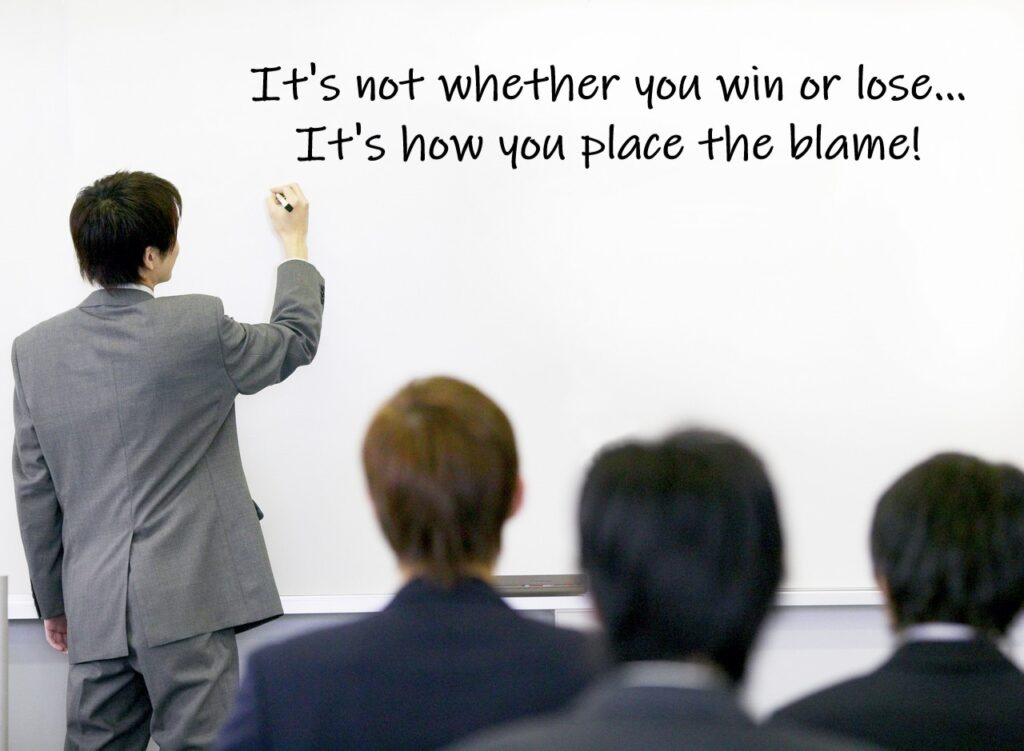
Solve the customer’s problem FIRST…THEN worry about assigning BLAME.

This advice comes from one of my own clients.

Up Close and Personal

A few years ago, I was preparing for a management training seminar for one of my corporate clients.  As part of the preparation, I interviewed my contact there, to get some valuable information about the group of managers attending, the organization, and the issues they wanted me to address.

I asked my contact one of my most important questions:  “Is there any specific issue, problem, or need you want me to be sure to address?”

His answer was IMMEDIATE!  He told me, “Will you PLEASE tell these managers:  When there’s a problem with one of our customers…Solve the customer’s problem FIRST, THEN worry about who to blame for it!”

Sadly…this is the way a lot of employees think!

Why do we blame?

I suspect, for most of us, it’s an instinctive self-protective response in the heat of the moment.  It probably starts in childhood, when we learn to point the finger at another sibling, playmate, or even a household pet!  (“The dog ate my homework.”)

When it becomes a consistent pattern…it probably flows from a poor self-image and accompanying emotional insecurities.  No matter what causes this kind of low self-esteem, it’s definitely best addressed by professional counseling or psychotherapy. 

If it continues…it becomes an insidious form of victimhood.

Who, ME??? Dunno whatcher talkin’ ’bout!

The problem with victimhood is that it prevents any growth or change—it’s the perfect barrier to any kind of personal development.  Civil rights activist Bob Woodson put it this way:

Nothing is more lethal than giving people a good excuse to fail.

One of the most important things I offer my executive coaching clients is the gift of empowerment.  The primary goal in our sessions together is to identify actions that the coaching client can take to address the challenges they face.  My purpose is to put my client in the “driver’s seat”—to give them the sense that they are “in charge” and not “at the mercy” of other people; situations; or circumstances.  Empowerment is the ultimate antidote to victimhood. 

Of course, I also help my client understand the realistic limits of their control!  Without a healthy sense of boundaries, any of us can easily fall prey to our own arrogance and forget that we are not the only stars in the heavens.  We can’t do everything ourselves.  We need to learn to collaborate.  Which brings us to the next point…

Who do we blame?

For many employees, finger-pointing is a well-developed art!

1. The other guy.  The nearest target is often someone on our own team—a colleague we can conveniently scapegoat (“It was Bob’s job to get the numbers right and he blew it!”).  It’s even worse when we blame our own direct reports (“I’ve got idiots working for me”).  When other people hear an excuse like that, their first thought about this boss is, “Maybe YOU are a bigger idiot for not helping them succeed, or for hiring the wrong people in the first place!”  Right…who’s the REAL idiot here???

2. The other department.  I run into this one a lot.  Other departments are easy targets, because we’re not going to make any one particular person look bad (and get mad at us).  When we throw the whole “faceless, anonymous” bunch to the lions, it feels a lot safer—less likely to come back and hurt US in the process.

No matter how you position it, it’s a bad idea.  Here’s the reality:  WE NEED THE SUPPORT OF OTHER DEPARTMENTS IN ORDER TO DO OUR WORK EFFECTIVELY.  Poet John Donne told us, “No man is an island.”  In the reality of organizational life, we could apply this truth and say, “No department is an island.”  In a functioning organization, the work of every department is connected to the work of every other department.  The success of the organization requires the successful performance of every department working well, and working well together.  This requires enormous cooperation and collaboration between the departments!  This is why I tell my management students:

Never throw anyone under the bus!

When we start tagging other people and other departments with failure, we end up shooting ourselves in the foot by creating enemies of the very people we need as allies.  And the last thing any manager should do is create enemies in the organization.  If you haven’t figured this out for yourself, I’ll spell it out for you:

Friends come and go…but enemies accumulate!

This is why I teach my executive coaching clients how to make friends in the organization—how to build bridges; nurture positive networks; and grow support with colleagues and direct reports.  BTW… if you would like some straightforward tactics to help you do this, download a copy of my article, “The Top 10 Habits of Highly Likeable People.”  It’s FREE and you can access it here.

3. The way it is.  I often hear this phrase, “That’s the way it is around here.”  That is a description of the culture of the organization (or the department; or the team).  Corporate culture can be very subtle, but deceptively strong.  “It’s in the walls” is the way one executive described his own organization’s strong identity and policies. 

Up Close and Personal

A pilot I know who was flying for Southwest Airlines was chatting up a pilot from one of the “legacy” airlines—between flights at one of the restaurants in the Terminal.  The legacy pilot said, “I hear Southwest is soon going to be flying into one of our major hubs.”  The Southwest pilot affirmed the news.  The legacy pilot shook his head “You guys are going to clobber us on those routes.”  “Why do you say that?” enquired the curious Southwest pilot.  The legacy pilot replied (with a discernable tone of cynicism), “Because we treat our customers like crap!”

That is the ultimate expression of bad culture!

Sometimes the culprit is bad procedures—a problem with dysfunctional systems in the organization.  That’s a tough nut to crack, because it’s so easy for people to throw up their hands and say, “There’s nothing I can do about it!”  What they really mean is that there’s nothing they can do by themselves to solve the problem.  It will require a whole team of people to address it—the people who each have a role to play in making the system work (or in this case, NOT work!).

10 2-Letter Words

One of the biggest barriers to solving any systemic problem is this lack of ownership.  In his wonderfully insightful book, Upstream, author Dan Heath shows us that a lack of ownership is one of the primary barriers to problem-solving in organizations, culture, and politics!  It’s when the people involved adopt the mindset, this is not my problem to solve.  Heath maintains that real change doesn’t happen until the people involved “overcome indifference and complacency and see what’s possible” and say to themselves, “I choose to fix this problem, not because it’s demanded of me, but because I can, and because it’s worth fixing.” 

Here’s another way to say it, in ten two-letter words:

IF IT IS TO BE IT IS UP TO ME

Shifting blame lets us off the hook, and saves us the added trouble, effort, and time it takes to solve problems and make things better.  DON’T LET YOUR TEAM OFF THE HOOK when it comes to solving problems—especially the ones that affect your customers!  When one of your customers has a problem—take the immediate first step to address that problem with appropriate apologies, remediation, and relief.  You might also consider material ways to say “thank you for your patience and understanding”—like when the restaurant manager offers you a complimentary dessert when the cook burns your steak!

Here’s the point:  When it comes to the customer, it’s more important to take responsibility to solve their problem than it is to figure out who to blame!

If you are looking for more ways to engage your team in higher performance and better problem-solving, give us a call.  We specialize in helping teams to become more collaborative, more creative, and more effective.

Until next time… Yours for better leaders and better organizations,

Dr. Jim Dyke – “The Boss Doctor” ™ helping you to BE a better boss and to HAVE a better boss!

Posted in Collaboration, Customer Service, Leadership, Management, Organizations, Problem-Solving, Team Culture, Team Dynamics, Team Leadership, Teams, Uncategorized | Tagged , , , , , | Leave a comment

Great Ideas from Top CEO’s – #14

Bring on the Joy!

It’s been widely promoted that happy workers are more productive, so it behooves managers and supervisors to create a team culture that supports a happy and joyful workforce.  So…How do you do that?  Here are some simple and practical things that you can do RIGHT NOW to create a more positive and engaging workplace.

Bring on the JOY!!! It’s up to YOU, team leader!

1.  Start by helping every team member grasp the importance of their work—how it impacts the success of the organization and serves clients and customers well.  People need to know that their work matters… that it has value and significance.  That’s at the heart of real job satisfaction. 

2.  Be consistently available to your team.  Give each person on your team what they need to succeed and make progress in their work!  Read the blogpost on 2/21/21 to see how this has a positive effect on employee mood and motivation.

3.  As much as possible, assign work to each team member that fits their gifts, strengths, talents—they will be as much as 200% more productive, and a whole lot happier!  You can read more about this in the blogpost on 1/17/21.

Show a little basic appreciation to team members! A little goes a looooong way!

4.  Be lavish with praise, affirmation, and appreciation.  People LOVE working in a place where the Boss notices their good work and says so!  Don’t underestimate the power of praise—studies show that when the Boss praises a worker ONE MORE TIME PER DAY than they normally do, that employee’s productivity can increase by as much as 31%.  Praise is your way of sending the important message to your people that you NOTICE and you CARE—you NOTICE that they are doing their job well; and you CARE about good performance.

5.  Get to know your people as individuals.  Take time for simple conversations that allow you to learn about their family, their hobbies, and their special interests.  Those simple details will give you important opportunities to join them in the little celebrations of life they savor, and also allow you to offer appropriate expressions of support during the tough challenges they face along the way.  This is how you build an emotional connection with your team, and make the workplace more personal. 

Up Close and Personal

One of my favorite leaders, David Payne, used MBWA to interact with his factory employees and learn what was happening with them personally.  He did twice-daily factory walkthroughs—connecting with workers via simple smiles, handshakes, and informal conversations.  He would often discover important milestones in his people’s lives (e.g. a new baby; a community action award; educational achievements).  It gave him the opportunity to affirm and encourage his people—which sent the message to them: You are unique!  You are a special part of this team!  You are important! You matter to me!  I CARE!

Those monthly birthday celebrations are good for your team!
— Image by © Royalty-Free/Corbis

6.  Set aside time for your team to socialize.  Don’t let financial downturns dampen your resolve—it doesn’t have to cost a lot of money!  Set aside an afternoon break each month and celebrate that month’s team member birthdays.  Make sure there’s plenty of cake and ice cream.  Another suggestion:  Schedule a regular brown bag lunch with time for interaction and conversation.  (My suggestion: let people bring their own lunch but you provide the dessert!)  One interesting fact:  Studies show that having a best friend at work is the strongest predictor for being a happy and productive employee.

7.  Be authentic in your leadership.  TIME magazine (1/17/05) put it this way—“What works for celebrity CEO’s doesn’t always work for everybody else.  An honest, low-key chat can be just as effective as a high-voltage pep rally.”  In other words, don’t try to be Tony Robbins if it’s not your style.  Keep in mind—the most important qualities of authentic leaders are openness and honesty.  Just keep it real, and you’ll be fine! 

Keep those communication lines WIDE OPEN!!!

8.  Keep your people in the loop.  Tell them what’s going on!  Share information with them—about their work, about what’s happening, and about the organization as a whole.  The routine information you just received in a boring department meeting may be the very thing they want to know, in order to feel like “insiders.”

More than one organization has adopted the philosophy that if you take good care of your employees, they will take good care of your customers.  The reality may be even more profound—since work consumes so much of our lives, leaders have an obligation as stewards to imbue the work of their people with meaning, value, and… yes, JOY.

If you are looking for help to transform your team or your organization into a place where employees are engaged and motivated, then give us a call… we can help!  We provide high-quality training and coaching that can energize your people and fit your budget.

And if you are looking for some more great ideas to “bring on the joy” then pull up this additional list of 12 WAYS TO BOOST MORALE.  You can view or download it here

In the meantime, stay tuned to this blog for continued help, direction, ideas, and practical tools.

Until next time… Yours for better leaders and better organizations,

Dr. Jim Dyke – “The Boss Doctor” ™ helping you to BE a better boss and to HAVE a better boss!

Posted in Celebration, Collaboration, Communication, Employee Motivation, Leadership, Management, Morale, Productivity, Recognition, Team Culture, Team Dynamics, Team Leadership, Teams | Tagged , , , , , , | Leave a comment

Great Advice from Top CEO’s – #13

Make Your People HAPPY

How happy and energized is YOUR TEAM???

In a recent survey in the workplace, researchers invited more than 600 managers from dozens of companies to rank the impact on employee motivation and emotions of five workplace factors commonly considered significant:

  1. Recognition for good work (given publicly or privately)
  2. Incentives beyond regular pay (“bonuses”) 
  3. Interpersonal support
  4. Support for making progress in their work
  5. Clear goals

“Recognition for good work” was ranked as number one. 

Unfortunately, those managers are COMPLETELY WRONG.

In Harvard Business Review, Theresa Amabile and Stephen Kramer revealed the results of a multiyear study done in the workplace, tracking the day-to-day activities, emotions, and motivation levels of hundreds of knowledge workers in a wide variety of settings.  The findings run counter to the assumptions of managers and leaders everywhere.  The study shows that the top motivator of performance for employees is… PROGRESS.

Yes, PROGRESS!  They tell us, “On days when workers have the sense they’re making headway in their jobs, or when they receive support that helps them overcome obstacles, their emotions are most positive and their drive to succeed is at its peak. On days when they feel they are spinning their wheels or encountering roadblocks to meaningful accomplishment, their moods and motivation are lowest.”

Your #1 Job–Help your team be productive and make progress in their work!

Remember what I shared in my last post about this connection—keen insight from management guru Ken Blanchard, who tells us, “People who feel good about themselves tend to do great work as a result.”  But he also reminds us of the reciprocal connection:  “People who do great work tend to feel good about themselves as a result.” 

So… what’s an effective leader to do with this information?  Amabile and Kramer draw some straightforward conclusions:

1.   GOOD NEWS: The key to motivation turns out to be largely within your control.  And…

2.   It doesn’t depend on elaborate incentive systems.  So…

3.   Provide your people with meaningful goals, resources, and encouragement.  And…

4.   Protect them from irrelevant demands and intrusions from other bosses and colleagues. And for YOU…

5.   Scrupulously avoid impeding progress by changing goals autocratically, being indecisive, or holding up resources.  And this additional key insight from neuroscience:

6.   Create a visual way for your people to measure their progress on team goals.

A simple technique you can use with your team…

One of the interesting motivational “hacks” that has recently surfaced in studies is the emotional lift we get when we can actually see the progress we’ve made in any enterprise we pursue.  The ability to have a visual reference to mark our progress is a surprisingly inspiring trigger for positive, optimistic emotions.

Remember those Thermometer charts we’ve all seen for fund-raising efforts?  It turns out that there is some solid neuroscience behind them.

Create a visual way to measure team progress!

And don’t forget this: be ready to RECOGNIZE and CELEBRATE your team’s progress, to add even more inspiration to their positive feelings of accomplishment!

Up Close and Personal

One of my coaching clients was disappointed when her team successfully completed a year-long effort that was assigned them by higher-ups, and the only response they got from her boss was a brief “thank-you” in the form of a short e-mail. 

I encouraged her, “As your team’s leader, you have the freedom and responsibility to do better than this.”   She did some creative thinking and took the initiative to organize an ice cream sundae “celebration” in the office workroom for her team.  It was hardly an elaborate affair, but she brought in the gourmet ice cream and all the fixings (at her expense) and invited her boss to join the party.  He came; pressed a few palms; gave the team a nice verbal “congratulations”; and stayed to enjoy the ice cream (and much-appreciated non-work-related informal conversations with her team members).  It was a nice personal touch her people really appreciated.

Don’t forget to CELEBRATE–your SUCCESS and your TEAM!!!

This is all about leadership function #4 – enabling others to act!  Yes, Kouzes and Posner (authors of The Leadership Challenge) got it right: Great leaders make sure their people have what they need in order to do their jobs.  Here’s another way to put it: Your #1 job as a manager is to help your people succeed!

If you need help giving your people the leadership they need to become focused, productive, and MOTIVATED workers, we can help!  Our resources, training workshops, and coaching services can help you and your organization’s leaders become more effective in their management and supervisory roles.  Give us a call!

Until next time… Yours for better leaders and better organizations,

Dr. Jim Dyke – “The Boss Doctor” ™ helping you to BE a better boss and to HAVE a better boss!

Posted in Celebration, Collaboration, Communication, Creativity, Employee Development, Employee Engagement, Employee Motivation, Events, Influence, Leadership, Management, Performance Management, Productivity, Recognition, Team Culture, Team Dynamics, Team Leadership, Teams, Uncategorized, Work | Tagged , , , , , , , , , , , , | 1 Comment

Great Advice from Top CEO’s – #12

Make Your People Feel Important

Everyone wears an invisible sign around their neck that says, MAKE ME FEEL IMPORTANT. 

Hey Boss! MAKE ME FEEL IMPORTANT!

This insight comes from Mary Kay Ash, the founder of Mary Kay Cosmetics and one of the most successful business leaders in American history.  What does this have to do with you, your team, their work, and your leadership?  And how do you use this information to improve your leadership and turbo-charge your team’s performance?

Feed your people’s need for significance! 

How are YOUR people feeling–do you know???
Image by © Royalty-Free/Corbis

Do the simple things that send a clear message to your people: YOU ARE IMPORTANT…

1.   Help your team members understand how important their work is to the success of the organization.

2.   Help each team member understand how important their work is to the success of the team.

3.   Appropriately involve people in the key leadership functions of PLANNING, EVALUATION, PROBLEM-SOLVING, and DECISION-MAKING.

4.   Ask people for their input.  Use the magic management phrase:  “What do YOU think?”

5.   Help your people succeed…and produce!   Your team is counting on you to help them to do their best work and make their best contribution.

6.   And when they do succeed…recognize their effectiveness and affirm their good work.  Even simple forms of recognition add fuel to the flames of employee self-esteem.

7.   Let people know that you care about them…as people: Acknowledge their birthdays, life milestones, and personal accomplishments.

Helping your people understand, experience, and really feel their importance can be as easy as treating them with respect and including them appropriately in the work that you all do together as a team.  Read Issue #11 of The Personal Trainer—it’s filled with specific ways to build respect with your team.  You can access it here.  And check out my book, Leading Teams—How to Inspire, Motivate, Lead and Succeed for chapter-after-chapter of additional practical tips.  You can get a description of the book here, and order it on Amazon here.

PLUS…There’s another important connection to your people’s sense of importance.

Ken Blanchard points out the connection between productivity and a strong sense of personal worth or significance.  He says, “People who feel good about themselves tend to do great work as a result.”  But he is also quick to point out, “People who do great work tend to feel good about themselves as a result.” 

I’ll share more about this important connection in my next blogpost.  DON’T MISS IT.

And…If you are looking for more ways to improve your leadership, we can help!  We can show you how real leaders are turning their people into motivated, engaged, high-productive teams with a few simple techniques that you can use as well.  And stay tuned to this blog—every post will feature great ideas and practical tools that will enable you to get better as leader!

Until next time… Yours for better leaders and better organizations,

Dr. Jim Dyke – “The Boss Doctor” ™ helping you to BE a better boss and to HAVE a better boss!

Posted in Authority, Coaching, Collaboration, Communication, Decision-making, Employee Development, Employee Engagement, Employee Motivation, Leadership, Management, Performance Management, Problem-Solving, Team Culture, Team Dynamics, Team Leadership, Teams, Uncategorized, Work | Tagged , , , , , , , , | Leave a comment

Great Advice from Top CEO’s – #11

Learn to Think INSIDE the Box

REAL CREATIVITY = The ability to address LIMITATIONS creatively!

This great advice comes from Chip and Dan Heath, authors of the best-selling book, Made to Stick: Why Some Ideas Survive and Others Die.  Their take on creativity is attention-getting because it goes against the grain of one of the business world’s most popular clichés: Think OUTSIDE the box. 

In their column in the December 2007 issue of FastCompany magazine, the Heath brothers make a strong case that innovation is easier when there is a sharp focus for the creativity process—like limits, boundaries, or specific parameters—a clear “box” in other words.  Bob Rosenfeld and other researchers of innovation would agree.  They have identified key innovation “styles” in the workplace that function inside of well-defined “boxes.”

One such innovation style is goal-based.  It is accessed when there is a clearly-defined goal at the focus of a team’s creative thinking.  The ideas generated all have to do with “how do we make this happen?”  The result will be innovative strategies or tactics.

easier/better/faster/smarter/cheaper/safer

Another innovation style is process-based.  It is the kind of creativity that Toyota Manufacturing is constantly applying.  They call it KAIZEN or continuous improvement.  This is when teams focus on a very well-defined “box” in the form of a specific production process—and think creatively about how to improve it and make it easier/better/faster/smarter/cheaper/safer.

Get your team thinking…to get that next GREAT idea!

The take-away for leaders is to learn how valuable “in-the-box” thinking can be for their teams and their organizations.  Don’t be afraid to turn your people loose on a tough issue; problem; challenge; OR LIMITATION of some kind.  Encourage your people to share their ideas with you.  Affirm them when they do.   And use careful experimentation to limit the risk of failure when you apply new approaches.

There are plenty of such opportunities in the workplace—challenges that every leader faces: 

  • How do we do what we do more efficiently? 
  • Where can we save some money or use what we have more effectively? 
  • How can we serve our customers better? 
  • Where are we wasting time… or money… or personnel… or precious man-hours?

If you would like your team to learn how to become more creative, let us know!  We can show them how with some fun and engaging workshops designed to unlock their creative thinking, and help them think inside their boxes!   

And if YOU would like to be more creative—stay tuned to this blog!  We promise to keep providing you with ideas and tools that will fuel your continued effectiveness and impact.

Until next time… Yours for better leaders and better organizations,

Dr. Jim Dyke – “The Boss Doctor” ™ helping you to BE a better boss and to HAVE a better boss!

Posted in Collaboration, Creativity, Decision-making, Innovation, Leadership, Learning, Management, Problem-Solving, Team Culture, Team Dynamics, Teams, Uncategorized | Tagged , , , , , , , , | Leave a comment

Great Advice from Top CEO’s – #10 Part 4

Don’t ignore your weaknesses!

This short series of posts has been about the concept of building your work around your strengths… the things that you really enjoy doing.  In the last issue I quoted the executive who said, “I want my staff to work in the areas of their strengths until their weaknesses become irrelevant.”  This sounds good in theory, but my experiences as an executive coach affirm the reality that many weaknesses NEVER become irrelevant – they can turn a promotable leader into the “walking dead”!

Don’t let your weaknesses turn you into an unpromotable work-zombie

Don’t let your personal weaknesses turn you into this guy at work!

Here are 5 categories of weakness you MUST address, if you want to continue to be effective and move up the ladder:

1.  Professional skills you need for your role.  These may not be your “thing” but they are basic to just about any level of professional success: how to manage a project; lead an effective meeting; negotiate a contract; coach an ineffective staff member; read a spreadsheet; construct a realistic budget.  (NOTE: this list is not comprehensive!)

2.  So-called secondary or soft-skills.  These are not in the category of technical skills, but often they will make or break your success in your particular role in the organization:  interpersonal communication; social skills; the ability to interact and collaborate well with others; public speaking and presenting; conflict resolution; organizational “politicking.”

3.  Personality style.  This is the way we are hard-wired in our personality and our preferred behavior.  You won’t be able to fundamentally change this, but you will be well-served if you are flexible enough (and have sufficient self-awareness) to make small adjustments in your behavior that will enable you to be more effective in relating to others in the workplace.

For instance…

Introverted, quiet, task-focused personalities become more influential when they smile more; greet people in the hallways; use lunches in the break room as an opportunity to strike up a conversation with a colleague and get to know them better. 

Extroverted talkers become more effective when they start to talk less and listen more; ask people for their opinions and ideas; tune into people and really give them their focused attention; acquire better time-management and organizational skills. 

Personality style is a major area of development for many of my coaching clients, and these are only brief examples of what I recommend. 

Get rid of your personal stumbling blocks!

Stop tripping over your own personal and professional weaknesses!!

4.  Emotional Intelligence.  This area is getting more and more attention these days.  Many experts are saying that high levels of EQ are essential to leadership success:  high self-awareness; the ability to see how your behavior affects other people you work with or supervise; tuning in to the emotional states and moods of others; the ability to control your own strong emotions and negative moods effectively; and your ability to self-motivate.

5.  Emotional deficits.  I’m talking about emotional baggage here – the emotional issues we internalize from childhood on: personal insecurity; self-esteem issues; fear of failure, abandonment, or rejection.  These inner demons can drive dysfunctional behavior and create addiction; control issues; defensiveness; jealousy; the unhealthy drive to acquire, achieve, attain status, or exercise power over others.  It’s not a pretty picture!  This is where executive coaching stops and psychotherapy begins.  If you are struggling with these, it’s time to get some professional help from a counselor or therapist.

The challenge with these weaknesses is that they often exist because the owner is blind to them.  How do you know if YOU are struggling, but lack awareness?  This is where a trusted colleague or mentor may be helpful – someone who can give you an honest and objective perspective. It’s also where the support of an executive coach can open up all new possibilities for your success!

If you have been passed over for a promotion; or recently received an unflattering performance review; or maybe had to field some complaints about you from HR…you may be struggling with a weakness that you need to address.  We’re here for you!  Our executive coaching services can help you break through and move up the ladder.  Contact us today and we will show you how executive coaching works and how it can work for YOU!

In the meantime…stay tuned to this blog for more great insight and tools!

Until next time… Yours for better leaders and better organizations,

Dr. Jim Dyke – “The Boss Doctor” ™ helping you to BE a better boss and to HAVE a better boss!

Posted in Career, Coaching, Collaboration, Emotional Intelligence, Employee Development, Learning, Performance Management, Personal Growth, Personal Success, Professional Development, Self-Awareness, Uncategorized, Work | Tagged , , , , , , , , , , | Leave a comment

Great Advice from Top CEO’s – #10 Part 3

DON’T Do What You DON’T Love!

In his thoughtful and insightful book, The One Thing You Need to Know…, author and consultant Marcus Buckingham discusses the importance of identifying your strengths, gifts, talents (I use these terms synonymously).  He admits, “…there’s no question that identifying your strengths and orienting your career around them is sound advice.” 

Find your personal and professional sweet-spot.

Focus your efforts at work doing what you enjoy and what you’re good at–your SWEET SPOT.

He mentions useful tools like the StrengthsFinder profile, the Myers-Briggs Type Indicator, and the Kolbe profile.  He also suggests, “first-hand reflection on past successes can serve as an excellent starting point.  The more you investigate your past successes, the more you’ll recognize that certain recurring patterns of behavior or perception always seem to crop up.” 

One of the important connections here is the research-revealed principle that when we are doing work that utilizes a talent, we enjoy it!  In other words, centering our work on our strengths supports the adage, “do what you love.”

Ultimately, however, Buckingham presents his own formula for sustained individual success: 

Discover what you don’t like doing and stop doing it. 

You know what we’re talking about!

He cautions, “as you grow, as you experience success, you must keep your senses alert to those aspects of your role that bore you, or frustrate you, or drain you.  Whenever you become aware of some aspect you dislike, do not try to work through it.  Do not chalk it up to the realities of life.  Do not put up with it.  Instead, cut it out of your life as fast as you can.  Eradicate it.”

So what do you do when you are faced with parts of your job that are not aligned with your talents?  Buckingham offers four tactics: 

1. Quit the role.  Find another job in the organization (or in another organization) that fits you better. 

2. Tweak the role.  Change the job description to better fit you and your strengths.  (We all tend to do this with our jobs over time… but most of us do it intuitively rather than mindfully, intentionally, or strategically.)

3. Seek out the right partners.  Find colleagues or subordinates you can team up with, who can do the things you dislike so you are free to focus your efforts where you really excel.  Effective bosses have been using this principle long before “workplace talents” were identified and described.  I call it “staffing by complementation” or “staffing to your weaknesses” by hiring team members who excel in your areas of weakness.  As an entrepreneur, I do this mostly by outsourcing (e.g. IT, accounting, web design, taxes!).

4. Find an aspect of the role that brings you strength.  Perform a little mental trick and find a way to do what you dislike in the interest of a greater, larger good.  If you don’t like leading meetings, tell yourself that the meeting you are forced to lead is a door into other opportunities that you value and enjoy (e.g. thinking and working creatively).

Do your weaknesses matter???

I worked for one executive who used to say, “I want my staff to work in the areas of their strengths until their weaknesses become irrelevant.”  But… is that really possible?  As an experienced executive coach, I can tell you from first-hand experience: many weaknesses will NEVER become irrelevant – they can stop your career like a brick wall!  In the next post, I will help you understand which weaknesses you can overlook, and which you MUST address.  Stay tuned!

Until next time… Yours for better leaders and better organizations,

Dr. Jim Dyke – “The Boss Doctor” ™ helping you to BE a better boss and to HAVE a better boss!

Posted in Career, Collaboration, Creativity, Emotional Intelligence, Employee Engagement, Employee Motivation, Hiring, Personal Growth, Professional Development, Self-Awareness, Team Dynamics, Uncategorized, Work | Tagged , , , , , , , , | Leave a comment

Great Advice from Top CEO’s – #10 Part 2

Do What You Love – Have Fun!

In this post I would like to continue the conversation with more good advice for long-term job satisfaction.  I shared this recommendation in my last post:  “Love what you do!”  You may have run across the same career success principle in this phrase: “Follow your bliss.”

Make sure you’re having fun doing your job!

Are you still having fun?

I heard yet another version from a very savvy CEO I worked for, who asked me an important question about a year into my new job with the organization.  He knew how hard I was working… how many hours I was putting into my job.  He also knew how much I was accomplishing, and how enthusiastic I was about my work.  He wanted to make sure I wasn’t headed toward burnout, and so he got right to the point and asked me directly, “Are you having fun?”  I think I was grinning when I confessed, “Oh yeah!”  He added, “Good… because when you stop having fun… it’s time to get out!”

I never forgot that advice.  It still applies today (maybe it applies even more today!)  Author Jeffrey J. Fox agrees.  In his insightful book, How to Become CEO, he writes, “Business is tough enough not to have fun.  If your job isn’t fun, you have to change jobs or find ways to add some fun.” 

In Smash the Pyramid, the 35-year-old Senior Vice President of a Global Mining and Minerals Company gives similar advice.  He counsels up-and-coming executives, “The more in love you are with your job the more successful you’ll be.  If you don’t love it, don’t be afraid to leave it and find one you will love.”  And this added caution… “Don’t let anybody else tell you what you will love to do.”

Sometimes…the love just isn’t there!

When you stop having fun…it’s time to GET OUT!

Sometimes… the love just isn’t there at all, and you simply have to leave.  A lot of things can take the fun and love out of your work:

1.  A bad boss.  Over 70% of people who resign a position, cite this as the cause.  Bad bosses come in all different shapes and sizes, but if you are in particular danger of becoming entangled in your boss’s unethical or illegal practices, it’s definitely time to go!

2.  A bad organization.  Companies can suffer from a variety of maladies: incompetent or unethical leadership; a toxic culture with destructive values and practices; a staff infected with infighting and back-stabbing.  In those cases, it’s impossible for one person to affect a cure.  Pack your bags and move on!  Otherwise it will be an exercise in futility.

3.  A bad job.  This can sometimes be a simple case of a bad “fit” – between a worker’s strengths, personality style, or interests and the demands of their job.  Sometimes it’s a matter of overwhelming workload and sheer overwork—the primary cause of burnout.  If you are in a situation like this, take a break and ask yourself if you face a realistic possibility of making measurable progress in your work and having a noticeable impact through your job.  If the honest answer is “no,” then it’s time to get out.  You are going to crash and burn if you don’t, and the toll will be physical as well as emotional. 

Are YOU still having fun?

If your work has lost its luster and you feel like your job is no longer the fun it used to be…call us—our executive coaching can help you get refocused; acquire new ways of approaching your work and workload; and help you discover a more strategic approach to what you do and how you do it.

In the meantime, stay tuned for future posts, filled with down-to-earth practical advice, tips, tools, and resources. 

Until next time… Yours for better leaders and better organizations,

Dr. Jim Dyke – “The Boss Doctor” ™ helping you to BE a better boss and to HAVE a better boss!

Posted in Career, Creativity, Employee Engagement, Employee Motivation, Personal Growth, Professional Development, Self-Awareness, Uncategorized, Work | Tagged , , , , , , | Leave a comment

Great Advice From Top CEO’s – #10

Love what you do.

This straightforward wisdom comes from many different sources.  Most recently, I gleaned a version of it from Robin Sharma in his video blog, “8 Things That Billionaires Do.” 

Love what you do at work! — Image by © Royalty-Free/Corbis

Find out what you like doing, and find someone who will pay you to do it.

Sharma shared his belief that real success for YOU comes from the intersection of your talents (what you are good at); your source of joy (what you really enjoy); and the world’s demands (what people are willing to pay for).  His premise: put those three things together and you’re headed for success.  He’s not alone in that philosophy – Marcus Buckingham shares similar advice in his book, The One Thing You Need to Know.

But is it really that simple? 

In an article in the April 2009 issue of FastCompany magazine, Po Bronson reiterated ideas from his book, What Should I Do With My Life?  He definitely recommends that people follow their bliss and do something they really enjoy.  But he also provides some important caveats to give us an instructive reality check:

#1. Be willing to make the most of a bad situation.  Most of us do not willingly seek out change and transformation – we grudgingly accept it only when it is forced on us.  No job is perfect (see the next point).  The key is to approach job challenges with a focus on learning—to embrace the situation by seeing it as an opportunity to acquire valuable experience, skill, and perspective.

Work isn’t always fun.
— Image by © Royalty-Free/Corbis

#2. Every job has sucky parts.  I remember one wise supervisor I worked with who reminded his teenage son, “Sometimes a job is not the perfect thing that fits your passion and purpose—it’s just a way to pay your bills and get you to the next step.  And that’s okay!” 

Po Bronson put it perspective for us. He said: “There’s this notion that you should love the mere act of what you do so much that just by virtue of it being Monday morning and you’re at work, neurotransmitters of joy will drip on your brain all day. That is not how real people do it. All jobs have things you hate about them. But real people feel fulfilled enough by the overall purpose that the crummy parts are worth it.”

This is the truth: Most people succeed because the joy they experience doing the parts of their job that they like makes up for the angst they experience doing the parts of their job that they hate.  Based on my experience, you’ve got to be able to like at least 60 to 70 percent of your job or you’ll burn out.

#3. You still need a sense of purpose for doing what you love – you need a vision for how your work will make the world a better place.  No vision / no purpose; no purpose / no passion.  A clear life purpose is like a vocational “umbrella” that can encompass many different ways (i.e. “jobs”) to express it.  For example, the life purpose “to help people achieve greater effectiveness and impact” can be pursued through a vast number of specific jobs, roles, titles, appointments or even assignments.   

Be ready to add real work to your passion!

#4. It’s still going to take some hard work.  Just loving what you do doesn’t let you off the hook!  Every business owner I knew (before I started my own business) told me the same thing: “You will never work as hard as you will work when you own your own business.”  I quickly experienced the truth of that when I started my own consulting business!  Fortunately, I also discovered that it’s a lot easier to commit to hard work when it involves the things you are most passionate about.  And thankfully, that turns out to be true for all of us!

It applies to your people, too!

So… How do you use this in your leadership role?  The best way you can apply this principle (beyond yourself), is to help your direct reports identify what they’re good at and really enjoy; and assign them as much work as you can that fits that definition.  They will enjoy their jobs more, and be a lot more productive—as much as 200% more productive, according to research! By the way…

There are other ways you can leverage your team’s preferences when you assign work. Check out Issue #9 of The Personal Trainer for some tips that you can use RIGHT NOW. You can access it here.

If you need help identifying your strengths and passions, we can help!  Our assessments will help you zero in on your inherent talents and interests and enable you to find the right focus for your work and your career.  We can help your people, too—we can equip your whole team for greater effectiveness in their work.  Our engaging, informative workshops and one-on-one coaching sessions will equip and energize you and your entire team!

In the meantime…stay tuned to this blog and we promise to give you fresh insight and practical tools every week.

Until next time… Yours for better leaders and better organizations,

Dr. Jim Dyke – “The Boss Doctor” ™ helping you to BE a better boss and to HAVE a better boss!

Posted in Career, Emotional Intelligence, Personal Growth, Professional Development, Self-Awareness, Uncategorized, Vision, Work | Tagged , , , , | Leave a comment