The Success Triangle

There’s a Simple FORMULA for SUCCESS

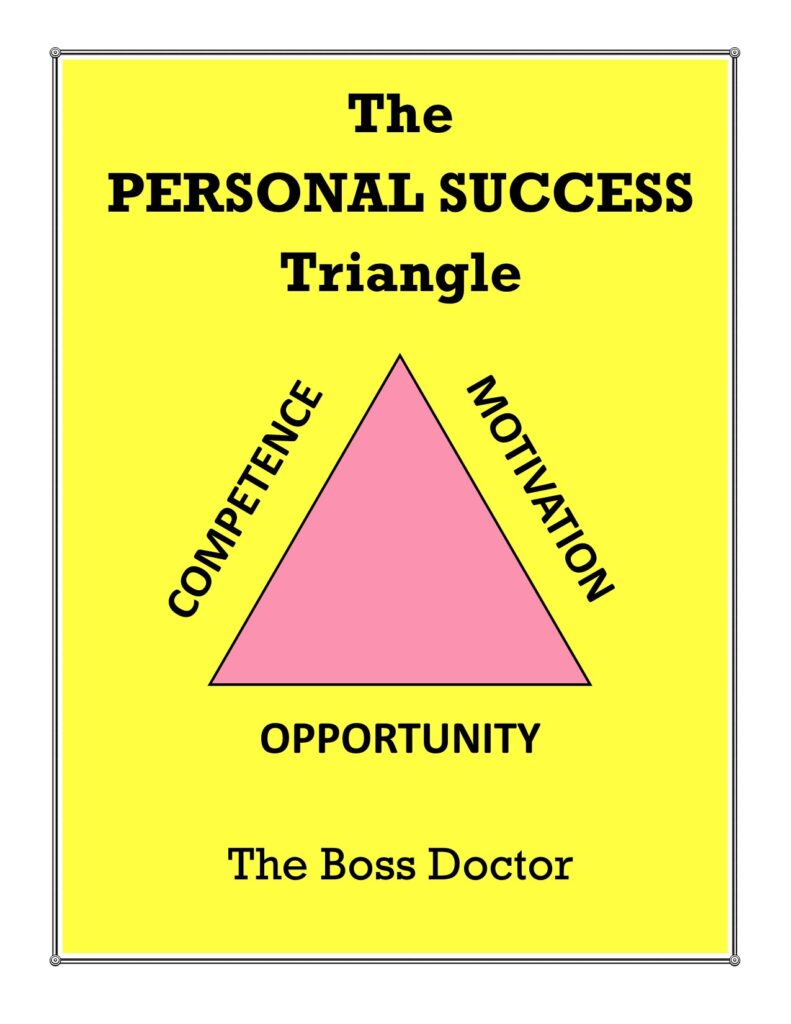
The best insight I ever received about personal success and career advancement came in the form of The Success Triangle—a concise and simple way to understand exactly what it takes to succeed (both in the present AND in the future!).

It owes its origins to the “Fire Triangle,” which was created to help people understand how to prevent (and defeat) any dangerous blaze.  The Fire Triangle consisted of three elements: fuel, heat, and air.  The concept of the Fire Triangle is a simple one: remove any of the three components in the triangle, and a fire is no longer possible or sustainable. 

The Success Triangle is a perfect parallel—remove any of the three components in the triangle, and SUCCESS is no longer possible or sustainable. 

For a quick one-page description, download the FREE copy of Issue #13 of The LeadershipTracks Newsletter.  You can access it here.

This Formula Can Really Help You!

The Success Triangle is a simple paradigm, but it has surprisingly wide application. 

Your pathway to SUCCESS

It offers practical guidance for an ambitious leader who is making momentous career decisions.  And it is of real help in the day-to-day decisions and assignments that a manager must make in the down-and-dirty world of employee performance and development.  You can read all about it in Issue #13 of The Personal Trainer.  You can download this FREE resource here.

Posted in Emotional Intelligence, Employee Development, Employee Engagement, Employee Motivation, Learning, Organizations, Personal Growth, Professional Development, Uncategorized | Tagged , , , , , , , , | Leave a comment

Build Internal Business Alliances

Make Friends with People and Processes

Issue #12 post
Cooperate and Collaborate

I’ll never forget reading a short column in the Harvard Business Review years ago that gave this straightforward advice:

Your number one priority whenever you step into a new leadership role—is to network.  

The author was underscoring the importance for leaders in organizations to connect with one another, especially across organizational or departmental boundaries.  The idea is to avoid the dysfunctional isolation that often occurs as organizations grow and tend towards inevitable siloing. 

We naturally drift apart

It happens organically and often imperceptibly—that departments / divisions become more specialized and more focused in their own unique areas of function.  So it requires leaders to exert an intentionally opposing activity of collaboration in order to counter the inherent inertia of dissociation that develops in organizations over time.

Take the TIME and Make the EFFORT to Connect!

Issue #12 post illustration
You must take the INITIATIVE!!

That requires managers to think organically (and cooperatively) about the functions they oversee—to understand how their area is connected to other areas in the organization.  That pushes leaders to reach out to other leaders; learn about other functions; become aware of the interconnectedness of the work; collaborate with other leaders; cooperate by coordinating their work with the work of others.  It is a highly interactive; highly interpersonal part of the work they do as a leader.

Success is a Community Effort

It means letting go of any egoistic tendencies toward kingdom-building or self-aggrandizement in favor of supporting the overall success of the organization.  That requires a delicate balance between ambition and humility.  No wonder effective managers are at a premium in most organizations!

Issue #12 of The LeadershipTracks newsletter presents this concept of reaching out and building what some call “internal business alliances.”  You can access it here.  And don’t forget to download the companion issue of The Personal Trainer.  It provides a simple form you can use to ask the right questions of colleagues and get the answers you need to collaborate effectively and exert positive influence on fellow managers.  You can access it here

And stay connected with this blog—I promise to keep giving you plenty of fresh insight and practical tools!

Yours for better leaders and better organizations,

Dr. Jim Dyke – The Boss DoctorTM

Posted in Authority, Collaboration, Communication, Conflict, Emotional Intelligence, Influence, Leadership, Management, Organizations, Team Leadership, Teams, Uncategorized | Tagged , , , , , , , | 1 Comment

8 Management Archetypes – The Responder and The Victim

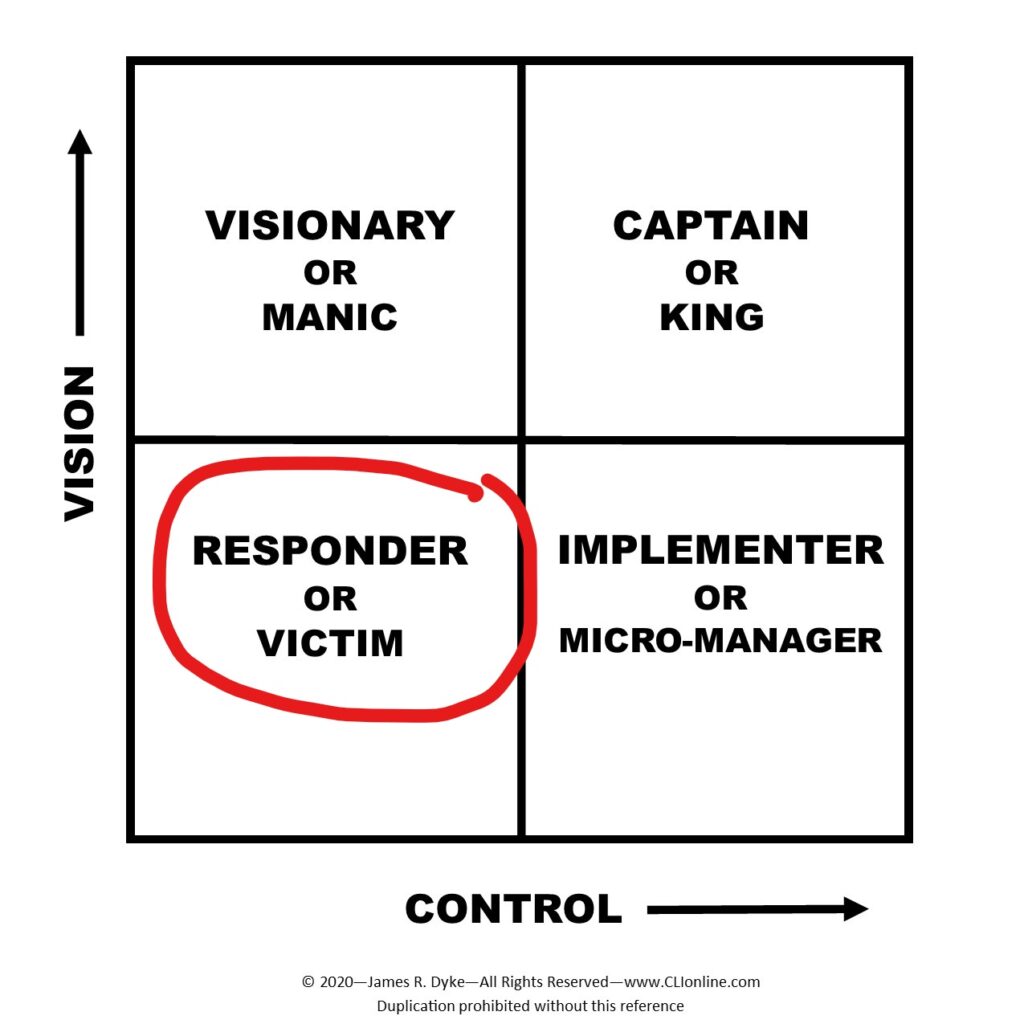
Low Vision and Low Control

The Closed Door Policy

The Responder doesn’t exercise much control in their management or supervision.  They are generally passive players in the organization.  They are very often viewed as an absentee boss—sitting in their office, almost completely disconnected from their team.  Because they offer little direct oversight—like the Visionary or Manic leader—they need a team of skilled and competent employees who can carry on the work without much support or interference from the boss.  They are mostly “maintainers” of the processes and procedures they have inherited with their leadership role.  They are not prone to do much trouble-shooting or updating.  They usually don’t run interference for their team.  (No one would ever view them as championing their people!)  In fact, their employees have to really push them to get any support or advocacy from them.

Apply Slight Pressure HERE

The same is true for anyone in the organization who requires the services of The Responder—they have to exercise initiative to actively and assertively engage The Responder, in order to get the work they need from The Responder or their team.  They have to push, because The Responder is not an initiator.  Part of the passive nature of this type of leader is that they don’t anticipate the needs of the organization; the team; their colleagues; clients; or higher-ups.  They tend to exist in the small universe of their own department—basically self-absorbed unless required to be otherwise by pressure from above.

You Get What You Push For

Their only redeeming quality is that they will RESPOND when goaded or coerced.  They will “come to the party” if higher-ups put the squeeze on them and compel them to cooperate.  But everyone knows they are doing so grudgingly, by virtue of coercion rather than enthusiastic accord.  As a result, they are quickly labelled as “difficult” by everyone who works for them or with them. 

Their future in the organization is secure only as long as their team continues to function effectively, and their department’s processes don’t become dated or obsolete.  As long as they produce the required work, colleagues and higher-ups are often willing to tolerate their flaccid leadership, and simply commit to the extra energy it takes to work with them.

Their promotion is highly unlikely, however.  And they may suffer termination if they are assigned to a new boss who tires of their inertia and lack of initiative.

“It’s Not My Fault!”

The Victim is the dysfunctional “shadow” of The Responder. 

Like The Responder, The Victim is a passive and disconnected leader.  The difference is that The Victim doesn’t have the skilled, effective, self-directing team they need in order to produce the required work.  The problems they avoid addressing have reached the point where the work of the department is suffering as a result, and now it’s come to the attention of the boss and other higher-ups.

Pushing Won’t Help

Goading The Victim to produce doesn’t work because they don’t have the initiating energy to take personal responsibility for their leadership—to address problems; set priorities; make key decisions; or work collaboratively with their team.  Instead, they are quick to blame their lack of initiative (and any lack of effectiveness) on other people and other situations.  When given clear performance directives, they fail; shrug their shoulders; and complain “What can I do?”  Termination for them is imminent. 

I had an executive coaching client like this. 

Don’t Become This Person!

He had been in his position a long time, enjoying the advantages of a long-term tenure, with a department that functioned without much oversight required.  Then the business changed, and his department was required to take on new workload and incorporate a new technology.  He was completely over his head.  The supervisors he appointed to share the management load were also overwhelmed—unqualified; untrained; ill-equipped; and lacking any coaching or direction from their Victim leader.   The Victim’s new boss took time to connect with him as well as his supervisorial team—to get a true sense of what was happening, and to give clear, straightforward performance goals to the leader.  Despite my counsel to The Victim leader to take appropriate action, he failed in all of his performance goals; blamed his new boss for “unrealistic expectations and management interference;” and resigned before he could be terminated.

The Team is the Key to Success

Both The Responder and The Victim would do well to work towards becoming an effective Implementer.  That would require them to start working more closely and directly with their team—to take a more active, collaborative role in their leadership.  It would require them to have regular, effective team meetings; interactive communication with their employees; more direct, cooperative ties with other colleagues and teams; stronger advocacy for their people; and above all, the willingness to assume personal accountability for the success of their team.

As you consider this information:

  • Do the descriptions of these manager/leaders bring to mind anyone you have seen or dealt with in your experience?
  • Are the descriptions uncomfortably applicable to your own management style?
  • Might the suggestions for improvement be helpful to your growth and development?
  • Would it be useful to share the information with leaders you are managing?

If you want to become a more effective leader, or have more effective leaders working for you—contact us!   We can provide leadership development ideas for you and your organization; effective training for your people; and executive coaching for YOU.

Until next time—yours for better leaders and better organizations!

Dr. Jim Dyke – “The Boss Doctor” ™ – Helping you to be a better boss and to have a better boss!

Posted in Authority, Collaboration, Communication, Conflict, Control, Leadership, Management, Organizations, Team Culture, Team Dynamics, Team Leadership, Teams, Uncategorized, Vision | Tagged , , , , , , , , , | Leave a comment

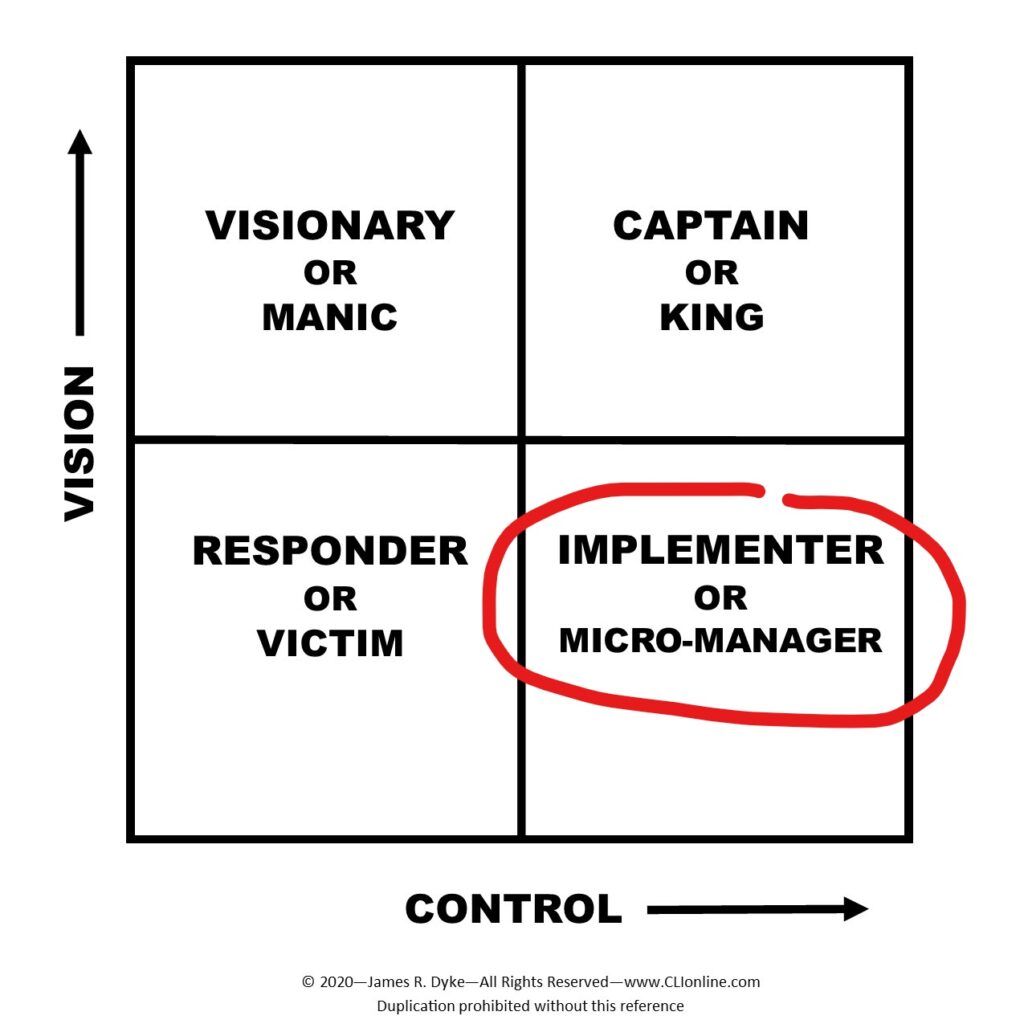
8 Management Archetypes – The Implementer and The Micro-Manager

Low Vision and High Control

Welcome to “hands-on” oversight and management!  The Implementer is an effective manager who keeps the department or organization operating in good order, with clear processes and procedures in place and everything running smoothly.  They are often detail-oriented, with a sharp eye on quality and compliance.  Control is their comfort zone.  They don’t like surprises—they want to live in a very predictable universe.  That’s why they are quick to embrace well-defined procedures that inform and regulate their activities with precise direction.  (You can’t make a mistake if you follow the instructions correctly!)  This is all in keeping with their quest to get the “right” outcomes, which is why they are often seen as perfectionists. 

Working in a Well-Worn Rut

Unfortunately, they can also be seen as rigid and unyielding—stuck in their ways, and unable to flex—unable to move beyond their well-kept procedures, or adjust to new demands.  As a result, faster-paced people in the organization may become frustrated with The Implementer’s methodical but plodding ways, especially when timeliness becomes an issue.

Getting Stuff Done

In a practical way, The Implementer brings real value to a team or organization.  They keep the wheels turning and they get the expected results their predictable routines produce.  What they lack is the vision to capture the bigger issue of “why” – e.g. Why are we doing this?  Why are we doing this this way?  Their lack of vision makes it extremely difficult to address their activities with innovation or improvement.  Their motto is, “If it ain’t broke; don’t fix it!”  Their problem is understanding exactly when and how processes really do get “broke” (i.e. when they need greater efficiency or quality) and how to apply the right “fix.”

Getting OUR Stuff Done!

They also lack the bigger picture of how their work supports the success of the organization overall.  They don’t ask themselves—What greater purpose do we serve?  How do our processes support or coordinate with other teams or departments?  The Implementer tends to operate in their own tiny world—where only their production goals matter, with little or no connection to the rest of the organization.  Colleagues in other areas face a difficult challenge to coordinate or collaborate with The Implementer.

Followers, Not Leaders

Implementers are not initiators, typically.  But if you give them orders and tell them what to do, they are compliant facilitators who will carry out their assignments with determination and thorough attention to detail.  They are subservient but helpful gatekeepers, who operate well when they are in charge of well-defined functions or operations.  Another way of understanding this leader is to see them as very capable in the PRESENT, but not well-equipped for anticipating the FUTURE.  What they need is a team member or boss who can help them think more developmentally. They also need an open mind to accept different views and new ideas without being threatened.

Getting YOUR Stuff Done MY WAY…

The Micro-Manager is the dysfunctional “shadow” version of Low Vision / High Control leadership.  They have all the afore-mentioned attributes of The Implementer: They are detail-oriented; control-based; procedural; methodical; and yes, often rigid; unyielding; slow to change.  The downside of the Micro-Manager is their tendency to exert control in a dysfunctional way—by intruding into the assignments they give their people and second-guessing; over-riding; and over-directing. 

Hard to Serve and Difficult to Please

People who report to The Implementer usually experience the freedom to do their work without intrusion—so long as they follow the procedures correctly.  They also gain the support and affirmation of the boss when they do so.  In contrast, people who report to The Micro-Manager rarely receive positive feedback because the boss is constantly correcting them and redirecting their efforts.  As a result, The Micro-Manager leader is almost impossible to please, unless the worker is willing to abdicate any and all personal initiative.  Employees with skill and experience usually find it too frustrating to work for this type of leader for any length of time.  Higher turnover is often the result.

Hard to Let Go of What You Care About Most

The Micro-Manager can fall into their bad habits for different reasons, but classic micro-management happens when technical experts get promoted into a supervisorial position.  Promotion requires them to take on managerial tasks and let go of technical tasks.  I told the story of the new manager who quickly grasped this important part of his transition in a recent post.  Take a look at the September 20th article on the topic of Google’s Management Pitfalls.  (You will also find some helpful information in my July 23rd post, “Getting Things Done Through Other People” and the resources I reference in that post.)

3 Sources of the Problem—3 Solutions for Success

In order to become the more functional Implementer, the Micro-Manager leader has to address the root cause of their over-bearing ways:

  • If they are intimidated by the challenge of mastering new managerial tasks, they have to muster the courage to let go of their desire to function technically, and take on their new role and responsibilities.  They must commit to the learning process involved and strive to succeed.
  • If they have extreme perfectionistic tendencies, they must adopt a different mindset that allows for a less insecure approach to their performance, and to the performance of their team.
  • If they have trust issues with subordinates, then they must learn how to monitor their team’s performance without being overbearing or intrusive.

As you consider this information:

  • Do the descriptions of these manager/leaders bring to mind anyone you have seen or dealt with in your experience?
  • Are the descriptions uncomfortably applicable to your own management style?
  • Might the suggestions for improvement be helpful to your growth and development?
  • Would it be useful to share the information with leaders you are managing?

If you want to become a more effective leader, or have more effective leaders working for you—we can help!  Our training content and executive coaching can give you what you need to take your management effectiveness to the next level!  Give us a call!

Until next time—yours for better leaders and better organizations!

Dr. Jim Dyke – “The Boss Doctor” ™ – Helping you to be a better boss and to have a better boss!
Posted in Authority, Collaboration, Conflict, Control, Leadership, Management, Organizations, Team Culture, Team Dynamics, Team Leadership, Teams, Uncategorized, Vision | Tagged , , , , , , | Leave a comment

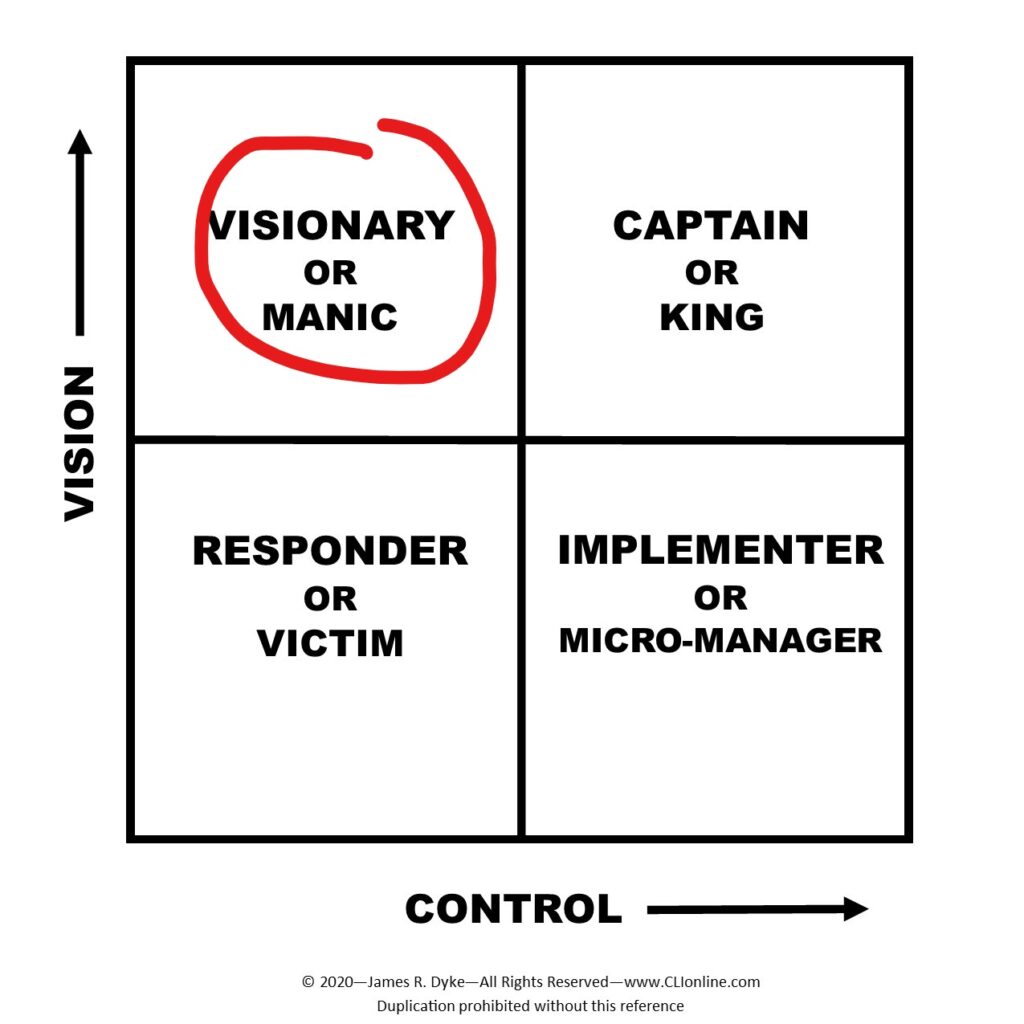
8 Management Archetypes – The Visionary and The Manic

High Vision and Low Control

All About The Vision

The Visionary is just that—a leader with a strong and clear vision.  Unfortunately, they don’t have an equally strong grip on the reins of the organization.  They have a clear goal to pursue.  But they don’t have the ability to oversee the work of the team or organization with an effective sense of strategy; objectives; processes; coordination; collaboration; or even basic operations.  They completely rely on their staff/team to figure out exactly HOW to achieve the vision. 

The Prophet–Up Front; On Stage

The Visionary tends to be a highly charismatic person.  They are usually effective public speakers—highly motivating and persuasive.  They can sway an audience easily.  They are “up front” a lot, using their public appearances to captivate and motivate people (and in the case of non-profits, to raise money!).  They build support through their emotive and emotional appeals.  They attract people to themselves naturally by virtue of their enthusiasm and positivity.  Their supporters are “true believers” who readily overlook their leader’s shortcomings and flaws.  But to truly succeed, The Visionary must surround themselves with highly competent; highly effective; highly ethical; highly trustworthy people who have the ability AND the initiative to develop (and manage) the strategies, structures, and activities needed to achieve the vision.  With the right team in place, The Visionary leader can assume the role of the figurehead of the organization—projecting an image of competence, trustworthiness, and signal purpose.

The Vision Unfulfilled

One cannot ignore a recent example of a Visionary leader who ultimately failed in their grand vision—Elizabeth Holmes, of Theranos infamy.  She became the highly visible “visionary” face of the company.  She became ubiquitous through her “up front” activities—conducting various interviews; appearing on the covers of influential magazines; performing a charismatic TED talk; raising millions of dollars of investment capital—yet having absolutely no idea of how to achieve her technological vision.  We have since learned that she hired an army of technologists and tasked them with the job of figuring out how to accomplish what she blatantly did NOT know how to do.  Sadly, they were unable to succeed in spite of their best efforts.

The Manic–Overcome with Too Much Vision

The dysfunctional leader who exercises strong vision and weak control is the “shadow” archetype known as The Manic.  The Manic leader has many of the same attributes of The Visionary—enthusiasm; positive energy; optimism; charisma; public speaking skill; persuasiveness; the ability to captivate and motivate.  They also have the same deficiencies of control, and so require the same kind of staff to carry out their vision.  Unfortunately, the Manic leader doesn’t just have ONE vision—they have a new vision to share with their staff every Monday morning.  They are highly creative, and are constantly captivated by the next interesting idea or concept.  They are then energized to move their team or organization in this new direction toward the fresh vision. 

Fasten Your Seatbelt…You’re in for a Bumpy Ride!

Working for this person is like being on a rollercoaster—constantly jerked in a new direction; fighting to stay in balance; and continuously searching for some state of equilibrium.  The only relief for the staff is knowing that the current bombast is only temporary and will disappear soon, replaced by the next big “thing.”  It’s not surprising that The Manic leader experiences more than their share of turnover in their executive suites.  Effective subordinates soon tire of the turmoil and depart for better, more stable opportunities.

The Art of Distraction

Some Manic leaders have discovered a role they can successfully fill and pursue.  It’s often in the form of becoming the organization’s figurehead, to focus on other activities they find more attractive and rewarding—writing books; doing interviews; keynote speaking; or serving on other boards and high-visibility planning or policy groups.  The distraction of these things keeps them from constantly inserting themselves into the daily operations of their organization.

3 Ingredients for Success

The key to success for both the Visionary and the Manic is the same three-part equation: establishing a clear overarching vision for the team or the organization; having the right people in place to make sure the organization functions effectively; and exercising benign neglect by staying out of the way and not interfering with their team’s work.

To summarize, both The Visionary and The Manic have the potential to front a vision-driven organization and do it with great style and captivating personality.  But they both need an unusually cohesive support team—one that is as vision-based as they are, and extremely committed, skillful, and loyal.

As you consider this information:

  • Do the descriptions of each archetype bring to mind any managers or leaders you have seen or dealt with in your experience?
  • Are the descriptions uncomfortably applicable to your own management style?
  • Might the suggestions for improvement be helpful to your growth and development?
  • Would it be useful to share the information with leaders you are managing?

We Can Help

If you sense the need to expand your leadership skills beyond your intrinsic strengths, we can help!  Our executive coaching can zero in on your specific needs, and provide focused support for your professional leadership development!  We can work with your team, as well, and show them how to follow and support your leadership effectively.

Until next time—yours for better leaders and better organizations!

Dr. Jim Dyke – “The Boss Doctor” ™ – Helping you to be a better boss and to have a better boss!

Posted in Authority, Collaboration, Control, Emotional Intelligence, Influence, Leadership, Management, Organizations, Uncategorized, Vision | Tagged , , , , , | Leave a comment

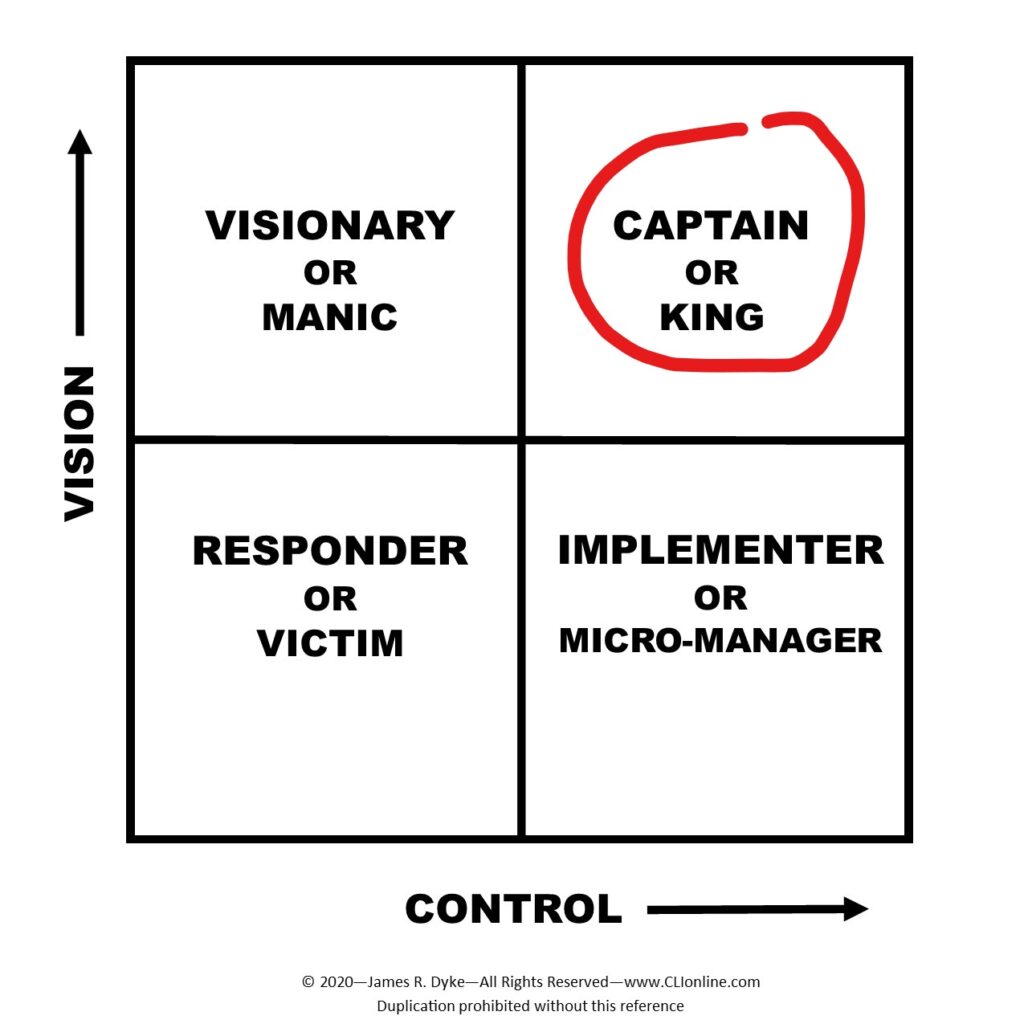
8 Management Archetypes – The Captain and The King

High Vision and High Control

Dynamics of Effective Leadership

In my work as a leader, trainer, and executive coach I focus a great deal of my attention and learning on the dynamics of effective leadership.  Many elements define leadership—things like qualities of character, behavior, skill, and temperament.  In this series of blogposts, I highlight two of the most defining of these elements: vision and control. I show how these two elements identify functional and dysfunctional styles of leadership and management. More important, I reveal how each style can improve and become more effective.

Control–Monitoring and Managing

The effective leader/manager maintains an appropriate balance of both vision and control. In fact, these two elements are often used to contrast the two roles of management and leadership as distinct from one another.  For example, an effective manager exercises control by monitoring the work of the team (or organization) and intervenes when problems arise to keep things functioning properly. 

Vision–Steering and Innovating

An effective leader exercises vision by having a clear sense of purpose for the team (or organization). They anticipate the need for adjustment, change, problem-solving, or innovation as the team moves forward in their work and moves forward in time.  Just to be clear, I will repeat what I said at the beginning:  The ideal for effective leadership and management maintains an appropriate balance of both of these two elements.

Leadership Archetypes

Carl Jung is famous for his development and use of archetypes. These are models he used to identify patterns of personal behavior. As part of his system of archetypes, Jung defined “shadows” that were dysfunctional versions of each archetype. The purpose of the archetype is to help the individual identify and explore their own behavior, and address their need for growth and development. In this series, I am using the concept of archetypes for the same reason: to help leaders identify and explore their patterns of behavior and discover areas of needed growth and development.

The Captain

The first archetypes describe the leader/manager who exercises strong control and clear vision. To communicate a better understanding of what that high vision/high control balance looks like in effective leadership, I use the metaphor of a ship’s captain.

The captain of a ship has a clear destination in mind, and keeps the ship on course.  In the same way, an effective leader has a clear understanding of where their team or organization is headed and how to get it there.  This kind of “captain” leader has clarity about the organization’s purpose; its goals; its objectives; and its strategies.  The Captain leader also makes sure the people (and their activities) are “on course” and supporting the purpose, goals, objectives, and strategies of the organization.  Both the ship’s captain and The Captain leader direct a group of people who are strongly committed to the mission.  And both of these individuals can also be thought of as initiators—leaders who make decisions, originate plans, give appropriate commands, and deploy their people strategically. 

Supervise a Skilled Crew

The captain of a ship does not operate the entire ship by their own efforts—they supervise a skilled crew.  Similarly, the effective Captain leader oversees a team of people whose combined skills and efforts collectively perform the work.  Neither an effective ship’s captain nor an effective Captain Leader attempt to do the entire work of the crew or the team.  Both, however, oversee the work and give appropriate direction; assess the effectiveness; address problems; and provide correction where necessary.  A good ship’s captain relies on their crew to do their jobs, and avoids becoming intrusive in the details of their assignments.  A good Captain leader relies on their team to do their jobs and also avoids becoming intrusive in the details of their assignments. 

A good ship’s captain sees that the crew is well-trained, well-fed, well-equipped, and in some cases, well-armed!  A good Captain leader exercises the same care for their team.  Both treat their people fairly, and both build strong bonds of loyalty with their followers.  Both maintain continuous two-way communication with their people—disseminating important information, but also relying on their subordinates for helpful feedback and input.

The King

I call the dysfunctional “shadow” of high control/high vision “The King.”

The King has clear vision, but their vision is centered primarily on themselves—how they might benefit, rise in power, increase influence, in effect—build their kingdom.  The King’s subjects do not serve some collective vision for the kingdom.  Their purpose is to serve the King and ensure the King’s vision and well-being.  There may be other parts of the vision that are more inclusive, such as building a prosperous kingdom that benefits the subjects, as well.  But those parts are incidental to the more important central vision of magnifying the King.  I should emphasize that the King imposes this vision on their subjects—there is no interaction, discussion, or debate involved. 

Leadership by Coercion

This imposition is an example of another aspect of the King’s leadership—it is enforced by authority and coercion.  Followership is demanded on the basis of duty and status in the kingdom (e.g. the King is on the top of the org chart!).  And the King is not adverse to exercising this authority by interfering with the work of their subjects—over-riding their authority; second-guessing their decisions; rejecting their ideas; taking charge of their people; and replacing their priorities with royal demands.  Disagreeing with The King is not recommended—it is usually seen as the mark of disloyalty, and can lead to the withdrawal of The King’s favor and support!

Type “A” and Driven

The dysfunctional leader who exhibits the qualities of The King is typically sharply-focused, driven, self-serving, autocratic, demanding, domineering, forceful, insistent, intrusive, and often aggressive in tone and behavior.  This kind of leader demands loyalty instead of earning it, and is often slow to recognize (and value) the contribution of others.

The King leader often survives in organizations because they are results-driven and often achieve their goals—albeit through sheer determination and drive.  Ultimately, though—especially at higher levels in the organization—they tend to lose the goodwill and support of their subordinates, their colleagues, and their superiors. 

Human resource managers are quite acquainted with this type of leader, because The King leader is likely to generate more than their share of employee complaints!  Eventually, this leader is no longer welcome in the organization.  More often than not, they are simply terminated. And this means another cost for the organization–the loss of The King’s skills and experience and any investment made in their employment.  As a result…

Executive Coaching

King leaders are often assigned to me for executive coaching, which is probably one of the best ways for organizations to help them improve.  Executive coaching offers the possibility of a positive result (if the leader is open and teachable) because the coach operates as an independent and confidential source of help and guidance.  I find many of these hard-driving leaders to be open to my suggestions, because I have no authority over them and they have nothing to prove to me.  They come to see me as a helpful supporter, not as a threat.

Executive coaching can be of incredible help because it has the potential to be highly individualized, highly personal, and highly focused on the executive’s specific issues and needs.

As you consider this information:

  • Do the descriptions of each archetype bring to mind any managers you have seen or dealt with in your experience?
  • Are any of the descriptions uncomfortably applicable to your own management style?
  • Might the suggestions for improvement be helpful to your growth and development?
  • Would it be useful to share this information with leaders you are managing?

Leaders like The Captain are often as rare as they are desirable.  But any person with a teachable mindset can learn and apply the skills of a good Captain leader.  If you or your organization has the vision for equipping leaders with better tools and insights, call us—we can help!

Until next time—yours for better leaders and better organizations!

Dr. Jim Dyke – “The Boss Doctor” ™ – Helping you to be a better boss and to have a better boss!

Posted in Authority, Collaboration, Communication, Conflict, Control, Employee Engagement, Employee Motivation, Influence, Leadership, Management, Team Culture, Team Dynamics, Team Leadership, Teams, Vision | Tagged , , , , , , , , , | Leave a comment

Google’s Management Pitfalls – #3

Pitfall #3: Spending too little time managing and communicating

When you become a manager, you enter the “people” business.

What We Learned From General Electric

This pitfall speaks to one of the most common challenges managers face.  This was seen at General Electric, among many other organizations.  Over time, GE mastered the art of leadership development like few companies in history.  The book, The Leadership Pipeline, shares much of what GE learned about this critical element of organizational success.  Here’s what they discovered at General Electric: 

Whenever a person is promoted to the next level of leadership in any organization, they encounter the same three challenges:

  1. They must learn and master a whole new set of tasks
  2. They have to use their time in a different way
  3. They have to value (and invest time and effort in) the new things they must do as a leader at that level

Investing Time in Management Work

The challenge for many new managers (especially first-time, first-level managers) is number three on this list.  They have to let go of the functional work they excelled at, as front-line employees, and focus their time and energy on the new “managerial” tasks that are required at their new level of leadership (e.g. giving work assignments; evaluating performance; addressing employee issues; assembling various reports as required by higher-ups; etc.).

Up Close and Personal – This manager really “got it”

I once led a training class for first-time supervisors (one of many of these classes, actually!).  When one of the early birds came into the room, I greeted him and asked him why he was there.  He said, “I was promoted about six weeks ago to be the manager of the team I was on.”  I told him, “You’re in the right place—I promise to give you lots of help with your new responsibilities!”  Then I asked him, “What kind of work does your team do?”  He said, “We do computer programming.”  I smiled and said to him, “Let me guess—before you got the promotion, you were the best programmer on the team.”  He blushed, and told me, “Yeah…actually… I was!”  Then I put this question to him:  “What is one of your biggest challenges, as a new manager?”  I never forgot his reply.  He said, “That’s easy.  Whenever a member of my team comes to me with a programming problem, my biggest challenge is to avoid the temptation to tell them to ‘get out of the chair’ and then sit down and solve their problem for them.  I’ve learned that it’s not my job to solve their programming problems.  It’s my job to help them learn how to find the solutions to their own programming problems.”  I smiled and told him, “You are wise indeed, oh manager!”

Sadly, not all managers are as wise as this one.  Many get distracted by functional work and end up “sitting down in the chair” instead of focusing on the more important supervisory tasks.  Not surprisingly, Google’s research discovered that this was a common problem for their managers, too.

Communicate, Communicate, Communicate

Google also surfaced the need for more and better communication on the manager’s part.

Here’s the reality:  Leadership roles require a LOT more communication than front-line functional roles.  One simple example is the manager’s responsibility to give clear work assignments.  The Leadership Pipeline reveals, “…many first-time managers stumble when it comes to defining and assigning work because they don’t have the right discussions with the right people.” (p. 37).  The book goes on to explain, “The logical person for a manager to discuss these issues with is his boss.  It’s more and more important, however, that he also talk with peers, customers, suppliers, partners, and other relevant parties.” (p. 38).  It’s clear that managers who are more used to doing than discussing will find it difficult to make the transition to more effective leadership.

It’s not PART of your job…it’s MOST of your job!

I got this message loud and clear from a smart CEO I worked for. I remember sitting in a C-level team meeting with him and the other executives who also reported to him.  The CEO paused in the midst of the discussion to remind us of the critical need for effective communication in our various areas of responsibility.  He said, “Let’s face it, people, mostly what we get paid to do is just talk.”  We all laughed, but we all understood the important role relationships played in our leadership success, and the need for constant interaction to sustain those relationships.

You can learn how to communicate BETTER

If you would like more help with your leadership role, let us personalize your development with executive coaching.  And if you have leaders in your organization who need some help, we can bring focused consulting and training that can help.  Give us a call.

Until next time—yours for better leaders and better organizations,

Dr. Jim Dyke – “The Boss Doctor” ™ – Helping you to be a better boss and to have a better boss!

Posted in Authority, Communication, Employee Engagement, Influence, Leadership, Management, Team Culture, Team Dynamics, Team Leadership, Teams, Uncategorized | Tagged , , , , , , | Leave a comment

Google’s Management Pitfalls – #2

Pitfall #2: Lacking a consistent approach to performance management and career development

Are you helping your people become WINNERS????
— Image by © Royalty-Free/Corbis

Google puts it this way:

They don’t help employees understand how these work at Google and they don’t coach them on their options to develop and stretch.

The sad truth is that many organizations employ vague and subjective performance measures in their formal (usually annual) performance reviews.  Even worse, employees are often rated on a five-point scale in a company culture with a tacit rule – “we don’t give out fives.” 

Performance is an area that requires crystal clear clarity—for both managers and employees. 

Performance Standards Must Be Crystal CLEAR

A consistent performance management approach requires clear, measurable descriptions for each level of performance in each category of performance.  In other words, employees need to know exactly what a “5” level of performance looks like in any given category.  The descriptions should be so clear that the employee will be able to know for certain what their performance level is, even without input from the boss. 

Furthermore, clarity in one’s current performance is essential for any reasonable process of professional (career) development—before you “stretch” you first have to be succeeding at your current level.  That’s why it’s vital to have clarity about where you are right now in your performance.

Start with These Key Questions…

So…Employees in any organization need clear answers to these performance questions:

  • How well am I expected to perform?
  • How will my performance be measured?
  • How will my good performance be rewarded?
  • How will my bad performance be addressed?
  • What opportunities for professional development are available to me?

Help Your Team Members Move Forward

Organizations take different approaches to professional development, but these are common ways many managers use to help their employees “stretch” …

  • By providing a higher level of authority/responsibility in current assignments (read my July 23rd post for some help with this)
  • Introducing new areas of technical skill, with opportunity for supportive training (e.g. presentation and public speaking; project management; business writing)
  • Giving assignments that introduce tasks associated with managerial level work (e.g. budgeting; hiring; planning);
  • Giving cross-functional assignments that put the employee in contact with leaders from other departments (e.g. planning committees; policy-making groups; leadership training classes)

Put It On YOUR To-Do List

The key here is simple:  Effective managers take the initiative with regard to their team members’ professional growth and development.  They don’t wait for the employee to make the first move.  Managers who don’t pursue this with their team members typically see less employee development as a result.  Google researchers saw this lack of commitment as a problem that was so common, it deserved special mention.  They cautioned leaders to avoid this error of low-performing managers, about whom they said:

They’re not proactive—they wait for the employee to come to them. 

In my blog post on Google’s Rules #6, I gave the example of Tony Knight.  I explained the simple way he took initiative to help his team members with their career development.  Be sure to read it and also download the special resource I referred to in the article—The Top Ten Habits of Highly Likeable People.

And if you would like help with your career and professional development, give us a call—our executive coaching services can turbocharge your learning and growth!

Until next time—yours for better leaders and better organizations,

Dr. Jim Dyke – “The Boss Doctor” ™ – Helping you to be a better boss and to have a better boss!
Posted in Employee Development, Employee Engagement, Employee Motivation, Leadership, Management, Organizations, Performance Management, Professional Development, Team Culture, Team Dynamics, Team Leadership, Teams, Uncategorized | Tagged , , , , , | Leave a comment

Google’s Management Pitfalls – #1

Pitfall #1: Having trouble making a transition to the team

These are your new peeps…are you ready to lead them????
— Image by © Royalty-Free/Corbis

In addition to their recommendations for good management practices, Google’s research project discovered three common reasons for management failures among Google’s leaders.  These failures were so prevalent, Google took pains to include them in their directives to managers as additional cautionary advice.  The first of these is the special challenge that managers face in taking on a new leadership role.

The Challenge of a New Leadership Position

Here’s what I’ve discovered in my experience working with thousands of managers and supervisors:  The vast majority of team leaders rarely have the chance to assemble their team from scratch, with the ability to recruit and handpick their own team members.  Most team leaders inherit someone else’s team; someone else’s people; someone else’s problems; someone else’s problem people!  (That’s a topic for another time!)

Google’s research identified two specific kinds of challenges for new team leaders.  The first type of challenge is very common in growing organizations that are hungry for leaders.  It happens when higher-ups identify a high-performing member of a team and make them the leader of the team.  Higher-ups often view this type of team member as a “de facto” leader because other team members already view them as a leader of sorts; and may also look to them for leadership in certain circumstances.  In other words, this particular team member has established a strong degree of trust, respect, and influence with the rest of the team, which gives them a certain measure of natural authority. 

For many higher-ups, it makes sense to give someone like this a formal position of leadership, since they already seem to have an element of informal leadership by virtue of their character and performance.  This is a common instance of what I refer to as a “convenience hire.”  

The “Inside” Hire–Making the Leap

A convenience hire happens when executives begin to experience “hiring fatigue” and want to avoid the bothersome drain on their time (and budgets) that effective hiring demands.  So a convenience hire is usually someone the executive already knows; already trusts—often someone who is already in the organization—someone familiar with the corporate culture who also demonstrates a proven ability to “fit in” with “us.”  Promoting an insider like this enables hiring managers to avoid the time consuming process of reviewing countless résumés, enduring endless interviews, and assuming the risks of hiring an “unknown” or an “outsider.”   

The problem, of course, is that the convenience hire may NOT be the best person for the job.  Google’s research revealed one of the reasons why.  They put it this way:

Sometimes, fantastic individual contributors are promoted to managers without the necessary skills to lead people.

This happens because the skills required to perform a particular kind of work, are different than the skills required to manage a team of people who perform that work!

And yet, high-performing team members continue to be promoted routinely in every organization, without regard for the unique skills required to manage and lead!  This is why one research study determined that 85% of people who serve in a leadership role in an organization do so without any training!

New Leaders Need Help!

What’s the solution?  I help organizations identify practices that address this issue:

  • Providing formal leadership/management training for existing and emerging leaders
  • Establishing mentoring initiatives that support individualized learning and growth
  • Making employee development a metric for managerial performance
  • Engaging the services of an executive coach, to help struggling leaders

These simple things done well can help any organization get better—improving its effectiveness by improving its leaders!

The “Outside” Hire–Fitting In

Another challenge that hiring managers face is the inevitable need to recruit leaders from outside the organization.  As mentioned before, this entails a greater risk—the possibility the newcomer will not understand the culture of the organization, or worse, may resist the vision and values that the employees must embrace in order to work cooperatively and collaboratively together.  Google’s researchers put it this way:

People hired from outside the organization don’t always understand the unique aspects of managing at Google.

How does an organization avoid this?

1.  It starts with the hiring and interviewing process.  Hiring managers need training that equips them with the sophistication and skills they need to determine cultural fit before the candidate is hired.  Sadly, the vast majority of managers receive no such training.

2.  Organizations can also assign “sponsors” to new management hires.  These are leaders on the same level (or sometimes higher) who are available to offer guidance; advice; support; and encouragement to the newcomer, to help them better understand “us.” 

Up Close and Personal

I was an outsider, myself, when I took over a “one-time-highly-successful-now-languishing” department in an organization.  I felt the need to get a better understanding of the history and the previous circumstances of the department, in order to engineer the right approach to an effective turnaround.  I found a “Rabbi” in the organization who generously offered his time and information.  The insight he shared with me was just what I needed to meet the challenge and lead my team to a new level of success.

3.  Employee feedback mechanisms can also help. A well-designed and skillfully-conducted employee survey can enable organizational leaders to see when managers are having difficulty assimilating the corporate culture.  Effective 360 degree surveys should include questions designed to measure this.

Cultural disconnects are difficult to address, because they are often so subtle.  Newcomers can easily be completely oblivious to their deficiencies in this regard.  It’s a confusing place for any leader to be.  But this kind of frustration can happen with many, many other issues! 

Executive Coaching Can Help

If you are frustrated and struggling in your leadership role—new or old—contact us!  Our executive coaching can help you identify where you need help; target your specific needs; and equip you with the skills you need to quickly become more effective!

And stay connected with this blogsite—every entry is designed to help you become more effective in your leadership role.

Until next time—yours for better leaders and better organizations,

Dr. Jim Dyke – “The Boss Doctor” ™ – Helping you to be a better boss and to have a better boss!

Posted in Authority, Conflict, Emotional Intelligence, Influence, Leadership, Management, Personal Growth, Professional Development, Team Culture, Team Dynamics, Team Leadership, Teams | Tagged , , , , , | Leave a comment

Google’s Rules

RULE #8 – Have key technical skills so you can help advise the team

Sometimes…teams need a little help from their leader!
— Image by © Royalty-Free/Corbis

One of the most challenging aspects of leadership advancement is the ever-expanding arena of responsibility, encompassing more and more areas of diverse function and expertise.  This is the principle:  The higher you rise in any organization, the more of a generalist you must become.  COO’s, for example, oversee many different aspects of organizational operations, each one employing a very specific skillset.  Can any COO realistically become an expert in every area under their supervision?  It’s unlikely.  Having said that, they still need to provide effective oversight of their immediate subordinates.  That will require them to have at least a basic grasp of their team’s technical work.  Google puts it this way:

Understand the specific challenges of the work.

Without that basic understanding, a team leader will be unable to provide the kind of helpful advice, direction, or support that every team needs and appreciates.  It’s the kind of job knowledge that leaders need in order to carry water for their team.

It also equips the team leader to be able to step in and lend a hand when necessary. 

Those opportunities are often created by the likes of unexpected workload demands; looming deadlines; shifting priorities; staff deficiencies; or spur-of-the-moment rush orders.  Google encourages their managers: 

Roll up your sleeves and conduct work side by side with the team, when needed.

I have done more than my share of this kind of thing.  And I’ve been amazed at the incredible positive impact it has on team morale.  It’s tangible:  Teams feel affirmed, valued, and respected by leaders who are willing to step into the fray and get their hands dirty with the real work of the team.  It also sends a very powerful message to your people:  We’re all in this togetherThe team quickly gets the message that the boss is a vital part of the team, not just an isolated overseer.

What complicates this is when an effective manager is assigned to a new team, especially a team whose technical work is unfamiliar to the new manager.  (This is not uncommon in organizations.  Many executives see management skills as fairly transferable between functions—e.g. if Bob was able to turn around an accounting team, he can probably do the same for an under-performing production team.) 

When this happens, my advice to the new manager is “learn fast.”  Acquire a working knowledge of the team’s technical work as quickly as possible.  If you stay ignorant too long, you will lose the respect of the team!  But if you prove yourself a fast learner, you will more easily gain the confidence of your people.  As a result, they will be more comfortable following your lead and looking to you for help and support.  Here’s a tip to help you in your learning process:  Don’t be afraid to ask questions and especially, don’t be afraid to ask your team for their help.

In conclusion, Google’s Rules offer leaders sage advice to inform their leadership and help them perform better as managers.  The Rules are certainly worth some time and attention, but they are not comprehensive of good management, by any means! 

The Oxygen Project also identified three prevalent “pitfalls” of Google managers—common problems experienced by a number of their leaders.  These problems were so widespread, Google felt they deserved special attention in the organization.  The next blog posts will present these pitfalls and provide ways that you can address them in your leadership!  So… stay tuned!

And if you find the advice of this blog helpful, please leave a comment—I would love to hear from YOU and answer any questions you might have about these blog entries.  And if you would like more information about our resources, let us know—we’re here to help!

Until next time… Yours for better leaders and better organizations,

Dr. Jim Dyke – “The Boss Doctor” ™ – Helping you to be a better boss and to have a better boss!

Posted in Authority, Communication, Employee Development, Employee Engagement, Employee Motivation, Influence, Leadership, Management, Performance Management, Team Culture, Team Dynamics, Team Leadership, Teams | Tagged , , , , , , , , | Leave a comment