Doer / Manager / Leader – 3 ROLES, 3 Levels, 3 Stages – Part 1.

Which one of these are YOU?  How you answer the question depends on how you are using or understanding these terms.  Each of these three designations can describe…

  • A role you fill in the organization where you work
  • A position of responsibility you hold at a certain level in that organization
  • A stage in your personal and professional development

In this issue, we’ll start by exploring these as ROLES.  [My thanks to author Charlotte Beers, who introduced these descriptions in a thoughtful article posted on the internet on December 11, 2012.]  ONE IMPORTANT POINT: I am addressing these roles in a very basic way, with broad brush strokes.  The reality is that the lines between these roles are very blurry—each role benefits from elements of the other!  But I’ll save more details for THAT discussion until the final installment of this series. 

So… here are the roles…

DOERS are task-oriented and results-driven.  Their comfort zone is control and protocol.  Give them a clear objective to achieve; the authority to act; a well-defined process to follow; and clear-cut guidelines to define their work; and they are off and running—usually with consistent and predictable success.  They are the producers—the ones who perform the tangible tasks of production, construction, manufacturing, or day-to-day processing.

Effective DOERS are the backbone of every successful organization!

MANAGERS are responsible for the environment in which work takes place.  They are custodians of structure, organization, protocol, and productivity.  They organize the work and see that it gets done—by others (DOERS).  They are masters of the status quo—making sure that the current structure of their area is working well and running smoothly.  Their major concern is in the present, to solve any problems that are obstructing effectiveness and efficiency—including any problems with employee performance.  John D. Rockefeller III wrote about the culture of large organizations, and the conservatism that dominates their existence. In The Second American Revolution, he wrote…

“An organization is a system, with a logic of its own, and all the weight of tradition and inertia. The deck is stacked in favor of the tried and proven way of doing things and against the taking of risks and striking out in new directions.”

Effective MANAGERS keep things running smoothly and successfully!

Managers are the caretakers of this organizational system, keeping it running and performing.  Ironically, this caretaking ensures that the organization will also be resistant to innovation and change—the very things that prevent organizations from becoming obsolete!

LEADERS are required to think and live in the future.  They are expected to anticipate where the organization and its people must travel in order to remain relevant in a changing world.  They are the very ones that are required to do what Rockefeller described as “taking risks and striking out in new directions.”  The risks that organizations must take are the risks associated with the innovation and change needed in order to survive (and thrive) in the midst of a changing cultural and economic reality.  They are sellers of vision and change, so they must capture the hearts and imaginations of their people in order to lead them forward.  In reality, they actually play an important role in shaping the future, not just adjusting to it!

Each role requires a specific set of skills.

DOERS coordinate their time, tasks, and processes.  They are expected to conform—to values, behaviors, protocols, priorities, and expectations.  On the surface this is fairly straightforward.  They focus on the concrete, measurable tasks of the organization—executing, performing, and delivering results efficiently and cost-effectively.  The skill that is required in their role is primarily a technical skill—welding, contracting, writing, carpentry, assembly, book-keeping, computer programming—whatever is required by the work they are tasked to do.

MANAGERS act in a more relational environment.  They must hire, set priorities, motivate others to do the work, and supervise performance.  They are required to act in a broader context—collaborating across organizational boundaries and divisions—running interference for their teams; solving problems; and gaining the cooperation of colleagues and higher-ups.  I tell managers,

“When you become a manager, you are now in the people business.”

Managers must divide their time between the processes they oversee and the people performing those processes.  Both are important to the success of their area of responsibility.

LEADERS must divide their time between the status quo and the future.  They choose managers and set appropriate standards and expectations.  Their role requires them to understand the work, the business, their industry, and also the changing world outside of the organization.  This expanded view is necessary in order for them to innovate and persuade and influence others to accommodate change and follow them into the future. 

LEADERS take people and organizations into a better FUTURE.

Another important part of a leader’s focus is on the future of their people—the professional (and personal) growth, development, and career advancement of employees.  This is about the needs of the organization in the area of leadership succession—and how to fill the need for future leaders as the organization grows and expands.

Here is the takeaway for all of us—it behooves us to be very aware of which of these roles we are assuming in our work, and to effectively exercise the skills necessary for that role.   The difficulty is that we are all challenged and pushed into any of these roles at various times—through circumstance; demands of higher-ups; the nature of our business.

In a recent Harvard Business Review article, John O’Leary reflected on a series of interviews he conducted with managers and leaders, focusing on their roles and functions.  He concluded,

“…we think of managers having a different focus from leaders. And yet this distinction blurs significantly when we look at the daily activities of…people in charge. The majority of the activities… [are] very similar, or even identical — delegating, learning, motivating, and so on.”

In the next installment, we will tackle more of the implications of these roles, and explore the blurred lines between them.  Stay tuned for more great insight!

Until next time… Yours for better leaders and better organizations,

Dr. Jim Dyke – “The Boss Doctor” ™ helping you to BE a better boss and to HAVE a better boss!

Posted in Agility, Authority, Career, Change, Change Management, Collaboration, Competence, Control, Creativity, Deadlines, Decision-making, Employee Development, Hiring, Influence, Innovation, Leadership, Management, Organizations, Performance Management, Personal Growth, Personal Success, Potential, Power, Problem-Solving, Productivity, Professional Development, Promotion, Self-Awareness, Staffing, Supervision, Team Culture, Team Dynamics, Team Leadership, Teams, Uncategorized, Vision, Work | Tagged , , , , , , , , , , , , , , , | Leave a comment

Mastering the Push and Pull of Effective Leadership – Part 2

In the last installment, I introduced a study done by Jack Zenger and Joseph Folkman that explored two key approaches to performance management—pulling and pushing.  Here’s how they introduced the concepts:

When you see a task that needs to be accomplished by your team, do you “push” them to get it done or do you “pull” them in, giving them a say in how they carry it out and using inspiration and motivation to get them going? These are two very different approaches to reach a goal, and the latter is often the best one, but knowing how to combine these two paths is an important skill for managers and leaders.

Here’s the important point they made:

knowing how to combine these two paths is an important skill for managers and leaders.

Defining the Terms

I’m going to use the definitions that Zenger and Folkman provide…

PUSHING means “driving for results.”  It involves giving direction, telling people what to do, establishing a deadline, and generally holding others accountable.  It is on the “authoritarian” end of the leadership style spectrum.

PULLING means “inspiring and motivating others.”  It involves describing to a direct report a needed task, explaining the underlying reason for it, seeing what ideas they might have on how to best accomplish it, and asking if they are willing to take it on.  The leader can further enhance the pull by describing what this project might do for the employee’s development.  Ideally, the leader’s energy and enthusiasm for the goal are contagious.

The Key Take-Away

Here’s what Zenger and Folkman discovered:

While our data is clear that most leaders could benefit from improving their ability to pull or inspire others, our research revealed that leaders who were effective at both pushing and pulling were ultimately the most effective.

Once again, effective leadership style was shown to be highly situational in nature!

Here’s how they put it:

…your influence as a leader comes from your ability to know when to use which approach, depending on the task, the timing, and the people.

Does this guy need PULLING or PUSHING????

So…this begs the obvious question:

How do you know when to use which approach????

To help answer that question, I presented a management model in the last issue that I call, Can They? / Will They?

In this issue, I am going to present a second model I call, The Leadership Style Continuum. 

Model #2 – The Leadership Style Continuum

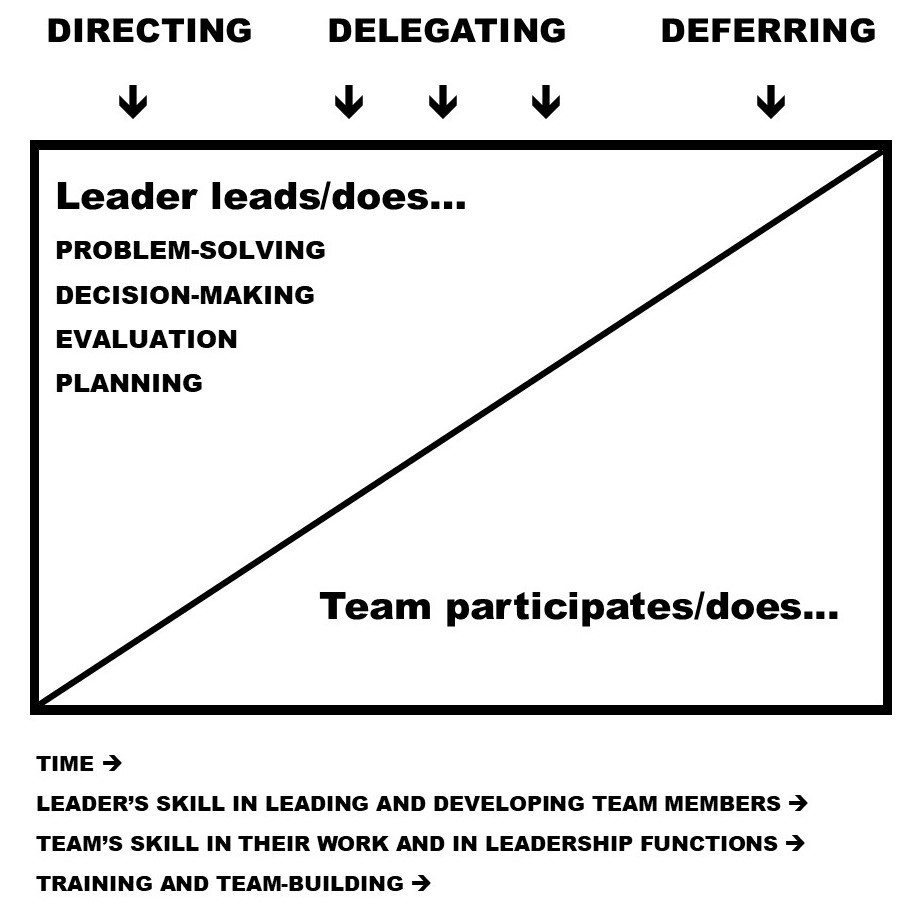
This model presents three broadly defined leadership styles (or “approaches to management”) on a continuum defined by a variety of situational elements.  Here’s a diagram that will help illustrate the model:

The Leadership Style Continuum

The three main leadership styles in the diagram are…

Directing—often called autocratic

Delegating—sometimes referred to as democratic

Deferring—in the extreme, referred to as laissez-faire

The diagram is meant to illustrate how much the manager and the team members participate in the broad-based leadership processes of planning, evaluation, problem-solving and decision-making—in particular, how their participation differs with each of the three main leadership styles.

The diagram indicates the following…

1.  The styles exist on a continuum.  To be more specific, the distinctions between the styles are not sharply defined.  The lines between styles are blurry and can blend gradually from one into another, depending on the details of a given situation.

2.  As you move from left to right on the diagram, the spaces in each of the two categories (what the “leader does” and what the “team participates/does”) show increasingly lesser involvement on the part of the manager in the leadership functions and greater involvement on the part of the subordinate in the leadership functions.

3.  The Directing leadership style illustrates what Zenger and Folkman would describe as pushing—“giving direction, telling people what to do, establishing a deadline, and generally holding others accountable.”  It shows that the manager is the one doing all or most of the planning, evaluation, problem-solving, and decision-making. 

The DIRECTING style is PUSHING with strong “boss” input.

4.  The Deferring leadership style illustrates what Zenger and Folkman would describe as pulling—“describing to a direct report a needed task, explaining the underlying reason for it, seeing what ideas they might have on how to best accomplish it, and asking if they are willing to take it on.”  The diagram shows that the leader is deferring to the subordinate, allowing them to take on the major responsibilities of planning, evaluating, problem-solving, and decision-making.  And in extreme cases (e.g. “laissez-faire”) allowing the subordinate to take initiative with little or no input or direction from the leader/boss.

DEFERRING is PULLING to the max – giving a competent subordinate freedom to do the job.

5.  Somewhere in-between the two extremes is the Delegating leadership style that illustrates a manager and a subordinate sharing input and participation in the four leadership functions.  Zenger and Folkman would probably identify this style as combining the two elements of pulling and pushing.  NOTE: This diagram illustrates a continuum, so how much participation is involved by each party can vary quite a bit.  And it can change gradually, over time.

DELEGATING is PUSHING AND PULLING – collaborative effort.

6.  The diagram also shows what is required to move from left to right, and what also limits movement in that direction—toward greater subordinate participation: 

…The level of skill that team members have (a) in their particular work; and (b) in the four leadership functions.  As the skill of a team member develops, they are able to more effectively participate in planning their work; evaluating their work; solving problems in their work; and making decisions about their work.  Also, as they develop skill in the leadership functions, they are able to more effectively participate in each one (e.g. as they develop better problem-solving skills, they are able to more effectively participate in problem-solving activities).

…The level of skill that the leader has (a) to lead and manage; and (b) to coach and develop team members.  Obviously, the more adept a manager is at training and coaching subordinates, the more likely those direct reports will be able to learn, grow, and participate more effectively in the leadership functions listed.

…Training and team-building activities.  Teams (and individual team members) function more effectively if (a) they receive training in how to function as a team; and (b) spend time exercising and developing their collaborative team-building skills.

…Time.  All of the above require an expenditure of time.  Individual growth and team development do not occur instantaneously.  Expecting otherwise is unrealistic and disheartening for both a manager AND their subordinates.

When leaders and teams get better…EVERYONE WINS!

These four variables give managers a practical framework for evaluating each situation, to help them determine how much pushing or pulling is required in each particular assignment.  Having said that, managing is still very much an art as much as it is a science—it requires a leader to develop skill, good instincts, and a realistic understanding of each of their subordinates—sufficient to inform effective management decisions in each situation, with each person, and each task  involved.

And if you would like help with your unique management challenges, leave a comment and your contact information…and help will be on the way!

Until next time… Yours for better leaders and better organizations,

Dr. Jim Dyke – “The Boss Doctor” ™ helping you to BE a better boss and to HAVE a better boss!
Posted in Authority, Coaching, Collaboration, Communication, Competence, Control, Decision-making, Delegation, Employee Development, Feedback, Leadership, Management, Performance Management, Problem-Solving, Productivity, Supervision, Support, Team Culture, Team Dynamics, Team Leadership, Teams, Trust, Uncategorized, Work | Tagged , , , , , , , , , , , , , , | Leave a comment

Mastering the Push and Pull of Effective Leadership – Part 1

Jack Zenger is one of my favorite leadership and management “thinkers.”  He and his partner, Joseph Folkman, recently conducted a study on the two key approaches to leadership and management efforts they termed, “push” and “pull.”  They wanted to determine which approach (or combination thereof) is most conducive to positive results.  They published their findings in a recent issue of the Harvard Business Review, and the insights are worth exploring and applying! 

Here’s how they explained the focus of their study:

When you see a task that needs to be accomplished by your team, do you “push” them to get it done or do you “pull” them in, giving them a say in how they carry it out and using inspiration and motivation to get them going? These are two very different approaches to reach a goal, and the latter is often the best one, but knowing how to combine these two paths is an important skill for managers and leaders.

Here’s the important point:

knowing how to combine these two paths is an important skill for managers and leaders.

Defining the Terms

I’m going to use the definitions that Zenger and Folkman provide…

PUSHING means “driving for results.”  It involves giving direction, telling people what to do, establishing a deadline, and generally holding others accountable.  It is on the “authoritarian” end of the leadership style spectrum.

PULLING means “inspiring and motivating others.”  It involves describing to a direct report a needed task, explaining the underlying reason for it, seeing what ideas they might have on how to best accomplish it, and asking if they are willing to take it on.  The leader can further enhance the pull by describing what this project might do for the employee’s development.  Ideally, the leader’s energy and enthusiasm for the goal are contagious.

Their study gathered data from over 100,000 leaders through a specially designed 360-degree assessments.  They measured both push and pull and found that 76% of the leaders were rated by their peers as more competent at pushing than pulling. Only 22% of the leaders were rated as better at pulling, and a mere 2% were rated as equal on both skills.

They also asked the people rating those leaders (over 1.6 million people) which skill was more important for a leader to do well to be successful in their current job. Pulling (inspiring others) was rated as the most important, while pushing (driving for results) was rated as fifth most important.

The Key Take-Away

Here’s what Zenger and Folkman discovered:

While our data is clear that most leaders could benefit from improving their ability to pull or inspire others, our research revealed that leaders who were effective at both pushing and pulling were ultimately the most effective.

Once again, effective leadership style was shown to be situational in nature!

Here’s how they put it:

…your influence as a leader comes from your ability to know when to use which approach, depending on the task, the timing, and the people.

Does this guy need PULLING or PUSHING????

So…this begs the obvious question:

How do you know when to use which approach????

Ah yes, my Padawan!  This is truly the path to wisdom and leadership success!

To help you answer that question, I am going to use the next two articles to present 2 Management Models to guide your thinking as you analyze each management situation.  The first model is what I call, Can They? / Will They?

Model #1 – Can They? / Will They?

I wrote about this in more complete detail in a previous article.  You can access it here:  https://thebossdoctor.net/2021/can-they-will-they

Can They? Is the question of COMPETENCECan they do the job?  Can they fulfill the assignment?  Do they have sufficient skill, training, resource, authority?

Will They? Is the question of MOTIVATIONAre they willing to do the job?  Are they engaged enough to take on the assignment with sufficient energy and determination?

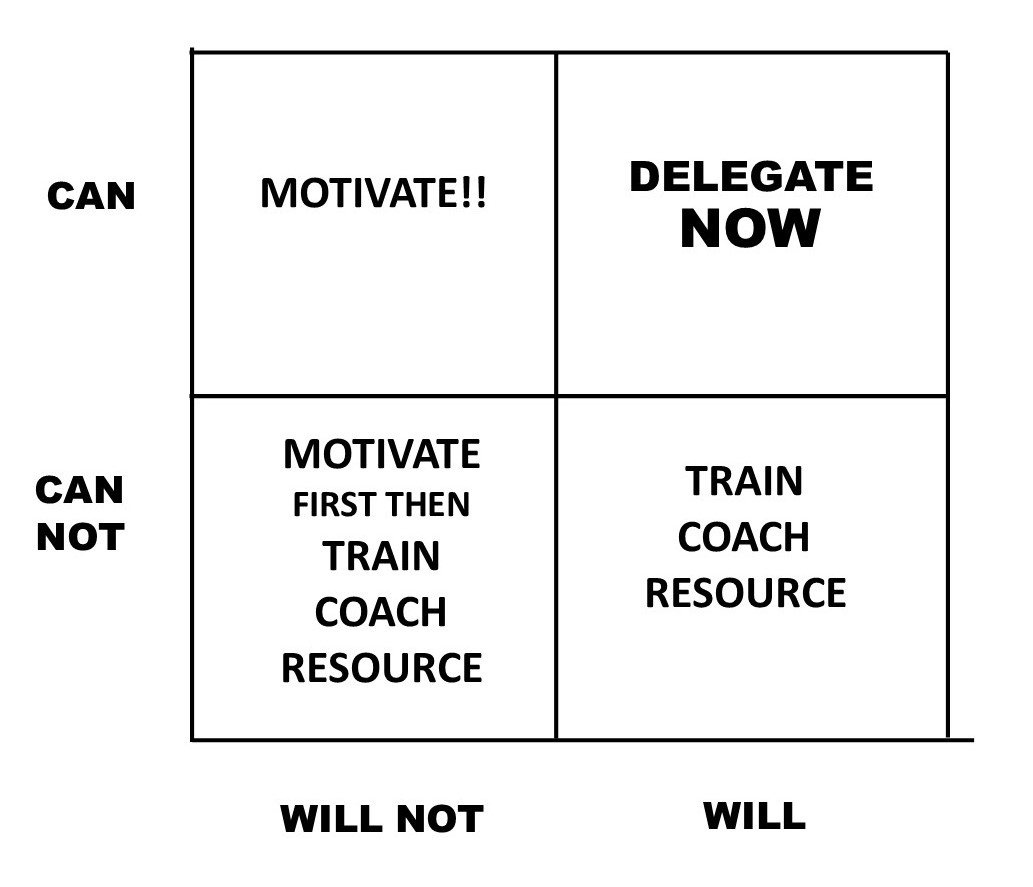
The answers to these questions determine what the boss needs to do, to effectively manage the performance of a subordinate.  The answers also inform the question of which approach to use: Pushing?  Pulling?  A Combination of the two?  The graphic below summarizes a manager’s appropriate response, in each case:

CAN / WILL is the ideal combination of answers to these questions. 

The manager is ready to give this subordinate an assignment because the worker CAN do the job (they have the skills and resources necessary) and the employee is WILLING to do the job (they are motivated to take on the assignment and see it through successfully).  In this case, the manager can go ahead and apply basic management oversight to ensure a clear assignment and a successful outcome. 

The appropriate approach in this case is pulling—reinforcing the worker’s motivation and giving them latitude to take action that is fitting for their level of skill.

This one seems EAGER…but also READY???? Maybe NOT!

CAN NOT / WILL is less than ideal, but offers the assigning manager a clear path forward. 

In this case, a willing employee needs training or coaching or resourcing of some kind in order to take on the assignment successfully.  The boss must determine exactly what prevents the employee from performing and address each need specifically and practically.  That might include things like:

  • Permission to act (official authorization of some kind)
  • Authority to act
  • Training
  • Coaching
  • Equipment of some kind
  • Budget
  • Additional personnel
  • Cooperation from another team or department
  • Possibly the ability to put other assignments on hold in order to take on the new assignment

This situation requires mostly pushing – Providing needed resources, direction, coaching, training, clear expectations, and a plan going forward with appropriate oversight.

The advantage of CAN NOT / WILL is that the toughest part of delegation is already a given—employee motivation.

CAN / WILL NOT is a bit of a challenge. 

The subordinate has the skills and resources to succeed.  But the delegating manager must find a way to connect with the employee’s personal and internal incentives, to ensure they have the will and determination to take on the assignment and complete it successfully. 

This one…is maybe not so EAGER!!!!!

In this situation, a combination approach makes sense…

Pushing – Making a clear case for the necessity, importance, and priority of the assignment; establishing clear goals, deadlines, and expectations; underscoring the impact of the assignment on team and organizational success.  THE CHALLENGE here is one of human nature—the more you push, the more likely the employee is to push back and resist.  That’s why a wise manager will add some pulling to the mix:

Pulling – Tapping into the employee’s priority of internal incentives and self-interest (e.g. professional success, advancement, remuneration, status, reputation, future with the organization).  And engaging them in active participation in various aspects of the assignment where it fits their level of skill—e.g. exercising creative problem-solving, choosing how to go forward, exercising initiative, having access to delegated authority.

Here’s the challenge:  Internal incentives are highly individualized and vary from person-to-person.  A manager has to know each subordinate well enough to understand their particular internal motivational “buttons.” 

CAN NOT / WILL NOT is the most challenging combination. 

This is the employee who lacks skill and is unmotivated to work!  (Some parents out there might be thinking, “That sounds like my teenage kid!”).  The manager’s proper response begins with the correct answer to the question:

Which comes first—COMPETENCE or MOTIVATION??

Does this guy look ready to train???

Does it make sense to try and train an unmotivated person?  The answer is obvious: FIRST you must motivate the worker; THEN you can more easily provide the necessary training and resourcing! 

Once again, a combination approach makes the most sense:

Pulling – Tapping into the employee’s priority of internal incentives and self-interest (e.g. professional success, advancement, remuneration, status, reputation, future with the organization). 

Pushing – Making a clear case for the necessity, importance, and priority of the assignment; then providing needed direction, coaching, training, clear expectations, and a plan going forward with appropriate oversight.

The advantage of The Can They? / Will They? Model is that it provides a manager with an objective approach to analyzing each management situation.  Granted, the categories of ability and motivation are quite large, encompassing a large variety of elements under each heading.  The thoughtful manager must be ready to consider a host of details when making a judgment about any given situation.  Alas, that is the challenge of a management role!

In the next installment, I will introduce a second model that will prove helpful as well.  Stay tuned!

And if you would like help with your unique management challenges, leave a comment and your contact information…and help will be on the way!

Until next time… Yours for better leaders and better organizations,

Dr. Jim Dyke – “The Boss Doctor” ™ helping you to BE a better boss and to HAVE a better boss!

Posted in Authority, Coaching, Collaboration, Communication, Competence, Control, Delegation, Employee Engagement, Employee Motivation, Employee Satisfaction, Influence, Leadership, Management, Performance Management, Productivity, Supervision, Team Culture, Team Dynamics, Team Leadership, Teams, Uncategorized, Work | Tagged , , , , , , , , , , | Leave a comment

4 More C’s for Effectiveness and Success in the Workplace

Management guru John Baldoni is the author of The Leader’s Pocket Guide: 101 Indispensable Tools, Tips, and Techniques for Any Situation, and Lead Your Boss. 

In his books he highlights three critical elements that equip people to lead effectively from the middle.  These are personal qualities that are absolutely necessary to build trust with subordinates, colleagues, and higher-ups—qualities that enable a mid-level manager to become a valued source of influence in their organization:

  1. Competence:  You have to be able to do your job well.
  2. Credibility:  Other people need to believe you know what you’re doing and can do the job well.
  3. Confidence:  Not only must you be confident in yourself—in your ability to do the job and to lead others—other people must also have confidence in you.

I would add a fourth C to Baldoni’s list: Consideration… consideration for other people.  There is an old adage,

“People don’t care how much you know until they know how much you care.” 

Caring about and caring for others is central to leading by inspiration rather than coercion.

People know when you really CARE!
— Image by © Royalty-Free/Corbis

The first fourth of my book, Leading Teams, is all about how to become an inspirational leader.  Each chapter explains one of the ABC’s of Inspirational Leadership:

  • Acquiring Respect;
  • Building Trust;
  • Communicating Compassion;
  • Demonstrating Competence;
  • Engaging Emotions;
  • Forging a Vision; and
  • Gaining Support. 

I’m not going to try and summarize seven chapters in this newsletter.  Just get the book.  Here’s a link to find it on Amazon:  Leading Teams: How to Inspire, Motivate, Lead, and Succeed!: James Dyke: 9781934589007: Amazon.com: Books

Instead, I’m going to focus this issue on the art of collegial consideration. 

If you want to collaborate more effectively with others in your organization, here are some practical things you can do to demonstrate consideration for colleagues, subordinates, higher-ups, clients and vendors…

1.  Take time to learn about the work that others do.  Find out what it takes for them to do their jobs effectively.  It will give you a much better understanding of the demands they face; the needs they have; how to build agreements with them more easily; and generally how to work with them more effectively.  Start with your own subordinates, but don’t stop there!

Reach out to colleagues in other departments, especially the ones you must work with and collaborate with on a regular basis (finance, shipping, marketing, WHATEVER)… 

2.  Find out what they need from you in order to do their work effectively.  And give them what they need!  Jump through whatever hoops they require of you, to conform to their processes and procedures.  Give them realistic deadlines to work with.  Help them to succeed.

Tune in to the needs of other colleagues and departments.

3.  Be willing to listen to other people’s information, ideas, instruction.  Be open to their feedback about you and your team, and especially any ideas about how you and your people might be able to improve your performance and productivity. 

Up Close and Personal

One of the feedback exercises I have teams do is “Continue; Stop; Start.”  That allows team members to give each other valuable feedback to help them become more effective… to let each other know…

(1) This is what you are doing that is helping me be effective… CONTINUE doing that;

(2) This is what you are doing that is getting in the way of us working effectively together… I would like you to STOP doing it; and

(3) This is something you aren’t doing yet that would help me collaborate more effectively with you… I would like you to START doing this.

It wouldn’t surprise me if many people in the workplace were resistant to being told what to do or how to do what they do—especially if that information comes from a colleague with no real management authority to wield.

But you CAN approach colleagues in the workplace and give them permission to suggest ways that YOU could work with them more effectively!  Here’s a simple way to request that information—a question that encourages helpful responses and healthy dialogue from others:

What do you need from me (and my team) in order to be able to do your job easily and effectively?

You may discover that just asking the question is enough to generate positive support from the people you ask!

And here are some other things you can do, to build consideration in the workplace:

4.  Get to know other people better.  Find out what makes them tick—their motivations, chief concerns, worries, pet peeves, and idiosyncrasies.  I have a networking questionnaire I give to my coaching clients to use for this process (it has a lot more detail).  If you want a copy, let me know and I’ll send one to you. 

Get to know your co-workers!

5.  Share credit with others.  Be lavish with praise and appreciation.  Don’t ever let anyone you know (or work with) feel that you take them (or what they do) for granted. 

6.  Show deference to others by being flexible and working within their constrictions of time and schedule as much as possible.  Don’t expect other people to conform to your expectations of availability and accessibility!  For example, don’t send them an email at 4 a.m. and then call them on the phone at 6 a.m. to ask them why they haven’t responded!

And one more “biggie” …

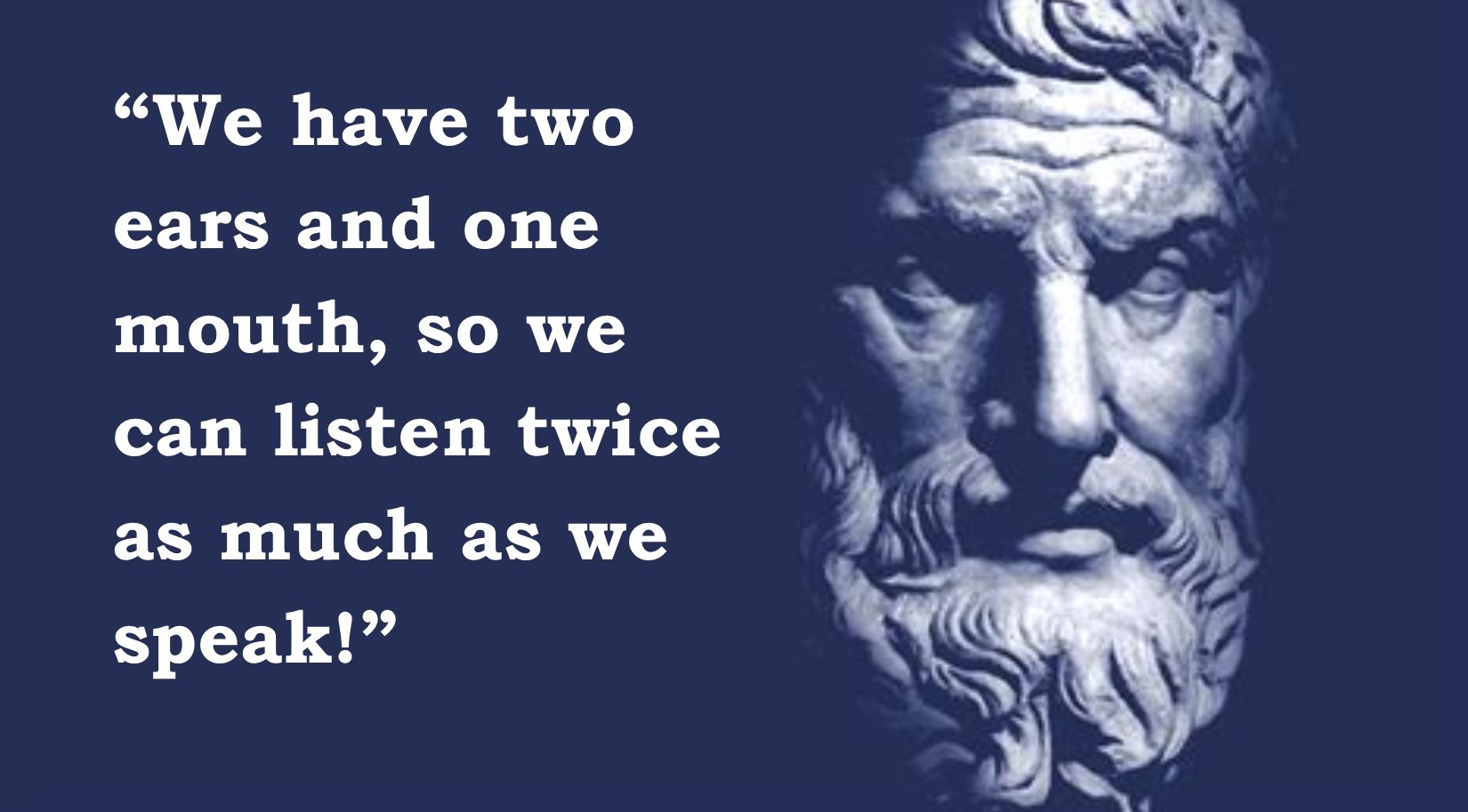
7.  Practice being a better LISTENER.  Nothing communicates RESPECT faster or more clearly than humble, open-minded, non-defensive LISTENING.  I’m sure you recognize this famous piece of wisdom from the Greek philosopher Epictetus…

These are just a few simple, practical things you can do to demonstrate consideration for others.  If your career is stalling, or you need help to develop your executive charisma, give us a call!  We can help you address the issues that are holding you back from promotion and advancement, and get you moving forward in your job and your organization.

Until next time… Yours for better leaders and better organizations,

Dr. Jim Dyke – “The Boss Doctor” ™ helping you to BE a better boss and to HAVE a better boss!

Posted in Caring, Character, Collaboration, Communication, Consideration, Employee Engagement, Influence, Leadership, Management, Organizational Politics, Organizations, Personal Success, Power, Success, Supervision, Support, Team Culture, Team Dynamics, Team Leadership, Teams, Trust, Uncategorized, Values, Work | Tagged , , , , , , , , , , , , , , , , | Leave a comment

The Four C’s – What Teams Need To Master In Order To Be Effective – Part 4 – Commitment.

The first “C” is COMMUNICATION—teams have to learn how to share information.

The second “C” is CONFLICT RESOLUTION—teams have to learn how to resolve their differences.

The third “C” is COLLABORATION—teams have to learn how to work together.

The fourth “C” is COMMITMENT—teams have to be committed to do the hard work it takes to have an effective team!  What hard work???  The hard work of COMMUNICATION, CONFLICT RESOLUTION, and COLLABORATION!

I tell teams, “I can help you with the first three ‘C’s’ but I can’t help you with the fourth.”

That’s because first three C’s are strongly skill-based.  In other words, team members can be TRAINED to talk, fight, and work together.  My expertise as a consultant applies in this arena—training people is what I do!

The fourth “C,” on the other hand, is entirely a matter of individual mindset.  It’s an attitude that team members either have or they don’t have; they either adopt it or reject it.  It’s entirely up to the individual team member—the manager has no control whatsoever in this arena!  (There is no such thing as mind control—any parent of a teenager knows this!)

Are your team members COMMITTED to work and succeed TOGETHER???

Commitment to the team—its charter and its ultimate success—is a matter of individual personal determination.  This is why a team leader must engage the entire team in drafting the Team Charter—it is the best way to gain each team member’s ultimate commitment and support.

This is also why author Larry Bossidy directs team leaders to hire to the vision.  In other words, leaders need to recruit new team members who already “get” the vision of the organization and the team—candidates who understand and accept the vision and who can easily internalize it in their personal engagement and focus.  (BTW…If this isn’t part of your strategy when you hire, it should be!)

The commitment of your team members also rests greatly on your credibility as a leader.  In their excellent book, The Leadership Challenge, authors Kouzes and Posner reveal the thought-provoking insights of a study that researched the importance of a leader’s credibility.

They state,

In our studies we found that when people perceive their immediate manager to have high credibility, they’re significantly more likely to … Feel a strong sense of team spirit.

Would you work for THIS leader???

It should come as no surprise that your believability as a team leader is a major part of the glue that holds a team together.  Especially in times of change, challenge, or crisis—your leadership becomes a rallying point for your team.

So… How do you gain essential commitment from your team members?

1.  Start by including them in the drafting of your Team Charter.  They will be much more likely to support it if they have a hand in creating it!  I teach this principle in my management training seminars: P = O … in other words, Participation Produces OWNERSHIP.

2.  Help them understand the reality (and value) of team success—that the team can’t be effective without the active support of every team member.  Show them how their individual work is important to the overall effectiveness of the team as a whole.  Then make sure they understand how the team’s work supports the ultimate success of the organization as whole.  Help them see the link between their work and the impact it has on clients and customers.

3.  Help them see how their success is tied to the success of the team.  If the team fails, every member bears the consequences.  Conversely… if the team succeeds, every team member enjoys the fruits of that success!  You can help them make that connection when you…

4.  Set team goals TOGETHER, with their input.  Provide positive consequences for team success.  Offer TEAM praise and affirmation (brag on your team’s success to YOUR boss — it’s good for you as well as good for your team!).  Celebrate TEAM success — that sends the right message that “we’re all in this together.”

It’s up to you, leader, to pull your people TOGETHER!

In one of my blogposts, I gave an inspiring illustration of how one manager did this with amazing success.  You can read about it here:  https://thebossdoctor.net/2022/share-credit

5.  Don’t be hesitant to confront team members who are not supporting the goals and the work of the team.  Non-performing team members drive down the morale of the team and lead to resentment among hard-working colleagues.  Don’t let any one team member’s lack of performance deter the success of your team!

Up Close and Personal

One of my consulting clients was a privately-owned manufacturer here in the U.S. whose owner had just sold the company to a global enterprise based in France.  As part of the acquisition, he had stepped down as CEO and promoted the COO into that top position.  It was a smart move—the COO was a capable leader who knew every nook and cranny of the company.  He was also widely known and respected by the employees.  It was a very successful leadership succession—something the majority of organizations don’t do well and rarely experience!  The challenge for company leadership was daunting:  Transition into a global company required a new focus; new standards of employee participation; and a more structured and formal approach to management and leadership. 

One key long-term employee, in particular, was struggling with the changes…and his attitude was affecting his performance.  The new CEO and the HR manager sat down with him for a simple, honest, and direct conversation.  The employee admitted his discomfort with the new direction of the organization and the changes it was requiring.  The HR manager led her response with sensitivity, but with clarity:  “It sounds like you would probably be much happier and much more comfortable working in a different kind of company,” she said.  “Yeah,” he replied, “I think you’re right about that.”  And in the next few minutes, they mapped out a generous and mutually-agreeable plan for his separation from the company.

It was a straightforward example of a lack of employee commitment—an insurmountable obstacle that couldn’t be magically transformed!

I tell managers, “If you have a team member who is unwilling to do the hard work of teammanship—communication, conflict resolution, and collaboration—then they really don’t belong on the team!  They need to find another place to work.  And the kindest thing a good leader can do is to help them make that transition successfully.”

If you want more ideas to help you develop a dynamic, collaborative team—send up a flare!  My consulting business is all about helping leaders like you build a more cohesive team… to enable you to experience the success and synergy of a vision-focused group working together to achieve exceptional results!

Start jet-propelling as a leader…TODAY!!!

AND GET MY BOOK!  It’s loaded with keen insights and practical tools you can use immediately to transform your leadership and your team!  You can buy it for a song on Amazon—here’s the link:

Leading Teams: How to Inspire, Motivate, Lead, and Succeed!: James Dyke: 9781934589007: Amazon.com: Books

And stay tuned to future installments—I promise to keep giving you the same high-quality content designed to grow your leadership and build your influence!

Until next time… Yours for better leaders and better organizations,

Dr. Jim Dyke – “The Boss Doctor” ™ helping you to BE a better boss and to HAVE a better boss!

Posted in Collaboration, Commitment, Competence, Consistency, Employee Engagement, Influence, Leadership, Management, Morale, Supervision, Team Culture, Team Dynamics, Team Leadership, Teams, Uncategorized | Tagged , , , , , , , , , , | Leave a comment

The Four C’s – What Teams Need to Master In Order To Be Effective – Part 3 – Collaboration.

I often tell teams—

  • Ya gotta learn how to talk;
  • Ya gotta learn how to fight; and
  • Ya gotta learn how to work together

These are the essential team skills. 

Now… here is one of the eye-opening truths about effective team dynamics:

You don’t have to LIKE each other to become an effective team—you just have to learn how to WORK together.

One of the myths of effective teams is that they are effective because team members like each other and have formed friendships with one another.  The reality is actually the opposite!  Research has shown that effective teams learn how to succeed as a team, and as a result, they feel good about themselves and their relationships as team members. In other words, COMPETENCE precedes CAMARADERIE!

Team members don’t have to LIKE each other to WORK together!

Expert J. Richard Hackman [the Edgar Pierce Professor of Social and Organizational Psychology at Harvard University] gives the illustration of exceptional symphony orchestras—which are loaded with musical egos and prima Donna mindsets.  Studies show that these teams develop a better sense of team identity when they are led to exceptional performances under the able direction of a skilled conductor.  The walls between musicians dissolve AS A RESULT of an effective performance, not the other way around!

This may sound counter-intuitive until you understand the definition of a professional: 

A PROFESSIONAL is an individual who is able to set aside personal bias, prejudice, or selfish interest in order to focus their energies and abilities on the work they are tasked to do.

Effective teams succeed because individual team members are able to do just that—to set aside their egos and their personal agendas in order to focus on the success of the team as a whole.

Here is how I express this to my clients:

NOBODY wins until the TEAM wins!

Any individual team member may be the best in their field, but if the team fails, that team member’s expertise counts for nothing!  The clearest example is a professional sports team.  The team may be composed of many talented, high-performing, and highly-paid individuals.  But we all know that the ultimate measure of success for a team is NOT the individual performance of each team member…the ultimate measure of success is if THE TEAM WINS. 

Once again, this is where your team VISION and VALUES are essential—they must be clear, and supported by every team member.  Your team vision and values constitute your Team Charter.  If you do not have a Team Charter, you are already missing an essential ingredient to team success!

I spent a whole chapter on team vision statements in my book, Leading Teams.  In that chapter, I listed the four main ingredients to a clear team vision statement:

  1. What we do
  2. Who we do it for
  3. How well we intend to do it
  4. The measurable results we will achieve

Get a copy of my book for more details about effective team leadership—I highly recommend it!  P.S. You can get a copy for a song on Amazon!  Here’s the link:  Leading Teams: How to Inspire, Motivate, Lead, and Succeed!: James Dyke: 9781934589007: Amazon.com: Books

Clear Team Vision is essential, but effective teams don’t just have clear VISION—they also have clear VALUES that are supported by specific SKILLS.

In a 2019 article in Harvard Business Review, researcher Francesca Gino identified the collaborative SKILLS that underscore the important VALUES of high-performing teams and organizations.  She discovered that many organizations embrace collaborative values, but fail to build a collaborative culture.  Here’s what she concluded: 

One problem is that leaders think about collaboration too narrowly: as a value to cultivate but not a skill to teach.

By studying highly collaborative organizations like Pixar and Webco, she identified key training practices that enable both leaders and employees to work well together; learn from one another; and overcome the psychological barriers that get in the way of doing both. These skill-producing efforts help people connect and collaborate more effectively and consistently.  And as you might imagine, her research reinforces what I have already been telling you: that COMMUNICATION is the #1 skill that teams need, in order to be effective.  You will see this, as we review her list of essential skills!  You will also see elements of my #2 skill in her list, in the arena of CONFLICT RESOLUTION.

Here is her list…

1. Teach People to Listen, Not Talk

Yep…what I’ve been teaching leaders for years—the value of effective listening skills.  Again, this is definitely in the COMMUNICATION category!  Gino adds the following supportive practices in this area: exercise curiosity instead of judgment; ask questions; tune in to the speaker; monitor your own bad listening habits; and…get comfortable with silence.

2. Train People to Practice Empathy

Empathy is the ability to understand another person’s point-of-view.  (Remember in the last post what I teach my people:  We must all agree that our Number One Goal is to gain better understanding!!!)

Gino reminds us: 

Being receptive to the views of someone we disagree with is no easy task, but when we approach the situation with a desire to understand our differences, we get a better outcome.

How do we do that?  It helps if each person involved assumes that everyone else contributing to the discussion is smart, caring, generous, and fully invested in a productive outcome.

3. Make People More Comfortable with Feedback

Good collaboration involves giving and receiving feedback well—and from a variety of directions—up, down, and especially sideways between fellow team members.  Read the first installment in this series to review my use of the tool, Continue / Stop / Start –a practical way to introduce your team to the important skill of feedback in the COMMUNICATION arena!

Feedback is the Breakfast of Champions!
— Image by © Royalty-Free/Corbis

Gino gives tips on how to make feedback an effective practice—by talking openly about the potential discomfort of giving and receiving feedback; by coaching team members on how to give feedback effectively; and by identifying helpful feedback as behaviorally-based, specific, direct, and helpful to the collaborative process.

4. Teach People to Lead and Follow

If “leading” means “taking initiative” and “directing,” then “following” has equal value when it means that others respond constructively by “stepping back to allow others to step forward,” “hearing from others in the group,” and “taking direction from others when appropriate.”

5. Speak with Clarity and Avoid Abstractions

Again, Gino is identifying another key element of COMMUNICATION.  So…How do you know if you have “spoken with clarity?”  How do you make sure you have communicated your thoughts CLEARLY without confusion or obfuscation???  It’s simple…ASK YOUR LISTENER THIS QUESTION:

What did you hear me say?

Their answer will immediately surface any miscommunication on YOUR part or misunderstanding on THEIRS.

BTW…The more feedback you get on your practice of communication, the better you will get at sharing information and ideas.  It’s just that simple!

6. Train People to Have Win-Win Interactions

We all want these.  Getting them EVERY TIME, however, is unrealistic… UNLESS you redefine “win-win.”  I teach my teams to focus on what is best for the team.  Remember what I said:

NOBODY wins until the TEAM wins.

So… whenever two team members are in conflict, it’s important for them to have some sense of what will best enable the team as a whole to perform in the best way possible, to achieve the TEAM vision TOGETHER.  It’s important for everyone on the team to embrace TEAM success as the ULTIMATE FORM OF “WINNING.”

It’s important for every team member to be understood!

IN ORDER TO FOCUS ON WIN-WIN INTERACTIONS, everyone involved needs a clear understanding of each party’s point-of-view.  That requires an honest sharing of each other’s needs.  Gino put it this way,

In the successful collaborative projects I examined, people were open about their personal interests and how they thought they could contribute to solving the problem. Such transparency allows participants to explore everyone’s vision of winning and, ultimately, get more-favorable results.

So… how “collaborative” is YOUR team?  Do they know how to work with one another… TOGETHER??  Or do you still see a breakdown of team cohesion and the resulting loss of productivity and performance?

Call us if your team needs help to become a more dynamic, collaborative group.  We have helped thousands of team leaders, equipping them with practical tools to help their people work together more effectively.  And we can help you, too!

Until next time… Yours for better leaders and better organizations,

Dr. Jim Dyke – “The Boss Doctor” ™ helping you to BE a better boss and to HAVE a better boss!

Posted in Collaboration, Communication, Conflict, Decision-making, Employee Engagement, Feedback, Honesty, Leadership, Management, Organizational Politics, Performance Management, Problem-Solving, Productivity, Supervision, Team Culture, Team Dynamics, Team Leadership, Teams, Uncategorized, Values, Vision | Tagged , , , , , , , , , , , , , , | Leave a comment

The Four C’s – What Teams Need to Master In Order To Be Effective – Part 2 – Conflict Resolution

I tell teams:

  • Ya gotta learn how to talk to each other.
  • Ya gotta learn how to fight with each other.

Conflict in the workplace is not uncommon – it’s normal and inevitable.  It’s only destructive if it’s handled badly—and most people in the workplace handle it badly!  I shared a simple conflict resolution formula in an earlier post (I heartily recommend you read it if you haven’t already!)  Here’s the link:  Great Advice from Top CEO’s – #4 | The Boss Doctor

Conflict in an organization is inevitable!

Beyond that, here are some tips for resolving conflict more effectively:

1.  First of all—make sure everyone agrees on the number one goal—which is to gain better understanding!  I teach this concept in my conflict management training seminars.  I label it as “The Number One Goal” for any and all conflict resolution.  I’ll say it again:

We must all agree that our Number One Goal is to gain better understanding.

This is an essential place to start, because we all know that perfect resolution of every conflict to every person’s complete satisfaction is an unrealistic expectation!  That’s why we all have this little adage in our life’s wisdom “back pocket” to pull out whenever we need it:

We will just have to agree to disagree.

2.  Hold to agreed-upon ground rules—e.g. no personal attacks; no interrupting; keep an open mind.

In my seminars, I encourage leaders to discuss conflict ground rules with their team members, and arrive at a unanimously agreed-upon list of specific rules…and to write them down and distribute them to every team member. 

This is essential for two reasons:

  1. If you want your team members to have ownership of the rules, you must involve them in the creation of those rules!
  2. The clearest agreement is always written agreement.  This is a principle I teach in my seminars… and it has very broad application beyond just ground rules for team conflict!

3.  Now… leave your egos at the door!  Conflict resolution is not about winning or losing—it’s about getting the right result and finding a practical resolution that works.  That leads to the next point:

4.  Help your team to view conflict as an opportunity for creative problem-solving.  And don’t forget:   There is almost always more than one way to skin a cat!

I encourage leaders to teach their people:

We must always think of conflict as a PROBLEM to be solved, rather than a BATTLE to be won.

Get your people around the table…to TALK and THINK together!

5.  Allow everyone involved to present their point of view without interruption.  That will require restraint on everyone’s part, because we are all sorely tempted to interrupt in order to (1) correct misinformation; (2) defend our position; or (3) explain ourselves.  The key is for everyone to save their remarks until it is their turn to speak.

6.  Keep the team vision center stage.  Ask yourselves—what is best for the team?  What resolution will help us achieve our vision most effectively?  With that in mind…

7.  Accept that sacrifices for the ultimate success of the team are not only appropriate, but acceptable and commendable.

When information is shared openly it may surprise you how easily team members are able to give in to the needs of others, because they can see clearly how much better it is for the team as a whole

Let your people work it out together and create a great resolution!

Up Close and Personal

I once served on an executive team composed of other leaders like me—high-energy, results-driven executives, eager to leverage whatever resources they could get their hands on.  We frequently found ourselves in contention over staff, budget, equipment, supplies, and space.  One fiscal year, our weary CEO came to us with a proposal.  He said, “I’m tired of being the one tasked with pouring over all your demands and having to say ‘no’ to most of what you all want, just to create a realistic budget for the year, and end up being everyone’s ‘bad guy.’  This time, I’m not going to do this by myself.  I’m going to make all of YOU do the dirty work!” 

He stood in front of a white board, and one-by-one, we had our departmental budget requests put up on that board, in front of all of us to see.  The total amount of ALL of the requests, of course, was completely unrealistic.  The CEO then turned to us, as a group, and said, “Okay, what do we cut????”  And one-by-one, each of us began to voluntarily take many of our own departmental requests off the list, as we began to see the importance of certain other department’s requests as being of greater importance to the success of the organization as a whole.  

I was amazed how quickly we resolved our issues when we had all of the information at our disposal and could see the big picture of our executive team success instead of the myopic view of our own individual departmental concerns.

You and your team are more likely to do the same if you follow the same recipe for healthy debate and collegial concern.

If your team needs help to become a more dynamic, collaborative group, call us!  We have trained team leaders from thousands of organizations, equipping them with practical tools to help their people work together more effectively.  And stay tuned to this newsletter for more great ideas and tips!

Until next time… Yours for better leaders and better organizations,

Dr. Jim Dyke – “The Boss Doctor” ™ helping you to BE a better boss and to HAVE a better boss!
Posted in Collaboration, Communication, Conflict, Consensus, Creativity, Decision-making, Emotional Intelligence, Employee Engagement, Leadership, Management, Morale, Point of View, Problem-Solving, Supervision, Team Culture, Team Dynamics, Team Leadership, Teams, Uncategorized, Vision | Tagged , , , , , , , , , , , , , , | Leave a comment

The Four C’s – What Teams Need to Master in Order to Be Effective – Part 1 – Communication

Companies pay me thousands of dollars to help their teams become more effective.  (That’s part of what I do as a management consultant.)  In this new series, I’m going to give you some of the same information I share with my paying customers!  These are simple, but powerful tips that can help you and your colleagues work together more effectively, regardless of your role or relationship.

Here’s what I tell teams and team leaders: 

You must master the four “C’s” if you want to be an effective team!

You will find all kinds of teams EVERYWHERE in organizations!

Here’s the truth:  Every organization needs help with team dynamics because teams permeate every organization, from the production line to the executive suite.  And all teams have their share of bad habits, disconnects, divisive personalities, or rogue members.  AND EVEN IF YOU ARE NOT ON A TEAM, you still function as part of the organization-wide “team” that all employees serve and support.  So, the FOUR C’S apply to you as well.

The first C is COMMUNICATION.  Team members need to learn how important it is to share information with one another, and especially how to share that information—in short, they need to learn how to talk to one another!  That sounds simple enough, but it requires the right kind of communication climate, where team communication is defined by four essential qualities…where team members can trust communication is:

  • Open
  • Honest
  • Direct
  • Forthcoming

Let’s break that down…

OPEN communication means we can talk about anything.  There are no elephants in the room—no taboo subjects that are “off the table.”  That means team members are free to talk about what is bugging them—even free to complain and gripe. 

Team members need to talk about…what team members need to talk about!

Up Close and Personal

In my extensive experience as a consultant, I have served in every conceivable kind of organization—every industry, shape, and size—public as well as private.  One of the most common challenges I have seen is when a team’s ability to perform is hampered by a problem or bureaucratic barrier that is beyond their authority to address.  Especially annoying is when organizational leaders who do have the ability to address it step back and, for some reason, refuse to act.  When that happens, frustrated team leaders often “table” any discussions of the problem, and prohibit team members from any further discussions of the issue.

That usually adds fuel to the fire of team frustration and anger, and makes the problem even worse!

What’s a leader to do?

A leader should always adopt the first rule of team communication: OPENNESS—there is no issue that is “off-limits.”  In other words, there is nothing that we CAN’T talk about, as a team!

This problem is so common, I wrote a helpful article to give team leaders practical tips for handling it effectively with their team.  You can access it on the Resource page of my blogsite.  Here is the link:  ProblemPaper.pdf (thebossdoctor.net)

That brings us to the second quality…

HONEST communication means that it is safe for team members to say what they really think, even if it is perceived as negative, critical, or complaining.  Effective leaders want to know if their people have concerns, so they can address those issues openly and help their team members gain a better perspective as a result.  Teams also need adversarial thinking, in order to avoid “groupthink.”  The opinion that disagrees with the majority needs to be voiced and respected, not diminished or criticized.

Can your people tell you what they really think?

Some leaders want unanimous agreement from their followers for every decision, issue, or solutionThat is a dangerous goal!  Worse, it may signal a leader who is deeply insecure and fearful of opposition, failure, or embarrassment!  If you are that kind of leader, you may not even be aware that your team is sensing that—because they pick up unspoken “cues” from the way you respond to contrary opinions and ideas.  It can be very subtle, but team members will eventually get the message: Don’t disagree with the boss!

It’s rarely as overt as Sam Goldwyn famously communicated:

“I don’t want any yes-men around me. I want everybody to tell me the truth even if it costs them their job.”

HONEST communication allows your team members to give you the kind of information you really need, in order to make wise decisions and lead your team effectively!

The next quality is equally important…

DIRECT communication means setting gossip aside and choosing healthy assertiveness instead.  So… if a team member has an issue with another team member, they confront the person about it directly instead of complaining to others.  This is what assertiveness is—the healthy ability and capacity to communicate clearly what you want or need from others. 

Assertiveness is an absolute necessity for healthy, functional relationships. 

But assertive communication is more effective when: 

  1. The person sharing the information is using a careful, diplomatic approach; and  
  2. The person receiving the information is able to set their egos aside, to listen patiently and objectively to the feedback.  [NOTE:  This is not as easy as it sounds.  That’s one of the reasons I have a LOT of work as an executive coach!]

DIRECT communication also means NOT “beating around the bush.”  DIRECT communication requires getting to the point, and being clear and focused about the information and issues involved.

That brings us to the fourth quality:

FORTHCOMING communication means we don’t have to drag information out of one another.  We make a point of sharing information instead of trying to exert power by “controlling access.”  The more freely teams share information, the easier it is for everyone to do their job, solve problems, work creatively, and collaborate effectively.

Ya gotta keep the information FLOWING!
Image by © Royalty-Free/Corbis

Up Close and Personal

One of the communication exercises I have teams do is Continue / Stop / Start.  This exercise allows team members to give each other valuable one-on-one feedback to help them become more effective in working together as a team.  It gives team members an opportunity to actually apply the four qualities of effective team communication in a way that surfaces valuable information that has the ability to enhance team collaboration.

This is the exercise in detail… 

Continue requires a team member to tell a fellow team member:  This is what you do that makes it easy for me to work with you…so please CONTINUE doing that.

Stop encourages a team member to tell a fellow team member:  This is what you are doing that is making it difficult for me to work with you… I would like you to STOP doing it.   And finally…

Start gives a team member an opportunity to tell a fellow team member:  This is something you aren’t doing yet that would help me collaborate more effectively with you… I would like you to START doing this.

Continue / Stop / Start is just one of many resources I use to help teams become more collaborative, productive, effective, and successful!

If you want to do a deeper dive into the qualities of communication climate, you MUST read this blogpost I published TWO YEARS AGO:  Can We Talk??? | The Boss Doctor 

It will introduce you to some expansive tools that will teach you how to communicate much more constructively with others, especially with your own team!

And if you want more help to lead and manage your team, call us!  We have helped team leaders in hundreds of organizations, equipping them with practical tools to help their people work together more effectively. 

Until next time… Yours for better leaders and better organizations,

Dr. Jim Dyke – “The Boss Doctor” ™ helping you to BE a better boss and to HAVE a better boss!

Posted in Collaboration, Communication, Decision-making, Emotional Intelligence, Employee Engagement, Employee Motivation, Employee Retention, Employee Satisfaction, Feedback, Honesty, Influence, Leadership, Management, Morale, Organizational Politics, Problem-Solving, Supervision, Team Culture, Team Dynamics, Team Leadership, Teams, Trust, Uncategorized, Work | Tagged , , , , , , , , , , , , | Leave a comment

Share Credit

In his excellent book, How to Become CEO, Jeffrey Fox advises leaders to “be a credit maker, not a credit taker.”  He says, “The credit taker is insecure, dishonest, and known to all.  Even the cleverest credit taker is ultimately found out.” 

In contrast, when you GIVE proper credit to others, you will become known as a leader who gets results.  This brands you as a person people want to work with and work for.  Your team will give you their best efforts because they know they will get the recognition they deserve.  Colleagues will support you and collaborate with you because they will feel genuinely valued and respected.

Recognizing the good work of other people is what great leaders do!

My brilliant friend, Keith Drury, calls this The Glory Garden Principle.  He explains,

You can only plant glory [recognition, credit] in other people’s gardens. 

This is a principle based on universal human psychology and behavior.  You know instinctively that this is true!  You know how this works:  When you brag about the work of other people, you are seen as generous, insightful, supportive, and appreciative.  But when you brag about your own accomplishments, you are seen as arrogant, self-aggrandizing, self-absorbed, and “full of yourself.”  Worse, you are also often seen as a “credit taker.”

Here’s how to apply The Glory Garden Principle in your own leadership:

1.  Create objective measurements for your team’s success.  Use those standards and metrics to challenge your team to do good work.  Then be sure to recognize them accordingly and give your team the credit they deserve when they succeed.

Up Close and Personal

One of my former colleagues, Tony Knight, challenged his team to reverse their poor tardiness record.  TOGETHER, he and his team set a straightforward, CLEAR and MEASURABLE goal for improvement.  When they were successful in hitting the goal, he applauded their success in a memo to his boss, who then forwarded the report to his colleagues.  His boss’s colleagues flooded Tony’s inbox with plaudits of his great leadership!  This is the unexpected result of sharing credit with your team:  When you praise them, you bathe in the reflected light of their success! 

You look good when your team looks good!

Speaking of which…

2.  Coach your team to greater effectiveness, and brag on their accomplishments to your boss.  This reinforces a positive image with your boss and sets the stage to groom your team members for future promotion and advancement.

3.  Find ways to give your team members more visibility in the organization, especially with higher-ups.  This positions you (and your team) as being integral to the success of your organization and its mission.

Introduce your successful team members to other important leaders in the organization!

4.  Make it a point to publicly acknowledge and praise the help of your colleagues.  One manager I know writes thank-you notes of appreciation to his colleagues’ bosses.  He has found this simple practice to be invaluable to his ability to expand his influence in the organization; collaborate more effectively across departmental lines; and achieve greater overall success in his role.

Mita Mallick is the head of inclusion, equity, and impact at Carta, a fintech company. She co-hosts the podcast Brown Table Talk. During a recent Harvard Business Review podcast hosted by Amy Gallo, Mita shared the following observation about this very issue:

…nothing in organizations happens alone. It’s a group of people. You might have done a lot, but it’s a group of people that are doing it. So, when you start to share that enthusiasm and when you start to give other people credit, they’ll give you credit back.

5.  And yes… you can praise your boss, too!  A simple word of appreciation can be a very positive thing.  Just make sure it’s specific so as to avoid brown-nosing.  Here’s what I’m talking about…

“You’re just the best boss in the whole wide world!”  [This is Brown-Nosing]

“Boss, I really appreciate you running interference for me by making that phone call to Accounting… that helped me get the information I needed to complete the quarterly report for our team.  That’s exactly the kind of support I need sometimes, in order to get the job done.  Thanks for the help!”  [This is Sharing Credit]

Bosses are human, too—they appreciate being appreciated!

Here’s one more idea to consider: 

6.  Brag about your boss to your boss’s boss.   That kind of “back door” compliment can really be powerful and helpful – to you AND to your boss. 

Up Close and Personal

Tony Knight’s fantastic leadership as the new boss of his team was so outstanding—to his team—that several of his subordinates actually went to Tony’s boss to thank him personally for hiring Tony!  You can imagine how affirming that was to both Tony AND to his boss!

And Finally…

It probably won’t surprise you that the simple behavior of sharing credit is one of the Top Ten Habits of Highly Likeable People that I highlighted in a special report of that title. That report is filled with simple, but powerful insights to help you have greater influence and impact as a leader. You can access it HERE.

And if you’re looking for more great ideas to fuel your success and the success of your people, then STAY TUNED to future posts of this blog!

Until next time… Yours for better leaders and better organizations,

Dr. Jim Dyke – “The Boss Doctor” ™ helping you to BE a better boss and to HAVE a better boss!

Posted in Affirmation, Caring, Celebration, Collaboration, Communication, Emotional Intelligence, Employee Engagement, Employee Motivation, Employee Retention, Employee Satisfaction, Encouragement, Feedback, Influence, Leadership, Management, Morale, Organizational Politics, Performance Management, Personal Success, Power, Recognition, Success, Supervision, Support, Team Culture, Team Dynamics, Team Leadership, Teams, Uncategorized, Validation, Work | Tagged , , , , , , , , , , , , , , | 1 Comment

Share Power

It has often been said that power corrupts.  My last newsletter dealt with the way leadership power can corrupt—how it can affect our attitudes and priorities as leaders.  Here’s the sad reality:

POWERLESSNESS also corrupts!

Studies in the workplace show the damaging effects when workers feel powerless—when they feel they have no say; no opportunity to participate meaningfully in their work.  Morale plummets, along with worker engagement, motivation, and productivity.  If you doubt this, take note of the Chinese factories that have been in the news—the ones with suicide nets surrounding their buildings!

When people feel powerless, they often also feel frustrated and ANGRY!!!

It’s highly unlikely that your workplace will ever see the need for suicide nets.  But it’s highly likely that your powerless team members will end up dragging their feet; producing lower quality results; and giving less-than-enthusiastic customer service.  Before that happens, take a few simple measures right now to create a team culture of shared power. 

Here are a few simple ways to share power with your people:

1.  Be open to your team’s ideas for making their work EASIER / BETTER / FASTER / SMARTER / CHEAPER / SAFER.  Even better…

2.  ENCOURAGE them to share their ideas—tell them you want to hear from them!  And be prepared to recognize and affirm their ideas with experimentation and implementation.

3.  Whenever possible, involve them in planning the work of the team and distributing the workload more strategically.  Try this—give them the opportunity to volunteer for assignments!

When you involve your team, you get greater engagement and higher morale!

4.  Ask for their input and help—to solve problems and make better decisions.

5.  Involve them in drafting a clear Vision Statement for your team.  You will be amazed at how engaged they will be in that process!

6.  Share information with them.  Tell them what’s happening with your organization; your industry; your markets.   Respond to rumor-mongering by giving your team the latest information and facts.  Most important…

7. NEVER LET YOUR TEAM BE BLINDSIDED… by bad news; change; or crisis!  Make sure your people feel included in the flow of important information, especially when it has a direct impact on their situation, their status, their well-being, or their work!

Remember: PARTICIPATION = POWER = OWNERSHIP

There are many more ways you can empower your team (my book is filled with them!)  If you need help developing an empowering team culture, CALL US.  We specialize in equipping supervisors and managers with the skills they need to develop highly-engaged, highly productive teams.

And STAY TUNED to future posts on this blogsite for more great ways to improve your leadership!

And if you are interested in my book, Leading Teams—stop by the “Resources” page for more information about this valuable tool: Resources | The Boss Doctor

Until next time… Yours for better leaders and better organizations,

Dr. Jim Dyke – “The Boss Doctor” ™ helping you to BE a better boss and to HAVE a better boss!

Posted in Authority, Collaboration, Communication, Control, Employee Engagement, Employee Motivation, Employee Retention, Employee Satisfaction, Feedback, Influence, Leadership, Management, Personal Success, Power, Productivity, Success, Supervision, Team Culture, Team Dynamics, Team Leadership, Teams, Uncategorized | Tagged , , , , , , , , , , | Leave a comment